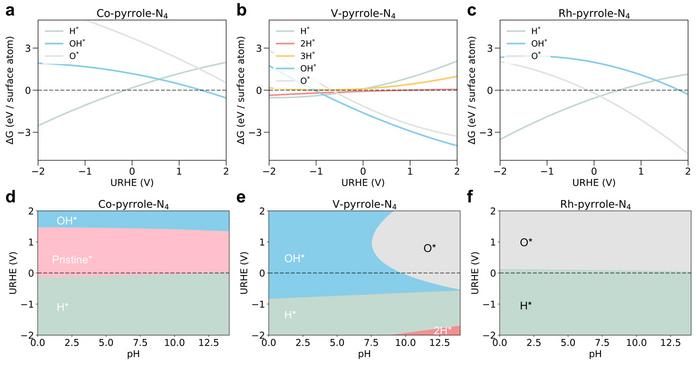
In the relentless pursuit of a sustainable energy future, hydrogen stands out as a promising vector for clean energy storage and conversion. However, the catalytic processes that underpin the efficient production of hydrogen, specifically through the hydrogen evolution reaction (HER), remain a challenging frontier for materials chemists and engineers alike. Recent groundbreaking research from the Hao Li Laboratory challenges long-standing paradigms in catalyst design, revealing that the conventional focus on hydrogen binding energy (HBE) alone is insufficient to fully describe the catalytic behaviors on single-atom catalysts (SACs). This insight reframes our understanding of hydrogen evolution and offers new avenues for designing next-generation catalysts that could accelerate the clean energy transition.
Single-atom catalysts, which feature isolated metal atoms dispersed on substrates, have been celebrated for their ability to maximize catalytic efficiency and atom utilization. Traditional thinking posits that the activity of these SACs for HER is mainly governed by the strength with which hydrogen atoms adsorb to the metal centers. The rationale being, hydrogen binding energy serves as a predictor for the energy barriers involved in proton-electron transfer steps that culminate in molecular hydrogen release. However, this research observes that this simplistic descriptor fails to account for the complex reality of surface interactions, especially under realistic operating conditions where various adsorbate species influence the catalytic environment.
A major hurdle in SAC design and HER performance is the phenomenon of site poisoning by reactive adsorbates such as hydroxyl radicals (HO) and oxygen radicals (O). These species can adhere to the active metal centers, interfering with the adsorption and reaction dynamics of hydrogen intermediates, thus suppressing catalytic activity. The study highlights that ignoring these poisoning effects leads to misleading predictions and suboptimal catalyst designs. Such insights emphasize the necessity to consider the adsorption coverage and the dynamic interfacial chemistry surrounding SACs, beyond just hydrogen-metal interactions.
Delving deeper into this complex interplay, the researchers employed advanced experimental techniques and theoretical modeling that simulated realistic adsorption environments. They discovered that hydrogen binding energy, calculated with a proper understanding of the adsorbate landscape, can serve as a more reliable predictor of catalytic activity. Intriguingly, when metal sites are compromised by poisoning, neighboring coordinating atoms—often nitrogen in metal-nitrogen-carbon (M-N-C) frameworks—can step in as alternative active sites. These adjacent nitrogen atoms offer an alternate pathway for HER, effectively circumventing the deactivation caused by adsorbate poisoning and maintaining catalytic performance.
This dual-site activity concept challenges the orthodox single-site framework and provides a more nuanced understanding of SAC behavior. The idea that non-metal coordinating atoms may significantly contribute to catalysis underlines the importance of holistic catalyst design strategies that integrate the entire local atomic environment. Such approaches could lead to enhanced catalyst durability and activity, especially in harsh conditions that involve aggressive adsorbates.
Another critical takeaway from this work is the refined use of catalytic descriptors. Historically, HBE was often regarded as the sole descriptor for SAC HER activity. The novel approach advanced by the research combined hydrogen binding energy with Gibbs free energy calculations to develop composite descriptors that better predicted spontaneous and efficient hydrogen evolution. This multidimensional descriptor provides a more predictive framework for tailoring catalysts that perform optimally across a wider range of pH conditions, surpassing the limitations previously imposed by HBE-only models.
The implications of this methodology extend into the design of next-generation catalysts specifically tailored for alkaline and other challenging environments. Alkaline conditions have been notoriously difficult for HER catalysts due to enhanced poisoning and different reaction kinetics. By considering HO* poisoning effects and enabling nitrogen sites as active centers, new classes of single-atom and dual-atom catalysts can be engineered with superior resistance to degradation and higher catalytic turnover.
Fundamentally, this study moves the catalytic science community toward a more realistic and comprehensive view of catalyst surface phenomena. It signals the diminishing supremacy of simplistic design rules and calls for a paradigm shift where intricate adsorbate interactions, poisoning dynamics, and multi-site catalysis are integrated into catalyst optimization strategies. As the race for more efficient and economic hydrogen production intensifies globally, these insights could prove instrumental in overcoming the kinetic bottlenecks that hinder scale-up and widespread adoption.
Moreover, the broader context of this advancement aligns well with Japan’s World Premier International Research Center Initiative (WPI), which aims to foster innovative research environments. Based at Tohoku University’s Advanced Institute for Materials Research, the Hao Li Lab exemplifies the international and interdisciplinary collaboration needed to tackle the multifaceted challenges in energy materials research. Their success typifies how cutting-edge fundamental science can fuel applied technological breakthroughs.
Looking ahead, the enhanced understanding of surface adsorbate dynamics and site cooperation in SACs sets the stage not only for improved HER catalysts but possibly for a wide range of electrochemical transformations, including CO2 reduction and nitrogen fixation. The principle of leveraging adjacent non-metal sites to bypass poisoning effects ignites fresh ideas for designing multifunctional catalysts that could revolutionize sustainable chemical production.
In essence, this work dismantles the dogma that hydrogen binding energy alone dictates hydrogen evolution efficacy on single-atom catalysts. It pioneers a holistic framework incorporating adsorbate coverage, poisoning resistance, and alternative active sites that collectively define catalytic success. For the clean energy community and catalysis scientists worldwide, this could mark a turning point, charting new pathways toward designing robust, efficient, and versatile catalysts indispensable for a green hydrogen economy.
Subject of Research: Hydrogen Evolution Reaction and Single-Atom Catalysts with Adsorbate Poisoning Dynamics
Article Title: Hydrogen Binding Energy Is Insufficient for Describing Hydrogen Evolution on Single-Atom Catalysts
News Publication Date: 20-Mar-2025
Web References: https://www.jsps.go.jp/english/e-toplevel/index.html, http://dx.doi.org/10.1002/anie.202425402
Image Credits: Hao Li et al.
Keywords
Catalysis, Active sites, Metals, Water molecules
Tags: atom utilization in catalysiscatalytic processes for hydrogen productionclean energy transitionhydrogen binding energyhydrogen evolution reactionmaterials chemistry innovationsnext-generation catalyst designovercoming catalytic challengesproton-electron transfer mechanismsrevolutionary catalyst frameworksSingle-atom catalystssustainable energy storage