• HOME
  • NEWS
  • EXPLORE
    • CAREER
      • Companies
      • Jobs
    • EVENTS
    • iGEM
      • News
      • Team
    • PHOTOS
    • VIDEO
    • WIKI
  • BLOG
  • COMMUNITY
    • FACEBOOK
    • INSTAGRAM
    • TWITTER
Sunday, May 24, 2026
BIOENGINEER.ORG
No Result
View All Result
  • Login
  • HOME
  • NEWS
  • EXPLORE
    • CAREER
      • Companies
      • Jobs
        • Lecturer
        • PhD Studentship
        • Postdoc
        • Research Assistant
    • EVENTS
    • iGEM
      • News
      • Team
    • PHOTOS
    • VIDEO
    • WIKI
  • BLOG
  • COMMUNITY
    • FACEBOOK
    • INSTAGRAM
    • TWITTER
  • HOME
  • NEWS
  • EXPLORE
    • CAREER
      • Companies
      • Jobs
        • Lecturer
        • PhD Studentship
        • Postdoc
        • Research Assistant
    • EVENTS
    • iGEM
      • News
      • Team
    • PHOTOS
    • VIDEO
    • WIKI
  • BLOG
  • COMMUNITY
    • FACEBOOK
    • INSTAGRAM
    • TWITTER
No Result
View All Result
Bioengineer.org
No Result
View All Result
Home NEWS Science News Chemistry

Revolutionizing batteries: Coffee grounds power high-performance sodium-ion anodes

Bioengineer by Bioengineer
February 5, 2024
in Chemistry
Reading Time: 3 mins read
0
CAPACITY IN THE PORE FILLING REGION AND ID ID ⁻¹
Share on FacebookShare on TwitterShare on LinkedinShare on RedditShare on Telegram

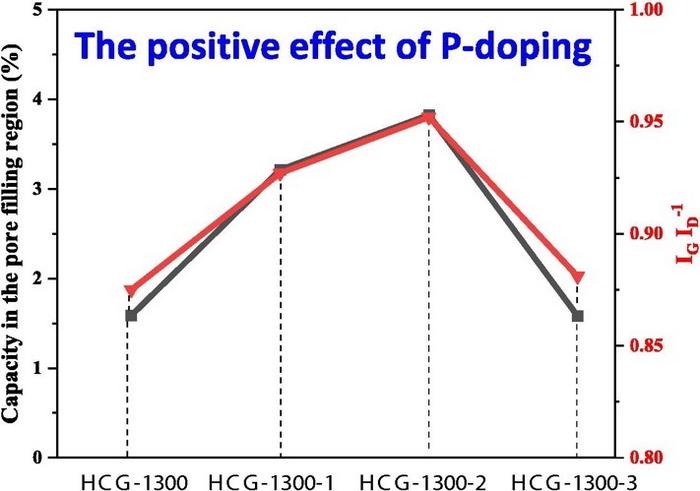
In a study recently published in the KeAi journal Carbon Resources Conversion, a team of researchers from Kazakhstan and South Korea reported the successful synthesis of P-doped hard carbon using coffee grounds as a precursor and H3PO4 as the doping agent. The investigation focused on determining the optimal doping level for maximizing the incorporation of phosphorus ions into the carbon framework, aiming to enhance the electrochemical performance of the material as an anode for sodium-ion batteries (SIBs).
CAPACITY IN THE PORE FILLING REGION AND ID ID ⁻¹

Credit: Kalibek, M., et al.,

In a study recently published in the KeAi journal Carbon Resources Conversion, a team of researchers from Kazakhstan and South Korea reported the successful synthesis of P-doped hard carbon using coffee grounds as a precursor and H3PO4 as the doping agent. The investigation focused on determining the optimal doping level for maximizing the incorporation of phosphorus ions into the carbon framework, aiming to enhance the electrochemical performance of the material as an anode for sodium-ion batteries (SIBs).

One notable aspect of the study is the use of coffee waste as a precursor material for hard carbon synthesis. The choice of coffee grounds is not only environmentally conscious, given the large annual disposal of approximately 18 million metric tonnes, but also leverages the unique lignocellulosic structure of coffee waste. This result addresses the challenges posed by the uneven distribution and scarcity of lithium resources, offering an alternative solution through the exploration of SIBs.

The researchers further varied the concentrations of H3PO4, and found that using 2M of the doping agent led to promising electrochemical performance for hard carbon as an anode material. The resulting P-doped hard carbon, carbonized at 1300 °C, exhibited a reversible capacity of 341 mAh g-1 at a current density of 20 mA g-1, with an initial Coulombic efficiency of 83%. These results underscore the potential of P-doped hard carbon in enhancing the energy storage capabilities of sodium-ion batteries.

Overall, the study offers valuable insights into the synthesis and optimization of P-doped hard carbon for sodium-ion batteries, emphasizing the importance of precursor materials, doping agents and carbonization conditions. The findings have implications for the development of more efficient and sustainable energy storage solutions, particularly in the context of sodium-ion batteries.

###

Contact the author: Aishuak Konarov, Department of Chemical and Materials Engineering, School of Engineering and Digital Sciences, Nazarbayev University, Astana, Kazakhstan,

[email protected]

The publisher KeAi was established by Elsevier and China Science Publishing & Media Ltd to unfold quality research globally. In 2013, our focus shifted to open access publishing. We now proudly publish more than 100 world-class, open access, English language journals, spanning all scientific disciplines. Many of these are titles we publish in partnership with prestigious societies and academic institutions, such as the National Natural Science Foundation of China (NSFC).


Journal

Carbon Resources Conversion

DOI

10.1016/j.crcon.2024.100225

Method of Research

Experimental study

Subject of Research

Not applicable

Article Title

From food waste to high-capacity hard carbon for rechargeable sodium-ion batteries

Share12Tweet8Share2ShareShareShare2

Related Posts

Study Reveals How Valproate Affects Early Brain Development: Insights into the Antiepileptic Drug’s Impact — Chemistry

Study Reveals How Valproate Affects Early Brain Development: Insights into the Antiepileptic Drug’s Impact

May 22, 2026
Sustainable Chemistry: Iron Replaces Noble Metals in Catalytic Reactions — Chemistry

Sustainable Chemistry: Iron Replaces Noble Metals in Catalytic Reactions

May 22, 2026

Advancing Thin-Film Device Manufacturing with Imaging Ellipsometry for Enhanced Process Control

May 22, 2026

Simple Adjustment in 3D Printing Enhances Fit of Dental Crowns

May 22, 2026

POPULAR NEWS

  • ESMO 2025: mRNA COVID Vaccines Enhance Efficacy of Cancer Immunotherapy

    314 shares
    Share 126 Tweet 79
  • New Study Reveals Plants Can Detect the Sound of Rain

    734 shares
    Share 293 Tweet 183
  • Research Indicates Potential Connection Between Prenatal Medication Exposure and Elevated Autism Risk

    847 shares
    Share 339 Tweet 212
  • Common Food Preservatives Associated with Elevated Blood Pressure and Increased Heart Disease Risk

    56 shares
    Share 22 Tweet 14

About

We bring you the latest biotechnology news from best research centers and universities around the world. Check our website.

Follow us

Recent News

AI Insights Uncover Causes of Injury Deaths

Comparing Robust Intelligent Controls for 3-DOF Robots

Predicting Flashover on Polluted Insulators with CNN-LSTM

Subscribe to Blog via Email

Enter your email address to subscribe to this blog and receive notifications of new posts by email.

Join 83 other subscribers
  • Contact Us

Bioengineer.org © Copyright 2023 All Rights Reserved.

Welcome Back!

Login to your account below

Forgotten Password?

Retrieve your password

Please enter your username or email address to reset your password.

Log In
No Result
View All Result
  • Homepages
    • Home Page 1
    • Home Page 2
  • News
  • National
  • Business
  • Health
  • Lifestyle
  • Science

Bioengineer.org © Copyright 2023 All Rights Reserved.