The principles of thermodynamics have long been embedded in the fabric of physics, providing a framework for understanding energy transfer and the nature of heat. The second law of thermodynamics stipulates a fundamental principle: heat naturally flows from a hot reservoir to a cold one. Historically, attempts to reverse this natural flow include ingenious concepts such as Maxwell’s demon. This theoretical construct suggests intervention through the acquisition of information during the measurement process, allowing for feedback control. However, a groundbreaking advancement in quantum mechanics now posits the potential for quantum measurement-based cooling, effectively bypassing the need for external feedback mechanisms.
At the forefront of this revolutionary idea is a recent study led by Professor Peng Xue and his research team from the Beijing Computational Science Research Center. The team’s novel work culminated in an article titled “Quantum cooling engine fueled by quantum measurements,” published in Science Bulletin. The researchers embarked on an ambitious journey into the realm of quantum thermodynamics, demonstrating a quantum cooling engine driven exclusively by quantum measurements.
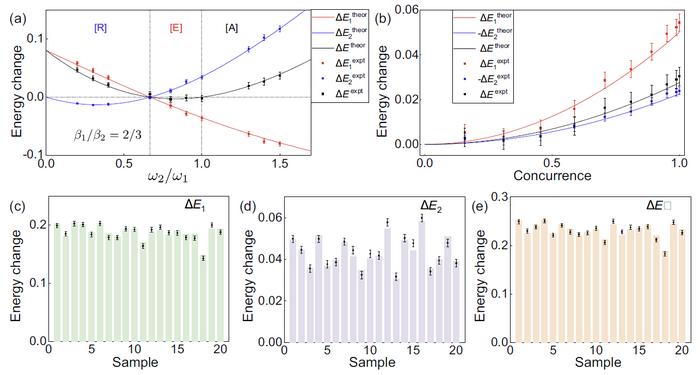
Utilizing a linear optical framework, the researchers successfully simulated a two-stroke, two-qubit engine, marking a significant experimental realization of quantum cooling concepts. The engine operated by maintaining a constant temperature ratio between hot and cold baths, allowing the researchers to manipulate different thermodynamic processes by varying the energy level spacing of the working substance. This intrinsic ability to tune energy levels in quantum systems is groundbreaking, directing attention to the nuanced interplay of quantum effects in thermodynamic operations.
One of the most fascinating aspects of this research is the role of quantum entanglement in energy exchange processes. Theoretical predictions suggested that entanglement could enhance energy extraction from thermal reservoirs, paving the way for more efficient thermodynamic cycles. Through their experiments, Xue’s team shed light on this phenomenon, establishing a connection between entanglement and the energy exchanged between the working substance and measurement apparatus.
To visualize the implications of these results, one must consider how entangled particles behave differently from their classical counterparts. In classical thermodynamics, particles operate under predictable rules defined by temperature differences. However, in the quantum realm, entangled particles can exhibit correlations regardless of distance, effectively altering their interactions with measurement apparatus and thermal baths in unexpected ways.
The experimental setup also revealed insights regarding the necessity of specific measurement bases in steering energy flow within the cooling engine. Unlike classical systems that depend heavily on feedback mechanisms, this quantum apparatus demonstrated the potential of directing energy transfer by merely selecting the appropriate measurement strategies. This paradigm shift not only challenges long-held beliefs in thermodynamics but also opens a new avenue for research and application within quantum technology.
The experimental endeavor was meticulously crafted, with the researchers carefully tuning the temperature parameters of the baths and the energy levels of the working substance. The methods employed highlighted not only the importance of precision but also the delicacy required when manipulating quantum systems. Each iteration of the experiment offered a glimpse into the refined nature of quantum thermodynamic processes, reinforcing the critical relationship between quantum mechanics and thermodynamic efficiency.
As the world continues to navigate the challenges of climate change and energy consumption, exploring quantum cooling engines becomes increasingly relevant. Traditional cooling systems are often inefficient, leading to excessive energy use and increased carbon emissions. A quantum cooling engine that harnesses quantum measurements paves the way for a revolution in energy management, potentially transforming cooling technologies across various sectors.
The implications of this work extend beyond mere theoretical curiosity; they pose critical questions about the future of engineering and technology across industries. The idea that measurement itself, devoid of traditional feedback, can drive energy efficiency heralds a new chapter in the application of quantum mechanics, extending its relevance well beyond the realm of fundamental science.
The findings from Xue’s team underscore the necessity for continued exploration of quantum-based systems. As researchers peel back the complexities of quantum entanglement and measurement, they are likely to uncover further principles that could define the next generation of thermodynamic processes. The challenges lie not only in theoretical exploration but also in realizing practical applications of these quantum systems in everyday life.
Importantly, the research serves as a reminder of the vast potential that exists at the intersection of quantum mechanics and thermodynamics. This intersection is a richly fertile ground for discovery, where the principles governing energy transfer are redefined by the strange, non-intuitive nature of quantum particles. The ongoing endeavors to verify and harness these findings will likely lead to innovative technologies that redefine our understanding of energy efficiency and consumption.
In this dynamic landscape, it is crucial for researchers, policymakers, and engineers to collaborate and translate these theoretical discoveries into actionable solutions. As the quantum cooling engine emerges as both a symbol and tool of potential change, its future applications remain a thrilling prospect in the unfolding story of modern science and technology.
The journey from theoretical understanding to practical realization is often filled with challenges, yet the contributors to this groundbreaking work have demonstrated that such challenges can be met with ingenuity and rigor. As their work is disseminated in journals like Science Bulletin, the hope is that it inspires further research and exploration in quantum thermodynamics.
In summary, the exploration of quantum cooling engines and the profound impact of quantum measurements not only bridge gaps between theoretical physics and practical technology but also signify a broader engagement with our most pressing energy challenges. The path forward is illuminated by these pioneering efforts, each step drawing us closer to a new era of efficient, sustainable energy solutions.
Subject of Research: Quantum cooling engine fueled by quantum measurements
Article Title: Quantum cooling engine fueled by quantum measurements
News Publication Date: October 2023
Web References: Science Bulletin
References: None available
Image Credits: ©Science China Press
Keywords
Quantum cooling, thermodynamics, quantum mechanics, measurement, entanglement, energy efficiency, Science Bulletin.
Tags: applications of quantum mechanics in engineeringBeijing Computational Science Research Center researchexperimental quantum cooling technologiesfeedback control in quantum systemsheat flow reversal mechanismsMaxwell’s demon and information theoryprinciples of thermodynamicsquantum cooling enginequantum measurements in thermodynamicsquantum thermodynamics advancementsrevolutionary energy transfer techniquestwo-stroke quantum engine simulation