• HOME
  • NEWS
  • EXPLORE
    • CAREER
      • Companies
      • Jobs
    • EVENTS
    • iGEM
      • News
      • Team
    • PHOTOS
    • VIDEO
    • WIKI
  • BLOG
  • COMMUNITY
    • FACEBOOK
    • INSTAGRAM
    • TWITTER
Tuesday, December 16, 2025
BIOENGINEER.ORG
No Result
View All Result
  • Login
  • HOME
  • NEWS
  • EXPLORE
    • CAREER
      • Companies
      • Jobs
        • Lecturer
        • PhD Studentship
        • Postdoc
        • Research Assistant
    • EVENTS
    • iGEM
      • News
      • Team
    • PHOTOS
    • VIDEO
    • WIKI
  • BLOG
  • COMMUNITY
    • FACEBOOK
    • INSTAGRAM
    • TWITTER
  • HOME
  • NEWS
  • EXPLORE
    • CAREER
      • Companies
      • Jobs
        • Lecturer
        • PhD Studentship
        • Postdoc
        • Research Assistant
    • EVENTS
    • iGEM
      • News
      • Team
    • PHOTOS
    • VIDEO
    • WIKI
  • BLOG
  • COMMUNITY
    • FACEBOOK
    • INSTAGRAM
    • TWITTER
No Result
View All Result
Bioengineer.org
No Result
View All Result
Home NEWS Science News

Revolutionary process to create ether from esters using metal catalysts

Bioengineer by Bioengineer
March 6, 2017
in Science News
Reading Time: 2 mins read
0
Share on FacebookShare on TwitterShare on LinkedinShare on RedditShare on Telegram
IMAGE

Credit: Waseda University

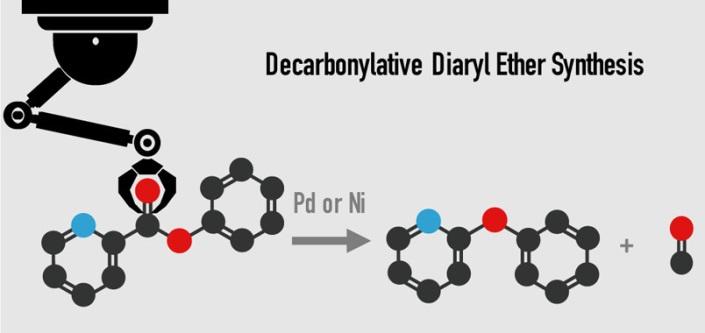
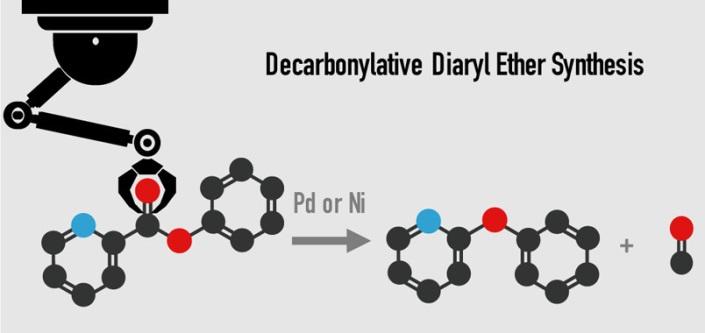
Tokyo, Mar 3, 2017 — A group of Waseda University researchers has developed a new process using palladium or nickel as a catalyst for removing carbon monoxide from esters to produce ethers. This innovation provides new opportunities for development of drugs to fight cancer, malaria and more.

The conventional method for producing diaryl ether uses an intermolecular cross-coupling reaction of aryl halides and phenols with a copper or palladium catalyst, but high cost and concerns about disposal of potentially hazardous halogenated waste have driven demand for a better method.

In this research, a nickel or palladium catalyst with an enabling diphosphine ligand successfully removed carbon monoxide from aromatic esters to synthesize diaryl ether. Using this innovative process, diaryl ethers can be produced from over 30 different kinds of aromatic esters, allowing a choice of more inexpensive and easily obtainable materials. The present reaction can also be conducted on a gram scale with excellent yield, all of which is expected to make a significant impact on development of new pharmaceuticals.

###

The group, including researchers from Nagoya University, published this research in the Journal of the American Chemical Society online on February 21.

Title: Decarbonylative Diaryl Ether Synthesis by Pd and Ni Catalysis Ryosuke Takise; Ryota Isshiki; Kei Muto; Kenichiro Itami; Junichiro Yamaguchi DOI: 10.1021/jacs.7b00049

About Waseda University

Waseda University is a leading private, non-profit institution of higher education based in central Tokyo, with over 50,000 students in 13 undergraduate and 21 graduate schools.

Founded in 1882, Waseda cherishes three guiding principles: academic independence, practical innovation and the education of enlightened citizens. Established to mold future leaders, Waseda continues to fulfill this mission, counting among its alumni seven prime ministers and countless other politicians, business leaders, journalists, diplomats, scholars, scientists, actors, writers, athletes and artists.

Waseda is number one in Japan in international activities, including number of incoming and outgoing study abroad students, with the broadest range of degree programs taught fully in English, and exchange partnerships with over 600 top institutions in 84 countries.

Media Contact

Marshall Adams
[email protected]
@waseda_univ

http://www.waseda.jp/top/index-e.html

############

Story Source: Materials provided by Scienmag

Share12Tweet7Share2ShareShareShare1

Related Posts

AI-Powered Nomogram Enhances Prognosis in Esophageal Cancer

December 16, 2025

Gender Disparities in Cognitive Decline: A Review

December 16, 2025

Diabetes Onset Accelerates Frailty in China’s Elderly

December 16, 2025

Human T-Cell Receptor–CD3: Resting and Active States

December 16, 2025
Please login to join discussion

POPULAR NEWS

  • Scientists Uncover Chameleon’s Telephone-Cord-Like Optic Nerves, A Feature Missed by Aristotle and Newton

    Scientists Uncover Chameleon’s Telephone-Cord-Like Optic Nerves, A Feature Missed by Aristotle and Newton

    122 shares
    Share 49 Tweet 31
  • Nurses’ Views on Online Learning: Effects on Performance

    70 shares
    Share 28 Tweet 18
  • NSF funds machine-learning research at UNO and UNL to study energy requirements of walking in older adults

    70 shares
    Share 28 Tweet 18
  • MoCK2 Kinase Shapes Mitochondrial Dynamics in Rice Fungal Pathogen

    72 shares
    Share 29 Tweet 18

About

We bring you the latest biotechnology news from best research centers and universities around the world. Check our website.

Follow us

Recent News

AI-Powered Nomogram Enhances Prognosis in Esophageal Cancer

Gender Disparities in Cognitive Decline: A Review

Diabetes Onset Accelerates Frailty in China’s Elderly

Subscribe to Blog via Email

Enter your email address to subscribe to this blog and receive notifications of new posts by email.

Join 70 other subscribers
  • Contact Us

Bioengineer.org © Copyright 2023 All Rights Reserved.

Welcome Back!

Login to your account below

Forgotten Password?

Retrieve your password

Please enter your username or email address to reset your password.

Log In
No Result
View All Result
  • Homepages
    • Home Page 1
    • Home Page 2
  • News
  • National
  • Business
  • Health
  • Lifestyle
  • Science

Bioengineer.org © Copyright 2023 All Rights Reserved.