• HOME
  • NEWS
  • EXPLORE
    • CAREER
      • Companies
      • Jobs
    • EVENTS
    • iGEM
      • News
      • Team
    • PHOTOS
    • VIDEO
    • WIKI
  • BLOG
  • COMMUNITY
    • FACEBOOK
    • INSTAGRAM
    • TWITTER
Sunday, October 4, 2026
BIOENGINEER.ORG
No Result
View All Result
  • Login
  • HOME
  • NEWS
  • EXPLORE
    • CAREER
      • Companies
      • Jobs
        • Lecturer
        • PhD Studentship
        • Postdoc
        • Research Assistant
    • EVENTS
    • iGEM
      • News
      • Team
    • PHOTOS
    • VIDEO
    • WIKI
  • BLOG
  • COMMUNITY
    • FACEBOOK
    • INSTAGRAM
    • TWITTER
  • HOME
  • NEWS
  • EXPLORE
    • CAREER
      • Companies
      • Jobs
        • Lecturer
        • PhD Studentship
        • Postdoc
        • Research Assistant
    • EVENTS
    • iGEM
      • News
      • Team
    • PHOTOS
    • VIDEO
    • WIKI
  • BLOG
  • COMMUNITY
    • FACEBOOK
    • INSTAGRAM
    • TWITTER
No Result
View All Result
Bioengineer.org
No Result
View All Result
Home NEWS Science News Chemistry

Revolutionary microfluidic sensors enable real-time detection of multiple heavy metals in water

by
August 2, 2024
in Chemistry
Reading Time: 2 mins read
0
Revolutionary Microfluidic Sensors Enable Real-Time Detection of Multiple Heavy Metals in Water
Share on FacebookShare on TwitterShare on LinkedinShare on RedditShare on Telegram

Recently, a group of researchers from Institute of Solid State Physics, the Hefei Institutes of Physical Science of the Chinese Academy of Sciences, designed and developed advanced microfluidic sensor arrays that use fluorescent probes to simultaneously visualize and quantitatively detect multiple heavy metal ions in environmental water in real-time.
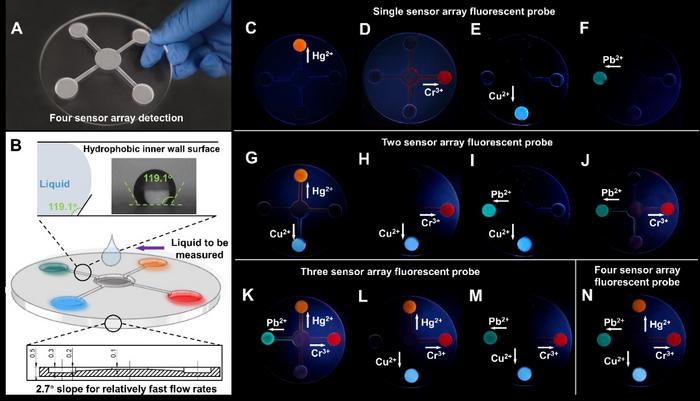
Revolutionary Microfluidic Sensors Enable Real-Time Detection of Multiple Heavy Metals in Water

Credit: LI Lingfei

Recently, a group of researchers from Institute of Solid State Physics, the Hefei Institutes of Physical Science of the Chinese Academy of Sciences, designed and developed advanced microfluidic sensor arrays that use fluorescent probes to simultaneously visualize and quantitatively detect multiple heavy metal ions in environmental water in real-time.

“This innovation offers a powerful new tool for monitoring water quality and ensuring water saftety,” said Prof. JIANG Changlong, who led the team.

The related research results have been published in Chemical Engineering Journal.

Heavy metals like mercury (Hg2+), lead (Pb2+), chromium (Cr3+), and copper (Cu2+) are common pollutants in our water systems. These contaminants are challenging to remove and can cause serious harm to both ecosystems and human health. Traditional methods of detecting these metals are often slow and require analyzing each metal one at a time, which is neither efficient nor convenient.

To overcome these limitations, the team designed microfluidic sensors on acrylic plates using a clever combination of capillary force and the hydrophobic nature of the plates’ inner surfaces. This setup allows for the creation of intricate microfluidic channels where the magic happens.

The key to these sensors is the use of organic fluorescent probes. These probes are not only cost-effective but also incredibly sensitive and selective. They can easily bind with specific heavy metal ions, causing them to light up and signal the presence of these contaminants.

The researchers built microfluidic chip arrays incorporating four different fluorescent probes, each designed to detect one of the target heavy metals. By using these probes, they created a highly sensitive, selective, and visual system that can simultaneously detect and measure the concentrations of Hg2+, Pb2+, Cr3+, and Cu2+ in water.

The detection system works with a microfluidic chip and a smartphone equipped with color recognition technology. This means that not only can these heavy metals be detected in real-time, but the results can also be visualized and quantified instantly, making it a user-friendly and highly efficient solution for monitoring water quality.

This approach provides a faster, more accurate way to ensure our water is safe from harmful heavy metal contamination, according to the team.


Journal

Chemical Engineering Journal

DOI

10.1016/j.cej.2024.152636

Article Title

Design of microfluidic fluorescent sensor arrays for real-time and synchronously visualized detection of multi-component heavy metal ions

Article Publication Date

28-May-2024

Share12Tweet8Share2ShareShareShare2

Related Posts

Frog Egg Byproduct Inspires Smart Food Wrap That Changes Color as Food Spoils

Frog Egg Byproduct Inspires Smart Food Wrap That Changes Color as Food Spoils

October 4, 2026
Solvent Polarity Steers Double Proton Transfer in a Promising OLED Fluorophore

Solvent Polarity Steers Double Proton Transfer in a Promising OLED Fluorophore

October 4, 2026

AI Digital Twins Could Transform Intensive Care in Landmark $38 Million Federal Project

October 4, 2026

Ancient Chinese Medicine Compounds Turned Into Next-Generation Antibiotic Candidates by AI

October 4, 2026

POPULAR NEWS

  • Alloys That Shrink Their Own Grains: New PIX Mechanism Refines Metals With Heat Alone

    Alloys That Shrink Their Own Grains: New PIX Mechanism Refines Metals With Heat Alone

    29 shares
    Share 12 Tweet 7
  • Endurance Exercise Reshapes the Liver in Males and Females Through Distinct Molecular Routes

    29 shares
    Share 12 Tweet 7
  • Single Transcription Factor PU.1 Rapidly Converts Fibroblasts into Macrophage-Lineage Cells

    29 shares
    Share 12 Tweet 7
  • New Scale Measures How Ready Nurse Educators Really Are for the AI Era

    29 shares
    Share 12 Tweet 7

About

We bring you the latest biotechnology news from best research centers and universities around the world. Check our website.

Follow us

Recent News

Alloys That Shrink Their Own Grains: New PIX Mechanism Refines Metals With Heat Alone

Endurance Exercise Reshapes the Liver in Males and Females Through Distinct Molecular Routes

Single Transcription Factor PU.1 Rapidly Converts Fibroblasts into Macrophage-Lineage Cells

Subscribe to Blog via Email

Success! An email was just sent to confirm your subscription. Please find the email now and click 'Confirm' to start subscribing.

Join 85 other subscribers
  • Contact Us

Bioengineer.org © Copyright 2023 All Rights Reserved.

Welcome Back!

Login to your account below

Forgotten Password?

Retrieve your password

Please enter your username or email address to reset your password.

Log In
No Result
View All Result
  • Homepages
    • Home Page 1
    • Home Page 2
  • News
  • National
  • Business
  • Health
  • Lifestyle
  • Science

Bioengineer.org © Copyright 2023 All Rights Reserved.