A narrative review published in the Bulletin of Faculty of Physical Therapy synthesizes research from 2020 to 2025 to evaluate six distinct rehabilitation techniques for improving upper extremity function in patients with chronic stroke. The study, conducted by Satish K. Pimpale, Annamma Varghese, and Geeta Bhatt, examines the efficacy of virtual reality, robot-assisted therapy, functional electrical stimulation, task-oriented training, noninvasive brain stimulation, and functional strength training. The authors aimed to identify which interventions offer the most significant benefits for motor recovery and functional independence in stroke survivors who are at least six months post-stroke. This comprehensive analysis draws from a wide array of databases, including Scopus, PubMed, and Web of Science, to provide a current overview of the field’s developments over the last half-decade.
The review process began with an extensive literature search that identified 1,945 records across seven different sources. After removing 465 duplicates and screening titles and abstracts, the researchers assessed 345 full-text articles for eligibility. The final analysis included 80 studies, comprising 50 randomized controlled trials, 22 systematic reviews with meta-analyses, and 8 other study designs. This rigorous selection process ensured that the review focused specifically on chronic stroke patients and validated outcome measures such as the Fugl-Meyer Assessment and the Action Research Arm Test.
Virtual reality-based interventions emerged as a prominent area of focus, offering interactive therapeutic environments that enhance patient engagement. Previous meta-analyses cited in the review indicated that immersive VR interventions led to major improvements in upper extremity function, with a mean difference of 3.04 on the Fugl-Meyer Assessment. The 95% confidence interval for this improvement ranged from 1.46 to 4.62, suggesting a statistically significant benefit. While VR helps patients with daily activities, the authors noted that varying study methods and time periods create challenges for direct comparisons between different trials. The technology provides a specialized virtual training environment that supports motor learning and keeps patients motivated throughout their rehabilitation sessions.
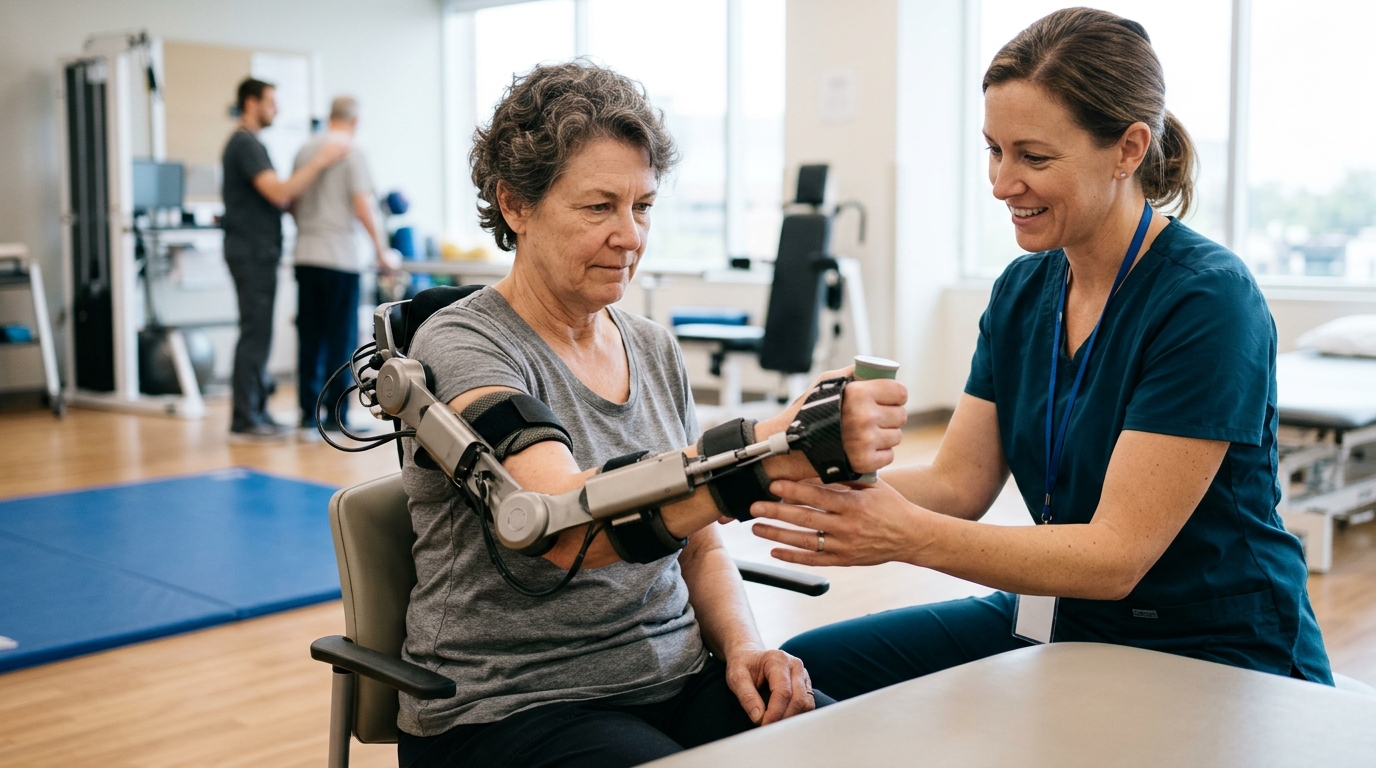
Robot-assisted therapy was identified as another key strategy, enabling patients to perform intense repetitive motor exercises that surpass the limits of standard physical therapy. Research indicates that combining robotics with physiotherapy produces major enhancements in Fugl-Meyer Assessment scores, reaching a mean difference of 6.33 with a 95% confidence interval from 4.15 to 8.50. The combination of robotic therapy with antispasticity treatment was found to produce better recovery results. However, the authors highlighted that the technology remains inaccessible to many patients due to its high cost, which poses a significant barrier to widespread adoption in community-based rehabilitation programs.
Functional electrical stimulation creates neuromuscular activation that helps decrease spasticity in the affected limb. Studies using randomized controlled trials showed better Action Research Arm Test scores when FES training was combined with Kinect-based training, with a p-value of less than 0.05. While spasticity decreased in these studies, the authors noted that long-term results were not always evaluated. This suggests that while FES provides immediate benefits, its sustained impact on motor function requires further investigation through extended follow-up studies.
Task-oriented training focuses on the repetitive practice of functional tasks, leading to moderate yet clinically important improvements in upper extremity function. A Cochrane review cited in the text showed standardized mean differences at 0.58, with a 95% confidence interval of 0.25 to 0.91. Chronic stroke patients also experienced better motivation and adherence when task-oriented training was assisted by exergames. This approach serves as a fundamental method for enabling people to learn functional skills that are directly applicable to their daily lives. The integration of gaming elements into therapy sessions helps maintain patient engagement and ensures consistent practice of real-world activities.
Noninvasive brain stimulation, which includes transcranial magnetic stimulation and transcranial direct current stimulation, has been researched as a potential addition to physiotherapy. The results for transcranial magnetic stimulation are conflicting, with multiple studies demonstrating no improvement in motor function. In contrast, transcranial direct current stimulation combined with physiotherapy produces noticeable improvements in Fugl-Meyer Assessment scores. Different stimulation protocols create difficulties for scientists to duplicate their work, leading to inconsistent outcomes across the literature. The review suggests that transcranial direct current stimulation is linked to more positive outcomes than transcranial magnetic stimulation, but the field still requires standardized protocols to move forward with medical applications.
Functional strength training tackles the essential problem of muscle weakness, which tends to be ignored during many stroke recovery programs. Patients who underwent progressive resistance training achieved better upper extremity function than those who received standard therapy, with a mean difference of 5.12 on the Fugl-Meyer Assessment. The 95% confidence interval for this result was between 2.89 and 7.35. Action Research Arm Test scores showed continuous improvement at six months follow-up, with a p-value of less than 0.01. A recent meta-analysis showed that functional strength training combined with task-oriented training produces moderate effect sizes, with a standardized mean difference of 0.67. This indicates that addressing muscle weakness is a critical component of long-term recovery and functional independence.
The review emphasizes that multimodal and patient-specific interventions seem to have the best chance of success. The evidence strongly supports integrated rehabilitation approaches, such as robotic therapy combined with standard physiotherapy or functional strength training combined with task-oriented training. These combined methods achieve the best results in motor control, spasticity reduction, and strength recovery. The field is moving toward creating customized treatment plans for individual patients, leveraging the unique benefits of each technology.
Despite the positive results, several obstacles prevent the adoption of these solutions at scale. Variations in research methods, outcome assessment tools, and study designs create difficulties for direct comparisons and meta-analysis. The availability of technology remains restricted because high-cost systems such as robotics and immersive VR face challenges in low-resource areas. The evidence shows that functional electrical stimulation and noninvasive brain stimulation produce immediate benefits, yet their ability to maintain these improvements over time lacks sufficient proof. These barriers highlight the need for more standardized research and cost-effective solutions to make advanced rehabilitation accessible to a broader population.
The authors identified several limitations in the current research field, including limited sample sizes and diverse research methods. These factors restrict the ability to apply findings across different clinical situations. Future research should focus on conducting extensive randomized controlled trials across multiple institutions to establish superior evidence quality. Standardized outcome measures, such as the Fugl-Meyer Assessment and Action Research Arm Test, are essential for comparing results between different studies. Additionally, researchers need to conduct extended follow-up studies to determine the lasting effects of treatments, especially for functional electrical stimulation and noninvasive brain stimulation.
Cost-effective solutions, such as tele-rehabilitation platforms and hybrid home-based programs, are proposed to address the financial barriers to advanced therapy. Affordable robotic or virtual reality systems could help expand access to these technologies in community settings. The review concludes that while recent research supports the use of these six interventions, the discipline must address the need for large-scale trials and standard outcome measures. Multimodal approaches to clinical practice offer a path to sustainable stroke rehabilitation, ensuring that patients receive high-quality care that improves their recovery and functional independence.
Subject of Research: Rehabilitation techniques for upper extremity function in chronic stroke
Article Title: Treatment techniques for improving upper extremity function in chronic stroke patients (2020–2025): a narrative review
Article References: Pimpale, S. K., Varghese, A., & Bhatt, G. (2026). Treatment techniques for improving upper extremity function in chronic stroke patients (2020–2025): a narrative review. Bulletin of Faculty of Physical Therapy, 31(1), Article 20. https://doi.org/10.1186/s43161-026-00346-x
Image Credits: AI Generated
DOI: 10.1186/s43161-026-00346-x
Keywords: stroke rehabilitation, virtual reality, robot-assisted therapy, functional electrical stimulation, task-oriented training, noninvasive brain stimulation, functional strength training, chronic stroke, upper extremity function, motor recovery, Treatment, techniques
News Source: Cassandra Pierce. (November 8, 2026). Review: Tech and Strength Training Aid Chronic Stroke Recovery. Scienmag.