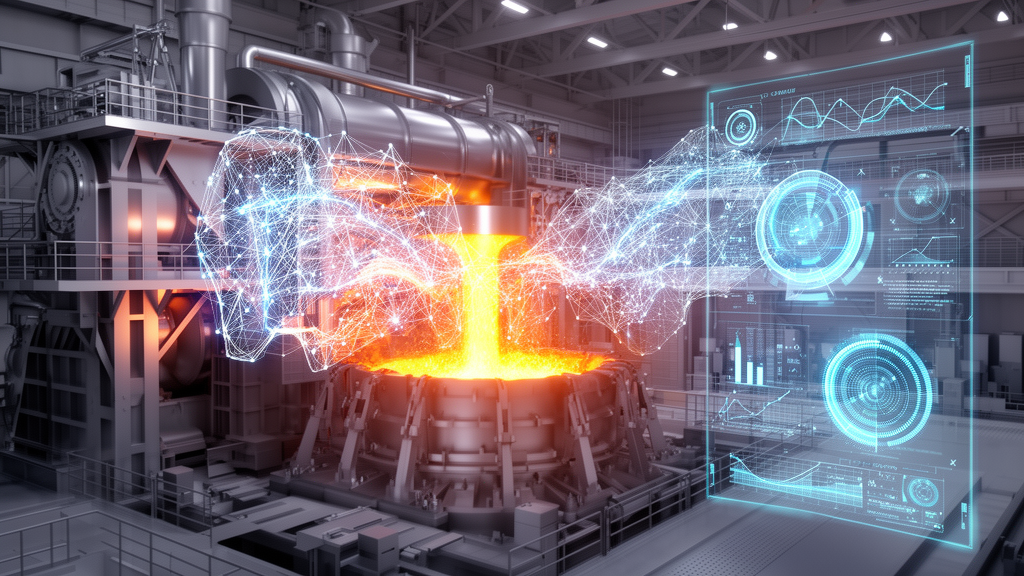
A comprehensive academic review published in Carbon Neutral Systems examines how artificial intelligence can accelerate decarbonization across the iron and steel industry by optimizing process efficiency, enabling feedstock substitution, and supporting carbon capture, utilization, and storage. Authored by Xidi Shang, Wuliang Yin, Jianxin Pan, Min Wang, Hua Wang, Kai Yang, and Qingtai Xiao, the study synthesizes findings from 133 representative investigations identified through structured database searches covering research published between 2000 and 2025. The authors highlight that the global steel sector accounts for approximately 7 to 9 percent of direct industrial carbon dioxide emissions, with traditional blast furnace and basic oxygen furnace configurations generating roughly 70 percent of global crude steel output. By shifting operations from empirical rules toward predictive modeling and multi-variable control, data-driven methods provide targeted pathways to reduce emission intensities across tightly coupled industrial processing networks.
The review delineates the baseline operating structure of integrated steelmaking, where raw-material preparation, blast furnace reduction, converter refining, and rolling units share significant energy flows and off-gas networks. Sintering, pelletizing, and coking supply the burden materials required for blast furnace operation, wherein fossil carbon acts simultaneously as a chemical reducing agent and an energy source. The authors map five technological pathways under evaluation across global producers, ranging from conventional coal-fed blast furnace systems paired with carbon capture to scrap-fed electric arc furnaces, hydrogen-based direct reduction, and electrolytic ironmaking. Electric arc furnace operations currently produce approximately 41.5 percent of crude steel in the European Union and 68.0 percent in the United States, circumventing ore agglomeration and ironmaking stages to achieve substantial energy reductions. However, broad deployment of newer hydrogen and electrolysis technologies faces substantial hurdles, including capital requirements, infrastructural bottlenecks, and high operational costs, requiring system-wide optimization within existing facilities while cleaner routes mature.
Upstream within the value chain, artificial intelligence applications focus on raw-material preparation, addressing composition variability in sinter feeds that directly dictates blast furnace thermal consumption and downstream emissions. Conventional chemical analyses remain accurate but require offline sampling that cannot provide high-frequency process feedback. To resolve this limitation, online laser-induced breakdown spectroscopy coupled with machine learning architectures, such as extreme gradient boosting cascaded with backpropagation neural networks, provides multi-element composition tracking without manual preparation. Spectral classification and regression trees, random forests, and convolutional neural networks assist in identifying iron ore types and predicting basicity ratios under variable operating conditions. Furthermore, multimodal perception frameworks that combine two-dimensional photographic images with three-dimensional point clouds have achieved material granularity recognition rates exceeding 90 percent, establishing reliable quality metrics before raw materials enter thermal processing.
Soft sensing methods in raw-material processing estimate operational indices that cannot be measured directly, including sinter basicity, iron oxide concentration, burn-through points, and endpoint bed temperatures. Researchers have implemented weighted kernel just-in-time learning, fuzzy broad learning systems, and three-dimensional convolutional neural networks to extract spatiotemporal patterns from sintering beds subject to noisy signals and process drift. Infrared image evaluation models have advanced from feature-engineering baselines toward deep convolutional architectures, improving the precision of online ferrous oxide estimation when benchmarked against laboratory measurements.
In blast furnace ironmaking, machine learning techniques complement traditional thermodynamic and transport equations to track internal furnace phenomena that elude physical instrumentation. Prediction tasks target hot-metal silicon content, slag basicity, top-gas utilization ratios, and furnace temperature dynamics. Studies demonstrate that recurrent models, including attention-enhanced gated recurrent units and temporal hypergraph attention networks, capture multi-step parameter variations across shifting operating regimes. Hybrid methodologies combining steady-state mechanistic mass-and-energy equations with nonlinear autoregressive dynamic data models have been integrated directly into model predictive control architectures. These integrated frameworks track hot-metal quality variables with high accuracy and suppress process disturbances, allowing operators to stabilize hearth thermal regimes and reduce overall fuel rates.
Artificial intelligence also enhances blast furnace monitoring, safety assurance, and anomaly diagnosis by parsing high-dimensional operational telemetry. Algorithms process tuyere optical feeds and tap-hole video records through spatiotemporal feature extraction to track combustion morphology and automate casting management. Multivariate statistical process control techniques enhanced by technique for order preference by similarity to ideal solution and grey relational analysis reduce missed detections and false-alarm frequencies during abnormal pressure fluctuations, burden hanging, or channeling events. Vision-based monitoring tools detect bosh pressure channel anomalies eight to sixteen minutes prior to operational disruptions. Furthermore, digital-twin structures integrated with deep residual networks identify carbon emission deviations, categorizing operational anomaly severity with reported classification accuracies exceeding 97 percent.
Within steelmaking and continuous casting, learning algorithms predict melt chemistry and endpoint conditions to prevent excessive resource consumption and eliminate unnecessary vessel reheating. In electric arc furnaces, artificial neural networks estimate endpoint carbon concentrations, achieving reported hit rates of 96.67 percent within an error margin of 0.05 percent carbon.
During continuous casting and downstream rolling, data-driven systems target product uniformity, strip shape, and surface integrity. Convolutional recurrent networks evaluate slab quality metrics, while physics-informed frameworks integrate thermal-stress equations to forecast strand internal cracking during solidification. In plate and strip rolling mills, support-vector regression and hybrid mechanistic models predict roll forces and cooling capacities, limiting plate crown deviations under shifting rolling schedules. For surface quality assurance, deep segmentation models such as DeepLabv3+ with residual backbones inspect strip defects in real time, outperforming classical threshold-based vision systems. Machine learning models also resolve inverse alloy design problems, utilizing feature attribution mechanisms such as Shapley additive explanations to map chemistry, tempering conditions, and microstructure to final tensile strength, ductility, and fatigue endurance.
At the plant energy management level, artificial intelligence models coordinate heterogeneous fuel and power networks to maximize the reuse of internal by-product gases. Echo state networks, variational mode decomposition, and swarm intelligence algorithms generate multi-step forecasts of blast furnace gas production and gasholder storage levels, driving root-mean-square errors below 0.05 across benchmark industrial datasets. These predictive models feed dynamic dispatch algorithms that schedule by-product fuels and steam generation under fluctuating operational loads, outperforming conventional static optimization.
For feedstock and fuel substitution pathways, algorithms facilitate the stable integration of scrap, hydrogen, and biomass into legacy metallurgy. In scrap-intensive electric arc melting, fuzzy logic soft sensors estimate bath temperatures under continuous charging regimes, shortening tap-to-tap durations and optimizing power delivery. Machine learning models evaluating co-gasification processes predict hydrogen yields across varied fuel blends, while discrete element modeling optimizes shaft-furnace internal profiles to stabilize burden descent during hydrogen-based direct reduction. On the supply side, intelligent scheduling models coordinate hydrogen production and storage with intermittent renewable power generation, reducing production costs for green steel configurations relying on fluctuating solar and wind resources.
In carbon capture, utilization, and storage infrastructure, computational methods accelerate material discovery and optimize complex multi-unit operations. High-throughput screening using genetic algorithms and machine learning identifies promising metal-organic frameworks for pre-combustion carbon dioxide capture by quantifying performance trade-offs between working capacity and gas selectivity. Operational algorithms deployed on post-combustion chemical absorption units continuously trim solvent circulation rates and regeneration heat inputs to maintain target capture rates during flue-gas flow fluctuations.
Despite documented efficiency and stability benefits, the authors observe that current industrial applications remain predominantly confined to isolated processing units operating within narrow parameter boundaries. Most models lack comprehensive representations of dynamic cross-unit couplings among material, energy, and carbon flows, which restricts route-wide optimization across entire industrial complexes. Furthermore, industrial datasets suffer from noise, missing values, regime drift, and a scarcity of validated operational logs for emerging hydrogen or electrolytic pilots. Because metallurgical operations depend strictly on thermodynamic conservation laws, unconstrained black-box learners risk outputting nonphysical predictions when extrapolating outside training domains. The review concludes that future progress depends on physics-informed, multi-scale gray-box architectures that embed conservation equations and transport kinetics directly into deep neural frameworks, supporting verifiable, plant-wide carbon reduction across the steel industry.
Subject of Research: Artificial intelligence applications in low-carbon iron and steel metallurgy
Article Title: Advances of artificial intelligence applications to low-carbon metallurgy of iron and steel
Article References: Shang, X., Yin, W., Pan, J., Wang, M., Wang, H., Yang, K., & Xiao, Q. (2026). Advances of artificial intelligence applications to low-carbon metallurgy of iron and steel. Carbon Neutral Systems, 2(1), Article 7. https://doi.org/10.1007/s44438-026-00028-0
Image Credits: AI Generated
DOI: 10.1007/s44438-026-00028-0
Keywords: artificial intelligence, steelmaking, ironmaking, low-carbon metallurgy, blast furnace, electric arc furnace, machine learning, soft sensing, process optimization, carbon capture, hydrogen metallurgy, digital twins, sintering, continuous casting, rolling process, industrial decarbonization
News Source: Blake Davidson. (November 16, 2026). Review Outlines Artificial Intelligence Framework for Decarbonizing Global Iron and Steel Manufacturing. Scienmag.