Credit: Xiaokang Weng et al.
In a paper to be published in the forthcoming issue in NANO, a team of researchers from Yunnan University, China, have reviewed the recent research on preparation methods and structures of Silicon nanowires (SiNWs) and Germanium quantum dots (GeQDs) and their composites, in order to explore their novel physical properties and improve on their optoelectronic properties.
Silicon nanowires are promising potential materials for future nano-optoelectronic information applications due to the important role of Silicon in the traditional microelectronic and photovoltaic fields. Recently, Si/Ge core-shell nanowire composites have attracted great attention due to their superior performance. Instead of Ge nanofilm layer, the integration of GeQDs and SiNWs can combine the characteristics of one-dimensional and zero-dimensional nanomaterials, which have promising applications in nanoscale light-emitting diodes, photoelectric detectors, solar cells, field-effect transistors and thermoelectric energy conversion, because of the stronger quantum confinement effect of GeQDs.
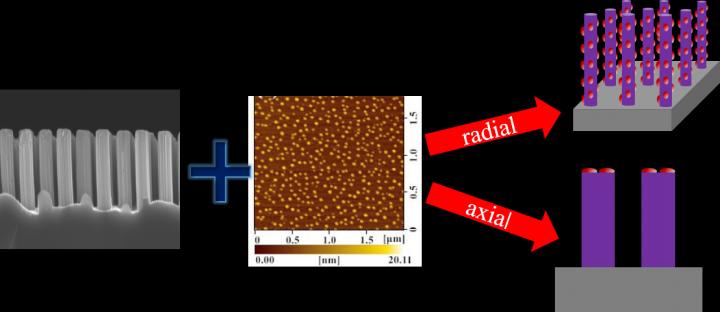
The authors have reviewed recent researches on the preparation methods and structures of SiNWs, GeQDs and their composites. The synthesis of SiNWs with random distribution and ordered arrays by using vapor-liquid-solid growth mechanism and metal assisted chemical etching technique is firstly summarized. Some special structures of SiNWs are also discussed. Furthermore, the development of some novel structures of GeQDs for further improving their optical properties is reviewed. Finally, the growth mechanism and structure evolution of SiNWs/GeQDs composites are illustrated from the view of theory and experiment. The strain in Ge shell layers and SiNWs, the relationship between Ge growth mode and SiNW diameter, and the distribution of GeQDs on the radial and axial directions of SiNWs are discussed in detail.
###
This work was supported by the National Natural Science Foundation of China (Nos. 11504322, 11564043, 11804295 and 11704330), and the Key Project of Applied Basic Research Program of Yunnan Province of China (Nos. 2016FB002 and 2016FB006). Jie Yang also appreciates the support from Yunnan University by the Project of Training for Dong Lu Young Teachers.
Additional co-authors of the NANO paper are Jie Yang, Dongze Li, Rongfei Wang, Feng Qiu, Chong Wang and Yu Yang from Yunnan Key Laboratory for the Micro/Nano Materials and Technology of Yunnan University.
Corresponding author for this study is Jie Yang, [email protected].
For more insight into the research described, readers are invited to access the paper on NANO.
IMAGE
Caption: As a promising backbone material, Si nanowires (SiNWs) have been utilized to integrate with Ge quantum dots (GeQDs). The studies of SiNW/GeQD composite materials have attracted attention due to their excellent optical and electrical properties. In this paper, recent research on the preparation and growth mechanisms of SiNW/GeQD composite materials is reviewed. The growth of GeQDs in the radial and axial directions of SiNWs are introduced respectively. Some problems and several prospective structures of SiNW/GeQD composite materials are proposed.
NANO is an international peer-reviewed monthly journal for nanoscience and nanotechnology that presents forefront fundamental research and new emerging topics. It features timely scientific reports of new results and technical breakthroughs and publishes interesting review articles about recent hot issues.
About World Scientific Publishing Co.
World Scientific Publishing is a leading independent publisher of books and journals for the scholarly, research, professional and educational communities. The company publishes about 600 books annually and about 135 journals in various fields. World Scientific collaborates with prestigious organizations like the Nobel Foundation and US National Academies Press to bring high quality academic and professional content to researchers and academics worldwide. To find out more about World Scientific, please visit http://www.
For more information, contact Tay Yu Shan at [email protected].
Media Contact
Tay Yu Shan
[email protected]
Original Source
https:/
Related Journal Article
http://dx.