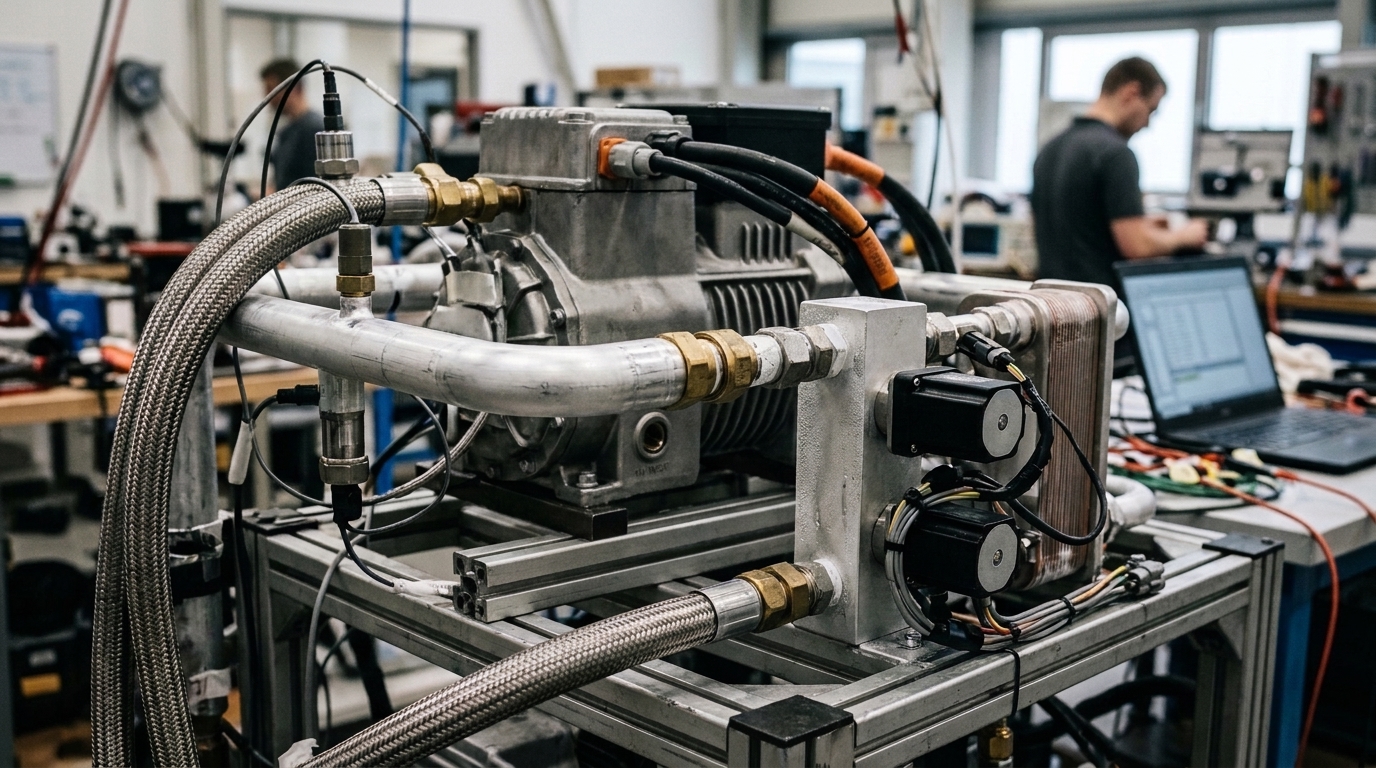
A comprehensive review published in Discover Vehicles examines the current state of carbon dioxide, or R744, based thermal management systems in electric vehicles. The study, authored by Blanca Foliaco and Paride Gullo, analyzes advancements in transcritical R744 heat pump technologies, operational challenges, and optimization strategies. The authors conclude that future thermal management strategies for electric vehicles can be based on integrated R744-based solutions, potentially featuring advanced add-ons such as AI-based control strategies. This work addresses a gap in the literature by providing an updated overview of R744 heat pump technology specifically for electric vehicles, emphasizing its integration with battery thermal management and broader vehicle systems.
The global transition to electric vehicles is essential for reducing transportation-related carbon emissions, yet limited driving range remains a significant barrier to widespread adoption. The high energy consumption of thermal management systems is a primary cause of this range anxiety. In cold climates, electric vehicles must source heat from the battery pack rather than utilizing waste heat from an internal combustion engine. This often necessitates the use of inefficient positive temperature coefficient heaters, which can decrease vehicle range by up to 50% during severe winter conditions. Consequently, the thermal management system must provide cooling during periods of high demand or fast charging and supply heating in cold environments to ensure both performance and longevity.
International regulations are phasing out conventional refrigerants with high global warming potential, leading to the use of natural refrigerants such as carbon dioxide. R744 meets environmental standards and exhibits favorable thermodynamic performance, including high volumetric cooling capacity and excellent heat transfer characteristics. These properties facilitate compact component design and enable heat pumps to operate efficiently for heating, even at low ambient temperatures where conventional systems are ineffective. The adoption of R744 in electric vehicle thermal management represents a technical strategy to address the limitations of electric mobility, offering both robust environmental benefits and high-performance heating that supports extended vehicle range.
The review details several performance enhancement technologies designed to address the inherent thermodynamic inefficiencies of the basic transcritical R744 vapor compression cycle. One key modification is the internal heat exchanger, which transfers heat between high-pressure R744 leaving the gas cooler and low-pressure vapor R744 leaving the evaporator. Experimental data showed that a R744 system with an internal heat exchanger can increase its efficiency by up to 25%. In the context of electric buses, a coaxial tube internal heat exchanger system demonstrated cooling capacities of 31.4 kilowatts and a coefficient of performance of 2.88 at 35 degrees Celsius, while also achieving heating capacities of 15.3 kilowatts and a coefficient of performance of 1.78 at minus 20 degrees Celsius.
Vapor injection and multi-stage compression are other significant enhancement methods. In a vapor injection cycle, some refrigerant is injected into the compressor at intermediate pressure, reducing power consumption and increasing the coefficient of performance. Experimental research indicates that a vapor injection system can increase heating capacity by 75.7% and the coefficient of performance by 45.5% at an ambient temperature of minus 30 degrees Celsius compared to a basic single-stage system. Multi-stage compression with intercooling divides the compression process into two stages, reducing the required work and lowering the final discharge temperature. Studies achieved 50% to 132% increases in heating capacity and 18.9% to 61.9% improvements in coefficient of performance at ambient temperatures between 0 and minus 20 degrees Celsius.
Technologies to reduce expansion valve irreversibility, such as ejectors and expanders, are also reviewed. Ejectors use the kinetic energy of high-pressure refrigerant to entrain and compress low-pressure vapor, reducing the compressor’s required pressure ratio and power consumption. A dual-ejector system in parallel can increase the cooling coefficient of performance by 17.3% to 23.4% compared to conventional cycles. Replacing the throttling valve with an expander allows for the recovery of expansion work, which can partly offset compressor power. A novel scroll compressor-expander yielded a 9.8% coefficient of performance improvement at a high discharge pressure of 15 megapascals, although this study was not validated experimentally.
The review explores integrated thermal management system architectures that connect R744 heat pumps with electric vehicle components. These systems use a single, centralized refrigeration circuit to coordinate all vehicle thermal loads, including the cabin, battery, and powertrain. Direct refrigerant cooling of the battery represents a promising approach within these integrated systems, reducing thermal resistance and overall system weight by removing secondary fluid loops. However, this setup is highly sensitive to vapor quality, and studies show that while series arrangements can achieve a 13.5% higher coefficient of performance at 35 degrees Celsius ambient temperature, they risk high vapor quality at the outlet of the last battery modules, potentially leading to local hotspots.
Waste heat recovery from powertrain components is another critical strategy for enhancing heating efficiency in cold climates. By capturing and repurposing low-grade waste heat generated by the battery pack, electric motor, and power electronics, the system can substantially reduce compressor workload. A study on an R744 dual-source heat pump found that using both ambient air and recovered waste heat increased heating capacity by 12.68% and the coefficient of performance by 13.51%, boosting driving range by 9.1% compared to a standard air-source heat pump. Another study reported that an R744 heat pump system recovering waste heat from the battery and motor increased heating capacity by 26.8% and the coefficient of performance by 27.3%.
Operational challenges remain a significant focus, particularly regarding optimal high-pressure control. In transcritical cycles, the coefficient of performance reaches its maximum at a specific optimal discharge pressure for each set of operating conditions. Operating at non-optimal pressure can result in substantial performance losses. Research indicates that heat exchanger degradation increases the optimal discharge pressure over the vehicle’s lifespan, which can cause coefficient of performance losses of up to 15% if not addressed. Advanced control strategies, such as model predictive control and machine learning, are being adopted to manage these dynamic conditions and maintain peak efficiency throughout the vehicle’s lifecycle.
Frosting and defrosting dynamics also present challenges for air-source heat pumps in electric vehicles, particularly in high-humidity environments. When frost covers more than 40% of the surface, heating capacity drops by 26% to 31%, and the coefficient of performance decreases by 22% to 30%. Reverse-cycle defrosting is the standard approach but is inherently parasitic, consuming excess energy and interrupting cabin heating. Recent evaluations have shifted toward frost-free control strategies that modulate system parameters to prevent accumulation without requiring auxiliary hardware. A comprehensive global performance improvement control method has been proposed that can increase electric vehicle range by up to 10% compared to conventional optimal discharge pressure control by proactively preventing frost.
Component-level innovations are essential for the implementation of high-performance R744 thermal management systems. High-pressure compressors, especially scroll types, must withstand pressures often exceeding 100 bar. A novel asymmetric scroll compressor design with variable wrap thickness improved the built-in volume ratio and operational stability by reducing the mass of the orbiting scroll. Microchannel heat exchangers made from brazed aluminum are standard in automotive systems due to their compactness and superior heat transfer. However, design must address the pinch point caused by the changing specific heat capacity of supercritical R744 near the pseudo-critical point, which can restrict heat transfer and reduce the effectiveness of the gas cooler.
The review identifies several future research directions, including the development of advanced materials that withstand high operating pressures while minimizing weight and material degradation. Simplified and reconfigurable system architectures can address integration challenges and improve adaptability across diverse vehicle platforms. Integration with comprehensive vehicle thermal management systems is essential for optimizing energy utilization and component interactions. The implementation of smart control systems and automated manufacturing processes is expected to improve system reliability and production efficiency. Comparative assessments of R744 against other emerging refrigerants, such as propane and low-global-warming-potential synthetic options, will be crucial to validate its long-term competitiveness and guide strategic refrigerant selection for future electric vehicle platforms.
In summary, the review indicates that R744-based thermal management is a promising technology for electric vehicles, offering significant benefits in heating performance and environmental sustainability. While the distinct thermodynamic properties of the transcritical R744 cycle present engineering challenges, particularly regarding throttling losses in warm conditions, technological innovations such as internal heat exchangers, vapor injection, and expansion work recovery are substantially enhancing system performance. Continued advancements in cycle design, component engineering, and control strategies will enable electric vehicles to operate efficiently and with low environmental impact in all climates, representing a critical step for the industry’s future.
Subject of Research: Review of R744-based thermal management systems in electric vehicles
Article Title: Advances and challenges of R744 based thermal management systems in electric vehicles
Article References: Foliaco, B., & Gullo, P. (2026). Advances and challenges of R744 based thermal management systems in electric vehicles. Discover Vehicles, 2(1), Article 10. https://doi.org/10.1007/s44465-026-00014-3
Image Credits: AI Generated
DOI: 10.1007/s44465-026-00014-3
Keywords: R744, electric vehicles, thermal management, heat pumps, transcritical cycles, battery cooling, waste heat recovery, refrigerants, energy efficiency, vehicle range, Advances, challenges
News Source: Denise Maddox. (November 11, 2026). Review Maps R744 Thermal Management Progress in Electric Vehicles. Scienmag.