

• HOME
  • NEWS
  • EXPLORE
    • CAREER
      • Companies
      • Jobs
    • EVENTS
    • iGEM
      • News
      • Team
    • PHOTOS
    • VIDEO
    • WIKI
  • BLOG
  • COMMUNITY
    • FACEBOOK
    • INSTAGRAM
    • TWITTER
Monday, January 12, 2026
BIOENGINEER.ORG
No Result
View All Result
  • Login
  • HOME
  • NEWS
  • EXPLORE
    • CAREER
      • Companies
      • Jobs
        • Lecturer
        • PhD Studentship
        • Postdoc
        • Research Assistant
    • EVENTS
    • iGEM
      • News
      • Team
    • PHOTOS
    • VIDEO
    • WIKI
  • BLOG
  • COMMUNITY
    • FACEBOOK
    • INSTAGRAM
    • TWITTER
  • HOME
  • NEWS
  • EXPLORE
    • CAREER
      • Companies
      • Jobs
        • Lecturer
        • PhD Studentship
        • Postdoc
        • Research Assistant
    • EVENTS
    • iGEM
      • News
      • Team
    • PHOTOS
    • VIDEO
    • WIKI
  • BLOG
  • COMMUNITY
    • FACEBOOK
    • INSTAGRAM
    • TWITTER
No Result
View All Result
Bioengineer.org
No Result
View All Result
Home NEWS Science News Health

Reversing a genetic cause of poor stress responses in mice

Bioengineer by Bioengineer
April 7, 2021
in Health
Reading Time: 2 mins read
0
IMAGE
Share on FacebookShare on TwitterShare on LinkedinShare on RedditShare on Telegram

IMAGE

Credit: Minghui Wang/Van Aelst Lab, CSHL/2021

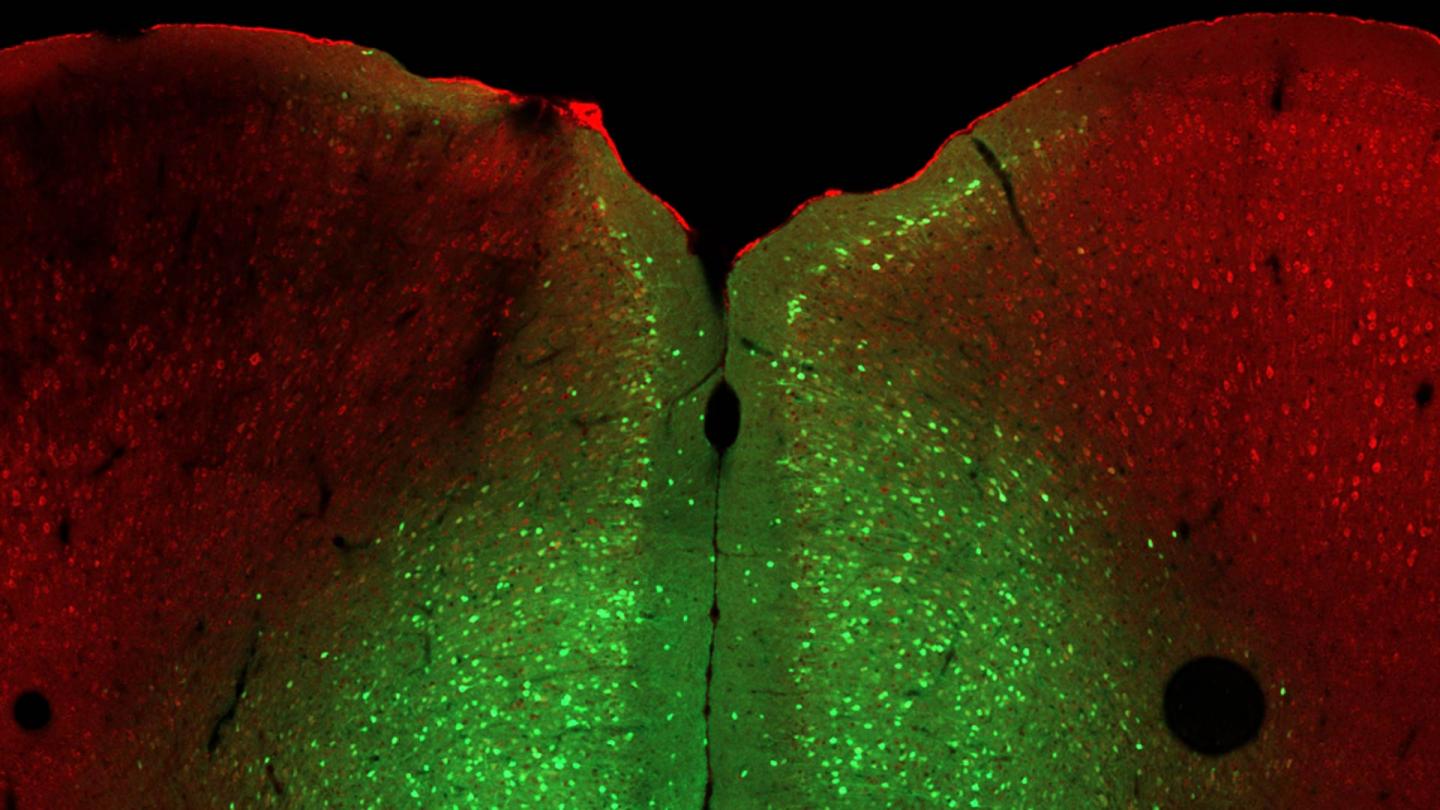
Everyone faces stress occasionally, whether in school, at work, or during a global pandemic. However, some cannot cope as well as others. In a few cases, the cause is genetic. In humans, mutations in the OPHN1 gene cause a rare X-linked disease that includes poor stress tolerance. Cold Spring Harbor Laboratory (CSHL) Professor Linda Van Aelst seeks to understand factors that cause specific individuals to respond poorly to stress. She and her lab studied the mouse gene Ophn1, an analog of the human gene, which plays a critical role in developing brain cell connections, memories, and stress tolerance. When Ophn1 was removed in a specific part of the brain, mice expressed depression-like helpless behaviors. The researchers found three ways to reverse this effect.

To test for stress, the researchers put mice into a two-room cage with a door in between. Normal mice escape from the room that gives them a light shock on their feet. But animals lacking Ophn1 sit helplessly in that room without trying to leave. Van Aelst wanted to figure out why.

Her lab developed a way to delete the Ophn1 gene in different brain regions. They found that removing Ophn1 from the prelimbic region of the medial prefrontal cortex (mPFC), an area known to influence behavioral responses and emotion, induced the helpless phenotype. Then the team figured out which brain circuit was disrupted by deleting Ophn1, creating overactivity in the brain region and ultimately the helpless phenotype.

Understanding the circuit

Pyramidal neurons are central to this brain circuit. If they fire too much, the mouse becomes helpless.

Another cell, an interneuron, regulates the pyramidal neuron activity, making sure it does not fire too much.

These two cells feedback to each other, creating a loop.

Ophn1 controls a particular protein, RhoA kinase, within this feedback loop which helps regulate and balances activity.

Van Aelst found three agents that reversed the helpless phenotype. Fasudil, an inhibitor specific for RhoA kinase, mimicked the effect of the missing Ophn1. A second drug dampens excess pyramidal neuron activity. A third drug wakes up the interneurons to inhibit pyramidal neurons. Van Aelst says:

“So bottom line, if you can restore the proper activity in the medial prefrontal cortex, then you could rescue the phenotype. So that was actually very exciting. You should be open to anything. You never know. Everything is surprising.”

Van Aelst hopes that understanding the complex feedback loop behind Ophn1-related stress responses will lead to better treatments for stress in humans.

###

Media Contact
Sara Roncero-Menendez
[email protected]

Related Journal Article

http://dx.doi.org/10.1016/j.neuron.2021.03.016

Tags: BiologyGenesGeneticsMedicine/Health
Share12Tweet8Share2ShareShareShare2

Related Posts

Targeting SPAK Halts Liver Cancer Progression, Boosts Immunity

January 12, 2026

Machine Learning Unveils Unified Cell-State Landscape

January 12, 2026

Optimizing Rapid Genomic Sequencing in Level IV NICU

January 12, 2026

Chromatin Architecture Guides Heart Disease Gene Regulation

January 12, 2026
Please login to join discussion

POPULAR NEWS

  • Enhancing Spiritual Care Education in Nursing Programs

    154 shares
    Share 62 Tweet 39
  • PTSD, Depression, Anxiety in Childhood Cancer Survivors, Parents

    146 shares
    Share 58 Tweet 37
  • Robotic Ureteral Reconstruction: A Novel Approach

    70 shares
    Share 28 Tweet 18
  • Study Reveals Lipid Accumulation in ME/CFS Cells

    50 shares
    Share 20 Tweet 13

About

We bring you the latest biotechnology news from best research centers and universities around the world. Check our website.

Follow us

Recent News

Targeting SPAK Halts Liver Cancer Progression, Boosts Immunity

Gradient Graphene Powers Precise Directional Laser Printing

Machine Learning Unveils Unified Cell-State Landscape

Subscribe to Blog via Email

Enter your email address to subscribe to this blog and receive notifications of new posts by email.

Join 71 other subscribers
  • Contact Us

Bioengineer.org © Copyright 2023 All Rights Reserved.

Welcome Back!

Login to your account below

Forgotten Password?

Retrieve your password

Please enter your username or email address to reset your password.

Log In
No Result
View All Result
  • Homepages
    • Home Page 1
    • Home Page 2
  • News
  • National
  • Business
  • Health
  • Lifestyle
  • Science

Bioengineer.org © Copyright 2023 All Rights Reserved.


