• HOME
  • NEWS
  • EXPLORE
    • CAREER
      • Companies
      • Jobs
    • EVENTS
    • iGEM
      • News
      • Team
    • PHOTOS
    • VIDEO
    • WIKI
  • BLOG
  • COMMUNITY
    • FACEBOOK
    • INSTAGRAM
    • TWITTER
Saturday, July 11, 2026
BIOENGINEER.ORG
No Result
View All Result
  • Login
  • HOME
  • NEWS
  • EXPLORE
    • CAREER
      • Companies
      • Jobs
        • Lecturer
        • PhD Studentship
        • Postdoc
        • Research Assistant
    • EVENTS
    • iGEM
      • News
      • Team
    • PHOTOS
    • VIDEO
    • WIKI
  • BLOG
  • COMMUNITY
    • FACEBOOK
    • INSTAGRAM
    • TWITTER
  • HOME
  • NEWS
  • EXPLORE
    • CAREER
      • Companies
      • Jobs
        • Lecturer
        • PhD Studentship
        • Postdoc
        • Research Assistant
    • EVENTS
    • iGEM
      • News
      • Team
    • PHOTOS
    • VIDEO
    • WIKI
  • BLOG
  • COMMUNITY
    • FACEBOOK
    • INSTAGRAM
    • TWITTER
No Result
View All Result
Bioengineer.org
No Result
View All Result
Home NEWS Science News

Revealing the reason behind jet formation at the tip of laser optical fiber

Bioengineer by Bioengineer
October 12, 2020
in Science News
Reading Time: 2 mins read
0
IMAGE
Share on FacebookShare on TwitterShare on LinkedinShare on RedditShare on Telegram

IMAGE

Credit: Junnosuke Okajima, Tohoku University

When an optical fiber is immersed in liquid, a high temperature, high speed jet is discharged. Researchers expect this to be applied to medical treatment in the future. Now, a research team from Russia and Japan has explored this phenomenon further and revealed the reasons behind the jet formation.

Lasers using a thin optical fiber and combined with an endoscope and catheter can be easily transported into deep areas of the body or inside blood vessels. Traditionally, affected areas or lesions are removed by generating heat inside the tissue through laser absorption – a process known as the photothermal effect.

Yet, hydrodynamical phenomena, such as microbubble formation or high-speed jet generation from the optical fiber, show immense medical promise.

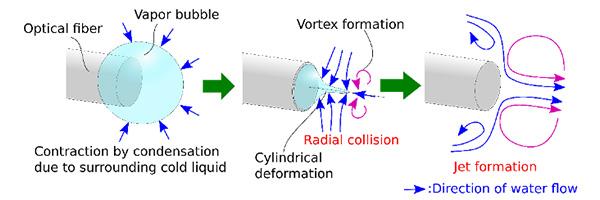
The process of jet formation happens when the laser is irradiated to the water, causing the water to boil and a vapor bubble to form at the tip of the optical fiber. The vapor bubble grows until the laser energy absorbed in the liquid is consumed. Because of the surrounding cold liquid, condensation suddenly shrinks the vapor bubble.

Using a numerical simulation, Dr. Junosuke Okajima from Tohoku University’s Institute of Fluid Science, along with his colleagues in Russia, set out to clarify the jet formation mechanism. Their simulation investigated the relationship between the bubble deformation and the induced flow field.

When the bubble shrinks, the flow toward the tip of the optical fiber is formed. The flow deforms the bubble into the cylindrical shape. This deformation induces the collision of flow in a radial direction. This collision generates the jet forward. As a result of collision and jet formation, the vortex is formed at the tip of the deformed bubble and it grows larger.

“We found the jet velocity depends on the relationship between the size of the vapor bubble just before the shrinking and the fiber radius,” said Okajima. “We will continue to develop this study and try to find the optimum condition which maximizes the jet velocity and temperature, making further laser surgical techniques more effective and safer.”

###

The project was part of the Russian Federation’s Ministry of Science and Higher Education’s Megagrant project, where Okajima serves as the leading scientist. For the current publication, he collaborated with Dr Roman Fursenko of the Siberian Branch of the Russian Academy of Sciences, professor Vladimir Chudnovskii, professor Sergey Minaev, and professor Mikhail Guzev, all from the Far Eastern Branch of the Russian Academy of Sciences.

Media Contact
Junnosuke Okajima
[email protected]

Original Source

https://www.tohoku.ac.jp/en/press/reasons_behind_jet_formation.html

Related Journal Article

http://dx.doi.org/10.1016/j.ijheatmasstransfer.2020.120420

Tags: Technology/Engineering/Computer Science
Share12Tweet8Share2ShareShareShare2

Related Posts

Ultra-fine bubbles revolutionize future of inkjet printing technology

Ultra-fine bubbles revolutionize future of inkjet printing technology

July 11, 2026

Polyunsaturated Fatty Acid Synthesis Influences Ferroptosis Sensitivity with Low Arachidonic Acid

July 11, 2026

Real-Time Pain and Activity Patterns in Older Adults with Chronic Pain

July 11, 2026

Study Finds Dopamine System Damage in Long COVID Patients’ Brains

July 11, 2026
Please login to join discussion

POPULAR NEWS

  • Detection of EDCs in Breast Milk and Infant Urine Up to Six Months Highlights Early Exposure Risks

    77 shares
    Share 31 Tweet 19
  • New Drug Candidate Developed at McMaster Shows Potential for Treating Brain Cancer

    58 shares
    Share 23 Tweet 15
  • KTU Researchers Explore Ultrasound’s Role in Enhancing Blood Flow Beyond Diagnostics

    53 shares
    Share 21 Tweet 13
  • 高齢者の骨粗鬆症治療の持続性比較

    51 shares
    Share 20 Tweet 13

About

We bring you the latest biotechnology news from best research centers and universities around the world. Check our website.

Follow us

Recent News

Ultra-fine bubbles revolutionize future of inkjet printing technology

Polyunsaturated Fatty Acid Synthesis Influences Ferroptosis Sensitivity with Low Arachidonic Acid

Real-Time Pain and Activity Patterns in Older Adults with Chronic Pain

Subscribe to Blog via Email

Success! An email was just sent to confirm your subscription. Please find the email now and click 'Confirm' to start subscribing.

Join 84 other subscribers
  • Contact Us

Bioengineer.org © Copyright 2023 All Rights Reserved.

Welcome Back!

Login to your account below

Forgotten Password?

Retrieve your password

Please enter your username or email address to reset your password.

Log In
No Result
View All Result
  • Homepages
    • Home Page 1
    • Home Page 2
  • News
  • National
  • Business
  • Health
  • Lifestyle
  • Science

Bioengineer.org © Copyright 2023 All Rights Reserved.