• HOME
  • NEWS
  • EXPLORE
    • CAREER
      • Companies
      • Jobs
    • EVENTS
    • iGEM
      • News
      • Team
    • PHOTOS
    • VIDEO
    • WIKI
  • BLOG
  • COMMUNITY
    • FACEBOOK
    • INSTAGRAM
    • TWITTER
Sunday, August 9, 2026
BIOENGINEER.ORG
No Result
View All Result
  • Login
  • HOME
  • NEWS
  • EXPLORE
    • CAREER
      • Companies
      • Jobs
        • Lecturer
        • PhD Studentship
        • Postdoc
        • Research Assistant
    • EVENTS
    • iGEM
      • News
      • Team
    • PHOTOS
    • VIDEO
    • WIKI
  • BLOG
  • COMMUNITY
    • FACEBOOK
    • INSTAGRAM
    • TWITTER
  • HOME
  • NEWS
  • EXPLORE
    • CAREER
      • Companies
      • Jobs
        • Lecturer
        • PhD Studentship
        • Postdoc
        • Research Assistant
    • EVENTS
    • iGEM
      • News
      • Team
    • PHOTOS
    • VIDEO
    • WIKI
  • BLOG
  • COMMUNITY
    • FACEBOOK
    • INSTAGRAM
    • TWITTER
No Result
View All Result
Bioengineer.org
No Result
View All Result
Home NEWS Science News Biology

Resist! TAK1 enables endothelial cells to avoid apoptosis

Bioengineer by Bioengineer
January 17, 2019
in Biology
Reading Time: 3 mins read
0
IMAGE
Share on FacebookShare on TwitterShare on LinkedinShare on RedditShare on Telegram

Osaka University-led study shows that TAK1 preserves endothelial cell survival in an inflammatory environment, and can be targeted for tumor suppression
IMAGE

Credit: Osaka University


Osaka, Japan – Cell death is an important aspect of tissue homeostasis, as well as inflammation and disease pathogenesis related to infection, injury, and tumor growth. Tumor necrosis factor-α (TNFα) coordinates cell death in a variety of tissues; however, endothelial cells within blood vessels show a unique resistance to the action of TNFα. This resistance has been poorly understood, until now.

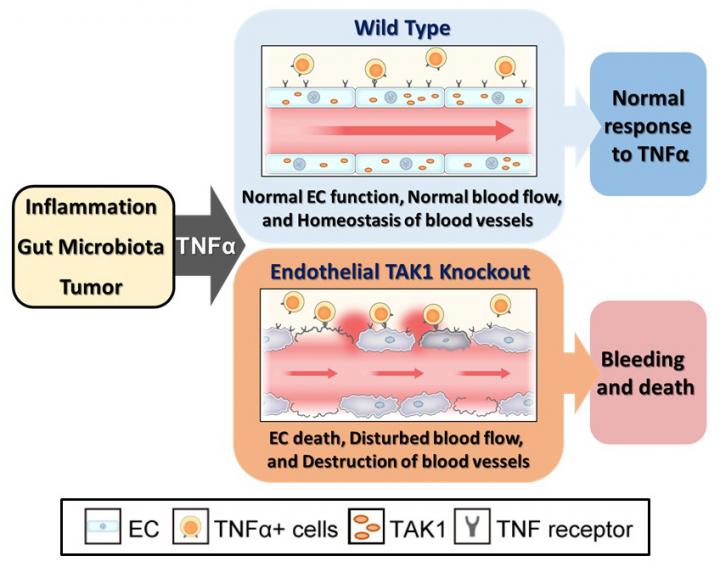
In a new study published in Developmental Cell, a research team led by experts from Osaka University investigated the mechanism underlying endothelial cell resistance to TNFα-induced apoptosis, an important mechanism of cell death in inflammatory conditions. They found that TAK1, a known signaling messenger involved in tissue homeostasis, was essential for survival of endothelial cells upon exposure to TNFα.

TNFα-induced cell death is tightly regulated and resisted in endothelial cells, which use TNFα exposure as a signal to exit the stationary “resting state” and become active and start inflammation. Despite a variety of research efforts, this resistance mechanism has remained ambiguous. Here, the researchers used a unique type of mouse, in which TAK1 could be deleted in specific tissues, to show that TAK1 is an essential component in ensuring survival of endothelial cells during inflammation and injury.

“We found that deletion of TAK1 blocked the ability of intestinal endothelial cells to disregard monocyte and macrophage inflammatory TNFα signaling induced by intestinal microbiota, resulting in hemorrhage within the intestine and liver,” says corresponding author Nobuyuki Takakura. “Thus, the presence of TAK1 safeguarded the survival of endothelial cells in these tissues.”

In the study, in vivo experiments with inflammation model mouse revealed that TAK1 was essential for survival of endothelial cells in lung tissue and hind limb muscle, under conditions similar to pneumonia and myositis.

“We suspected that inflammation in tumor tissues may be a powerful weapon to destroy tumor vasculature,” says lead author Hisamichi Naito. “We found that, in tumor in which TNFα is expressed abundantly, localized deletion of TAK1 resulted endothelial cell death and thereby tumor regression, suggesting that TAK1 may be a useful target in anti-angiogenic therapy.”

In addition to providing a clear understanding of endothelial cell survival during inflammation, this study has revealed a potential pathway for other cell types to avoid the onset of apoptosis, and may be important in future regenerative medicine therapies.

###

The article, “TAK1 Prevents Endothelial Apoptosis and Maintains Vascular Integrity,” was published in Developmental Cell, at DOI: https://doi.org/10.1016/j.devcel.2018.12.002.

About Osaka University

Osaka University was founded in 1931 as one of the seven imperial universities of Japan and now has expanded to one of Japan’s leading comprehensive universities. The University has now embarked on open research revolution from a position as Japan’s most innovative university and among the most innovative institutions in the world according to Reuters 2015 Top 100 Innovative Universities and the Nature Index Innovation 2017. The university’s ability to innovate from the stage of fundamental research through the creation of useful technology with economic impact stems from its broad disciplinary spectrum.
Website: https://resou.osaka-u.ac.jp/en/top

Media Contact
Saori Obayashi
[email protected]
81-661-055-886

Original Source

https://resou.osaka-u.ac.jp/en/research/2019/20190111_1

Related Journal Article

http://dx.doi.org/10.1016/j.devcel.2018.12.002

Tags: cancerCell BiologyImmunology/Allergies/AsthmaInternal MedicineMedicine/HealthTransplantationTrauma/Injury
Share12Tweet8Share2ShareShareShare2

Related Posts

New wheat gene Sdd1 offers resource for improving plant architecture

New wheat gene Sdd1 offers resource for improving plant architecture

August 8, 2026
C/EBPγ Links Cancer Plasticity, DNA Repair, and Therapy Resistance in Lung Adenocarcinoma

C/EBPγ Links Cancer Plasticity, DNA Repair, and Therapy Resistance in Lung Adenocarcinoma

August 8, 2026

Antenna-like cell structure helps turtles sense warmth that determines sex

August 8, 2026

USC Launches Center Investigating Sex Differences in Aging

August 8, 2026
Please login to join discussion

POPULAR NEWS

  • How Neuroblastoma Balances Replication Stress and Genome Stability Across Chromosome 17q

    29 shares
    Share 12 Tweet 7
  • Cigar, Cigarillo, and Pipe Smoking: Lung Cancer Risk and Screening Eligibility

    29 shares
    Share 12 Tweet 7
  • How Low Gravity and Pressure Affect Space Manufacturing of Carbon-Fiber Structures

    29 shares
    Share 12 Tweet 7
  • Calreticulin-targeted L-asparaginase–flagellin conjugate boosts Salmonella’s antitumor effectiveness

    29 shares
    Share 12 Tweet 7

About

We bring you the latest biotechnology news from best research centers and universities around the world. Check our website.

Follow us

Recent News

How Neuroblastoma Balances Replication Stress and Genome Stability Across Chromosome 17q

Cigar, Cigarillo, and Pipe Smoking: Lung Cancer Risk and Screening Eligibility

How Low Gravity and Pressure Affect Space Manufacturing of Carbon-Fiber Structures

Subscribe to Blog via Email

Success! An email was just sent to confirm your subscription. Please find the email now and click 'Confirm' to start subscribing.

Join 86 other subscribers
  • Contact Us

Bioengineer.org © Copyright 2023 All Rights Reserved.

Welcome Back!

Login to your account below

Forgotten Password?

Retrieve your password

Please enter your username or email address to reset your password.

Log In
No Result
View All Result
  • Homepages
    • Home Page 1
    • Home Page 2
  • News
  • National
  • Business
  • Health
  • Lifestyle
  • Science

Bioengineer.org © Copyright 2023 All Rights Reserved.