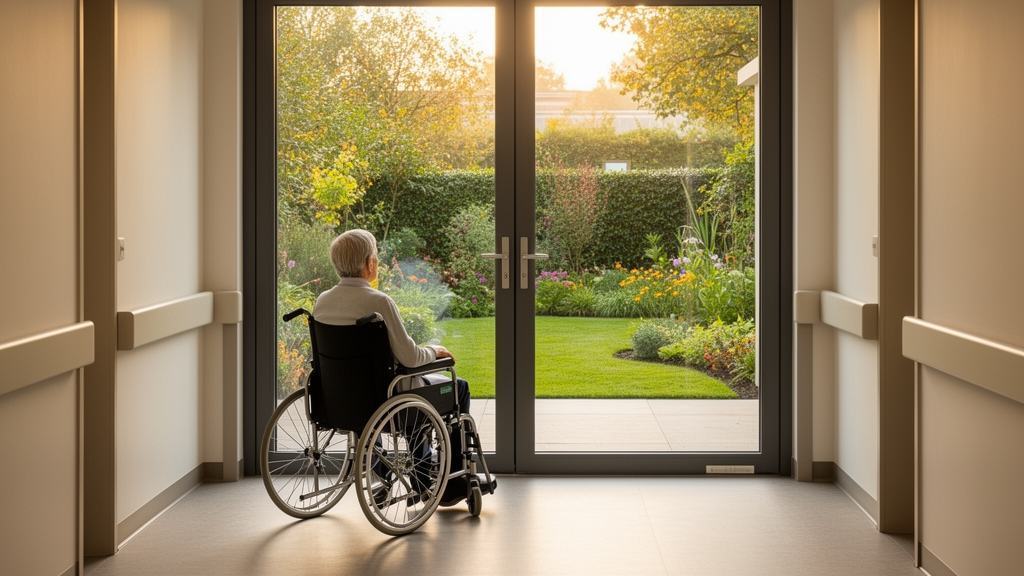
Access to outdoor environments in residential care facilities can reflect structural ageism when physical designs and organizational procedures translate age-related functional differences into unequal opportunities for resident participation, according to a qualitative study published in BMC Geriatrics. The research demonstrates that ageism within residential care extends beyond individual interpersonal prejudice, manifesting directly through environmental and structural conditions that govern whether older adults can access outdoor spaces, maintain personal autonomy, sustain mobility, and engage in social participation.
To evaluate how structural ageism operates through environmental access, researchers conducted a qualitative secondary analysis re-analysing walking interview data collected with twelve older adults residing in three Swedish residential care facilities. The selected facilities exhibited documented variation across building structure, geographic location, and baseline outdoor accessibility. The investigative team analysed the qualitative interview data through an inductive qualitative content analysis grounded in a structural ageism perspective, subsequently applying deductive mapping across a four-stage zone model designated as Zones 1 through 4.
The analysis established three primary interrelated categories governing outdoor access, led by physical structural barriers that directly constrain resident autonomy and physical mobility. Specific physical impediments identified across the residential settings included elevated thresholds, uneven walking surfaces, and restricted entryways to exterior areas. In the absence of supportive modifications, these architectural obstacles prevented residents from moving independently into the outdoor environments that surround their daily living quarters.
The second identified category centered on residents’ dependence on facility care workers for safe exterior navigation and physical access. The study determined that outdoor access is fundamentally shaped by continuous interactions between the built environment and facility organizational practices. Key organizational factors governing resident access included operational safety protocols, the provision of physical assistance, and the routine availability of care staff to accompany residents beyond interior living spaces.
Conversely, the third category identified supportive environmental conditions that actively enable resident independence, sustained social interaction, and psychological well-being. The investigation noted that designated outdoor settings, including balconies, patios, communal gardens, and surrounding neighborhood spaces, foster personal identity and place attachment among older adults. However, despite these documented contributions to quality of life, access to such outdoor spaces remains frequently restricted within residential care institutions.
Across Zones 1 through 4, the researchers mapped specific age-friendly architectural and environmental design elements that counter structural barriers and facilitate outdoor engagement. Critical supportive design aspects identified in the analysis included unobstructed visual access to the outdoors, accessible architectural transitions, functioning elevators, adaptable entrance spaces, inclusive balconies, sensory-rich gardens, and continuous even surfaces that allow residents to navigate safely.
The authors concluded that establishing genuine age-friendly residential environments necessitates simultaneous attention to physical architectural design and the internal organizational practices that permit or restrict resident movement. Addressing environmental exclusion requires institutional arrangements that do not penalize differences in functional capacity. Consequently, the researchers directed their findings toward policymakers, architects, landscape architects, and care providers working to design inclusive residential care settings.
Subject of Research: Structural ageism and age-friendly outdoor design in residential care facilities
Article Title: From exclusion to inclusion: addressing ageism in residential care outdoor environments through the lens of age-friendly design
Article References: Liljegren, M., Bengtsson, A., Lindahl, G., & Wijk, H. (2026). From exclusion to inclusion: addressing ageism in residential care outdoor environments through the lens of age-friendly design. BMC Geriatrics, 26(1), Article 1435. https://doi.org/10.1186/s12877-026-08700-3
Image Credits: AI Generated
DOI: 10.1186/s12877-026-08700-3
Keywords: structural ageism, residential care facilities, age-friendly design, outdoor access, walking interviews, zone model, care worker availability, older adults, resident autonomy, environmental barriers, sensory-rich gardens, inclusive balconies, Swedish care homes, qualitative content analysis, place attachment, social participation, physical mobility
News Source: Ophelia Keating. (November 16, 2026). Residential Care Facility Outdoor Access May Reflect Structural Ageism Study Finds. Scienmag.