Credit: Virginia Tech
The first image that may come to mind when someone says “logging” is trucks loaded with logs, ready for transport to a sawmill. But what about the rest of the tree: the branches and tops that cannot be cut into boards or made into plywood?
Those secondary materials, called “residues” in the forest industry, represent both a challenge to foresters and a potential boon to the industry. Although they are routinely left behind at harvest sites because of the high cost of processing and transport, new possibilities are being developed to use residues as an alternative source of energy production. They can be converted to electricity or utilized as a heat source in pellet stoves.
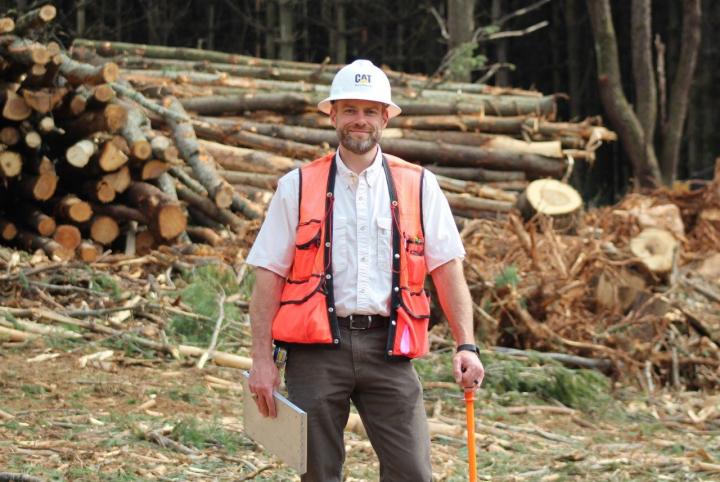
To better understand the challenges and potential gains of harvesting residues, Associate Professor Chad Bolding of Virginia Tech’s College of Natural Resources and Environment will participate in a large-scale collaborative project with three other universities to examine forest residue collection across the eastern United States and determine how to make residues an economically viable resource.
Funded with a $1 million grant from the U.S. Department of Agriculture’s Agriculture and Food Research Initiative, Virginia Tech will work collaboratively with Auburn University, the University of Maine, and West Virginia University to develop and optimize forest residue collection while examining the environmental impacts and economic potentials for the eastern U.S.
“A goal of this project is to determine the procedures used and the profitability of residue collection in the eastern United States,” Bolding explained, “and to see if we can optimize the system by reducing costs and making residues a more viable option as a renewable energy source.”
To understand the specific challenges, the collaborators have divided the eastern U.S. into four regions: northeast, upper mid-Atlantic, lower mid-Atlantic, and southeast. Virginia Tech will focus on the lower mid-Atlantic states: Kentucky, North Carolina, South Carolina, Tennessee, and Virginia.
“Each of the four regions is unique in terrain, tree species, and climate,” Bolding noted. “Even within each region, there are different variables to contend with. Virginia, North Carolina, and South Carolina are important forestry states, with slopes that are more gentle and easier to grow and harvest plantation forests on short rotations.
“Kentucky and Tennessee have steeper slopes and more hardwood trees, and forestry is less central to their economy,” he continued. “We will diversify our research strategy to better understand those differences and use that information to extrapolate broader conclusions.”
One aspect of forest residue collection that Bolding will be focusing on is the environmental impacts of removing residue from forests.
“When residues are removed from the forest, there’s a potential to expose more bare soil, which can lead to erosion and sedimentation,” he said. “Our research will investigate harvest sites across the region to estimate potential soil erosion and determine compliance with water quality best management practices. We will also suggest methods for improvement if necessary.”
The grant funding, which will cover three years of research, is part of the Agriculture and Food Research Initiative’s commitment to improve rural economies by stimulating new ventures in biological resource utilization. Part of the project will be the doctoral work of Austin Garren, a doctoral student in Virginia Tech’s Department of Forest Resources and Environmental Conservation.
For Bolding, the joint efforts of the four universities are an opportunity to capitalize on the research strengths of each school while allowing a broader collaborative effort with partners and companies in the forest industry.
“It’s a very exciting project to be working on,” Bolding said. “It’s very challenging, but by working regionally, I think it will be easier to get a clearer picture of what’s taking place across the eastern United States and where we can go next. I think this work is going to greatly expand what we know about residue collection, and it could have a positive impact on renewable energy in the eastern U.S.”
###
Media Contact
Krista Timney
[email protected]
Original Source
https:/