Researchers at the University of Oxford have, for the first time, captured the step-by-step assembly of individual virus-like particles as they happen, molecule by molecule, rather than inferring the process from before-and-after snapshots. The work, published on 16 September in Nature, reveals how simple molecular interactions between protein building blocks can reliably construct complex biological structures even when there are thousands of possible ways for those components to fit together. The achievement offers a molecular-level view of how the protein shells associated with viruses can spontaneously and reliably assemble from their individual components, a question that has occupied scientists for decades.
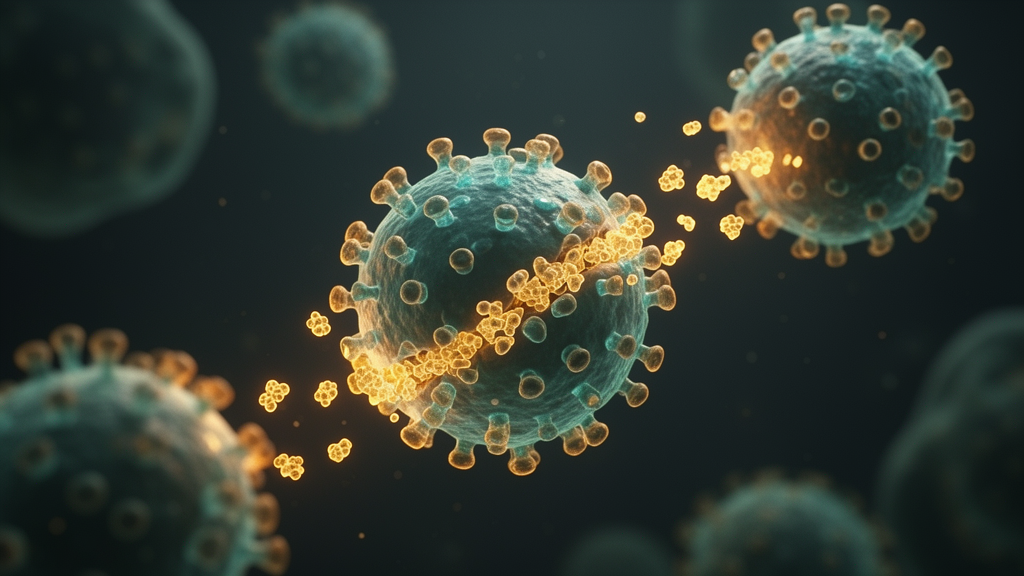
Viruses protect their genetic material inside precisely organised protein shells called capsids. These structures can contain tens or even thousands of protein components, yet in many viruses their building blocks spontaneously assemble into the correct shape without any blueprint or external machinery directing the process. Understanding how viruses assemble, and what can disrupt this process, could ultimately help researchers design novel antiviral treatments, as well as engineer vaccines and other therapies. The new study provides a direct experimental window onto that construction problem at the level of single molecules.
Scientists have studied viral assembly for a long time, but observing it directly has proved extremely difficult. Crucial intermediate structures are scarce and often short-lived, meaning that conventional experiments can show researchers what is present before and after assembly without necessarily revealing the molecular steps connecting the two. The Oxford team tackled this problem using an engineered virus-like particle made from 60 protein units. They combined mass photometry, a technology developed at Oxford that measures the mass of individual molecules by detecting the light they scatter, with a new method for confining individual molecules so that they could be observed continuously. This allowed the team to effectively weigh a particle repeatedly as new protein components joined it, revealing its growth step by step.
Co-first author PhD student Dan Loewenthal, of the Department of Chemistry and the Kavli Institute for Nanoscience Discovery at Oxford, described the immediacy of the technique in plain terms. This method lets us study the assembly process directly, he said, we just take a video. The ability to follow a single particle continuously, rather than averaging over large ensembles of molecules at different stages, is what distinguishes the new approach from earlier experimental strategies that could only reconstruct the assembly pathway indirectly.
The study found that the process works rather like finding a route through a maze in which only the productive turns lock into place. Protein building blocks initially make weak, reversible connections, allowing unsuccessful arrangements to fall apart and be tried again. But when the proteins form particular closed structures, their multiple connections make them much more stable. These structures act as a small number of molecular waypoints, progressively funnelling an otherwise highly complex process towards the completed particle. In this way, an assembly process with an enormous number of theoretically possible routes is channelled through a relatively small number of productive stages.
A crucial moment occurs when five larger protein building blocks form a closed pentagonal ring, the first particularly stable structure in the pathway. After this step, fewer protein building blocks are needed to reach each new stable stage, allowing the assembly process to speed up. The findings also explain why the difficult initial step, known as nucleation, is followed by much faster growth once assembly is underway. The weak interactions give the system room to make mistakes, explained co-lead author Dr Roi Asor, also of the Department of Chemistry and the Kavli Institute for Nanoscience Discovery. Most encounters do not have to be successful: the components can separate and try again. But once enough of them come together in the right closed arrangement, the structure becomes stable and assembly can move forward. That combination of trial and error followed by locking in successful structures is what makes the process so reliable, he said.
Dr Asor framed the scale of the problem that viruses solve in striking terms. A virus has to solve an extraordinary construction problem, he said. Its components somehow have to find the right arrangement among a huge number of possibilities, without a blueprint or machinery directing the process. We can now watch what happens molecule by molecule and see the physical rules that make it possible. The new observations turn what had been a theoretical description of self-assembly into a set of experimentally observed rules governing how individual protein units join, detach and finally lock into place.
Co-lead author Professor Philipp Kukura, of the Department of Chemistry and the Kavli Institute for Nanoscience Discovery at Oxford, emphasised how the new capability changes the field. Until now, much of our understanding of how these structures assemble has had to be reconstructed from snapshots or theoretical models, he said. Being able to both quantify the underlying interactions and follow one particle as it grows changes that. We can see the important intermediate structures appear and deduce a detailed model of the construction process. The combination of quantitative interaction measurements and continuous single-particle tracking is what allows the intermediate structures, previously invisible to conventional methods, to be identified and placed in sequence.
Co-author Dr Jack Tan, of the MRC Weatherall Institute of Molecular Medicine and the CAMS-Oxford Institute, noted that the ability to understand these processes at the molecular level could have important applications in vaccine development and in antivirals that disrupt viral assembly. The researchers caution that these are potential directions suggested by the findings rather than immediate outcomes; the study itself concerns the fundamental mechanism of assembly in an engineered virus-like particle, not the efficacy of any new drug or vaccine. Even so, the principle could extend well beyond viruses. Self-assembly is fundamental to biology, underpinning structures ranging from the cellular skeleton to molecular compartments and protein complexes, and the researchers say their approach provides a way to investigate these processes one molecule at a time.
The study, titled Molecular-level observation of the self-assembly of a virus-like particle, was published in Nature on 16 September 2026. By showing that a complex biological construction process can be watched in real time at the level of individual molecules, the work opens the door to applying the same single-particle observation strategy to other self-assembling biological systems. For now, the immediate contribution is a detailed, experimentally grounded model of how a 60-unit virus-like particle builds itself: through weak reversible contacts that permit repeated trial and error, a small set of stable closed intermediates that act as waypoints, a decisive pentagonal ring that marks the onset of rapid growth, and the progressive locking-in of successful structures that carries the particle all the way to completion.
Subject of Research: Direct molecular-level observation of the self-assembly of a virus-like particle
Article Title: New method reveals how virus particles can build themselves, molecule by molecule
Article References: New method reveals how virus particles can build themselves, molecule by molecule. Original publication (Bibliographic details unavailable.)
Image Credits: AI Generated
DOI: Not provided
Keywords: virus-like particle, self-assembly, capsid, mass photometry, nucleation, protein shells, antivirals, vaccine development, University of Oxford, Nature, molecular biology, biophysics
News Source: Kristina Jarvis. (October 27, 2026). Researchers watch a virus-like particle assemble itself, one molecule at a time. Scienmag.