WASHINGTON — Researchers have reported the first 3D measurements acquired with quantum ghost imaging. The new technique enables 3D imaging on a single photon level, yielding the lowest photon dose possible for any measurement.
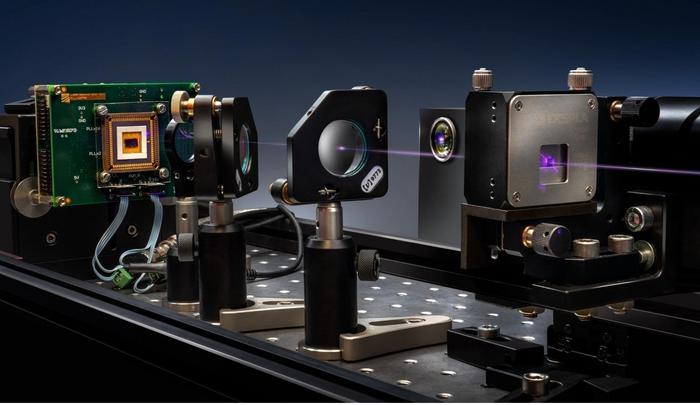
Credit: Fraunhofer IOSB/indigo
WASHINGTON — Researchers have reported the first 3D measurements acquired with quantum ghost imaging. The new technique enables 3D imaging on a single photon level, yielding the lowest photon dose possible for any measurement.
“3D imaging with single photons could be used for various biomedical applications, such as eye care diagnostics,” said researcher Carsten Pitsch from the Fraunhofer Institute of Optronics, System Technologies and Image Exploitation and Karlsruhe Institute of Technology, both in Germany. “It can be applied to image materials and tissues that are sensitive to light or drugs that become toxic when exposed to light without any risk of damage.”
In the Optica Publishing Group journal Applied Optics, the researchers describe their new approach, which incorporates new single photon avalanche diode (SPAD) array detectors. They apply the new imaging scheme, which they call asynchronous detection, to perform 3D imaging with quantum ghost imaging.
“Asynchronous detection might also be useful for military or security applications since it could be used to observe without being detected while also reducing the effects of over-illumination, turbulence and scattering,” said Pitsch. “We also want to investigate its use in hyperspectral imaging, which could allow multiple spectral regions to be recorded simultaneously while using a very low photon dose. This could be very useful for biological analysis.”
Adding a third dimension
Quantum ghost imaging creates images using entangled photon-pairs in which only one member of the photon pair interacts with the object. The detection time for each photon is then used to identify entangled pairs, which allows an image to be reconstructed. This approach not only allows imaging at extremely low light levels but also means that the objects being imaged do not have to interact with the photons used for imaging.
Previous setups for quantum ghost imaging were not capable of 3D imaging because they relied on intensified charge-coupled device (ICCD) cameras. Although these cameras have good spatial resolution, they are time-gated and don’t allow the independent temporal detection of single photons.
To solve this problem, the researchers developed a setup based on new single photon avalanche diode (SPAD) arrays developed for LiDAR and medical imaging. These detectors have multiple independent pixels with dedicated timing circuitry, which allows them to record the detection time of every pixel with picosecond resolution.
The new approach uses two entangled photons — a signal and an idler — to obtain 3D images with single photon illumination. This involves directing the idler photons onto the object and then detecting the backscattered photons in time. Meanwhile, the signal photons are directed to a dedicated camera that detects as many photons as possible in both time and space. The researchers then compared the time of detection of every pixel with the detection of the single-pixel detector to reconstruct the entanglement. This also allowed them to determine the time of flight of the interacting idler photons, and with that, the depth of the object.
An adaptable setup
Another key innovation was periodic poling of the KTP crystal used to create the entangled photons. “This allows highly efficient quasi-phase matching for nearly any triplet of pump-signal-idler and lets us freely choose the wavelengths for illumination and imaging,” said Pitsch. “It also lets us adapt the setup to many other applications or wavelengths.”
The researchers demonstrated the 3D capabilities of their asynchronous detection scheme using two different separate setups. One, which resembled a Michelson interferometer, acquired images using two spatially separated arms. This setup allowed the researchers to analyze the SPAD performance and improve the coincidence detection. The other setup used free-space optics and was more application centered. Instead of imaging with two separated arms, two objects in the same arm were imaged.
Although more work is needed, both setups worked well as a proof-of-concept demonstration for the new technique. The experiments also showed that asynchronous detection could be used for remote detection, which could be useful for atmospheric measurements.
The researchers are now working with a SPAD manufacturer to increase the spatial resolution and duty cycle – the percentage of time the detector is on – for the SPAD cameras. They also plan to replace the fiber-coupled idler detector with a faster free-space coupled detector that became available recently. Finally, they plan to apply the setup to hyperspectral imaging, which could be used to perform imaging in the important mid-infrared spectrum without the need for detectors that work at these wavelengths.
Paper: C. Pitsch, D. Walter, L. Gasparini, H. Bursing, M. Eichhorn, “3D Quantum Ghost Imaging,” Applied Optics, vol. 62, issue 23, pp. 6275-6281 (2023).
DOI: doi.org/10.1364/AO.492208
About Applied Optics
Applied Optics publishes in-depth peer-reviewed content about applications-centered research in optics. These articles cover research in optical technology, photonics, lasers, information processing, sensing and environmental optics. Applied Optics is published three times per month by Optica Publishing Group and overseen by Editor-in-Chief Gisele Bennett, MEPSS LLC and Georgia Institute of Technology, USA. For more information, visit Applied Optics.
About Optica
Optica Publishing Group is a division of Optica (formerly OSA), Advancing Optics and Photonics Worldwide. It publishes the largest collection of peer-reviewed content in optics and photonics, including 18 prestigious journals, the society’s flagship member magazine, and papers from more than 835 conferences, including 6,500+ associated videos. With over 400,000 journal articles, conference papers and videos to search, discover and access, Optica Publishing Group represents the full range of research in the field from around the globe.
Journal
Applied Optics
DOI
10.1364/AO.492208
Article Title
3D Quantum Ghost Imaging
Article Publication Date
8-Aug-2023