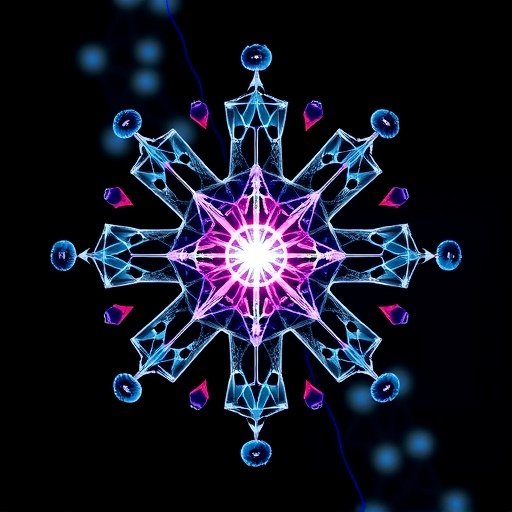
In a groundbreaking development at The University of Osaka, researchers have unveiled a novel phenomenon of spontaneous chiral symmetry breaking (CSB) within a single organic crystal. This extraordinary discovery highlights a solid-state transition wherein an achiral crystalline compound transforms into a chiral form without the intervention of external solvents or impurities. The implications of this finding stretch across the realms of fundamental chemistry and material science, offering a simplified and experimentally accessible model to unravel the deep-seated mechanisms behind biological homochirality—a mystery that has long confounded scientists.
Chirality—an intrinsic “handedness” present in structures ranging from cosmic to molecular scales—is foundational to countless natural phenomena. Most notably, life’s molecular building blocks, such as amino acids and sugars, exhibit remarkable uniformity by existing almost exclusively as one enantiomer, a phenomenon called biological homochirality. Despite decades of intensive research, the origin of this striking molecular asymmetry remains elusive. The conventional theories have often centered on complex solution-based systems exhibiting CSB behaviors. However, these environments present significant analytical challenges due to the presence of multiple interacting components and dynamic equilibria.
The Osaka research team’s work breaks new ground by demonstrating that CSB can occur in a crystalline solid-state environment. By focusing on a chiral phenothiazine derivative, they observed a crystal that initially exhibits achirality transform into a chiral state, all while retaining its single-crystal nature. This unanticipated inversion of molecular chirality within the crystal lattice happens autonomously, without external chemical or physical stimuli, signifying a spontaneous, intrinsic property of the molecular assembly. This phenomenon offers a drastically streamlined experimental platform to dissect the principles governing chiral selection.
.adsslot_LAUzPqv9VO{ width:728px !important; height:90px !important; }
@media (max-width:1199px) { .adsslot_LAUzPqv9VO{ width:468px !important; height:60px !important; } }
@media (max-width:767px) { .adsslot_LAUzPqv9VO{ width:320px !important; height:50px !important; } }
ADVERTISEMENT
One of the critical advantages of this discovery lies in the accessibility of advanced crystallographic techniques to probe the structural changes at an atomic level. Utilizing sophisticated X-ray diffraction methods, the researchers could trace the precise molecular rearrangements occurring during the symmetry-breaking transition. Unlike solution-based CSB dynamics, which are often ephemeral and complex, the solid-state process unfolds in a stable, well-defined lattice setting. This stability permits detailed visualization and quantification of subtle molecular displacements and conformational changes that collectively yield the macroscopic chiral crystal.
The mechanism underpinning this spontaneous chiral symmetry breaking is thought to stem from subtle intermolecular interactions within the crystal lattice that favor one chiral conformation over its mirror image. These interactions induce a collective, cooperative rearrangement of molecules, resulting in a stable chiral phase. This phase transition is unprecedented in organic materials, as previous observations of CSB predominantly involved crystallization from solution or chiral additives driving enantiomeric excess. The Osaka discovery refines the conceptual framework, showing that intrinsic molecular architecture and packing forces alone can trigger CSB in the tightly confined solid state.
Remarkably, this chiral transition also imparts unique optical properties. The researchers demonstrated that circularly polarized luminescence (CPL), an emission phenomenon sensitive to molecular chirality, “turns on” upon the symmetry-breaking event. This on/off switchability of CPL not only offers profound insights into the interplay between molecular symmetry and photophysical behavior but also opens avenues for designing next-generation optical materials. Such materials with tunable circular polarization responses could revolutionize fields including optoelectronics, bioimaging, and information security technologies.
The significance of this research extends beyond the immediate chemical sciences community. By establishing a robust, model system for chiral symmetry breaking, the findings pave the way for a deeper understanding of life’s molecular origins. Life’s reliance on single-handed chiral molecules and their assemblies is essential for enzymatic activity, genetic fidelity, and metabolic pathways. Unraveling how such molecular asymmetry can arise spontaneously remains critical for origin-of-life research, synthetic biology, and the development of chiral drugs with targeted biological effects.
Dr. Ryusei Oketani, the lead investigator, emphasized the importance of this discovery by noting the profound link between fundamental chirality and practical applications. “Understanding how chiral bias emerges at the molecular level is not only a matter of scientific curiosity,” he explained, “but also directly relevant to the efficient synthesis of pharmaceuticals and advanced materials where chirality dictates function.” Indeed, many drugs rely on single-enantiomer forms for efficacy and safety, and new methods to control and generate chirality in solid phases promise transformative advances in pharmaceutical manufacturing.
Aside from chiral pharmaceuticals, materials with solid-state chiral properties hold promise for emerging electronic and photonic technologies. The ability to induce and control chiral phases in crystalline materials may lead to innovative sensors, switches, and enantioselective catalysts. The reported CPL activation further suggests potentials in quantum computing and communication systems, where polarization states of light are exploited for high-density information encoding and transmission.
The Osaka team’s experimental approach combined rigorous crystallographic analyses with photophysical characterizations, demonstrating how molecular design and crystal engineering can synergize to provoke spontaneous symmetry breaking. This strategy highlights the power of molecular frameworks that are precisely tailored to navigate the narrow energetic landscape between achiral and chiral states, enabling controlled explorations of phase transitions. Their findings encourage broader application of solid-state chemistry techniques to probe fundamental symmetry dynamics in molecular materials.
By leveraging the stability and simplicity of a single crystal system, this research circumvents many complexities inherent in liquid-phase CSB studies. This simplicity is critical for theoretical modeling and computational simulations, which can now be more reliably anchored to direct experimental observations. The new insights gained from this work thus build a solid foundation for predictive modeling of chirality emergence, which is essential for rational design in both scientific and industrial contexts.
In summary, The University of Osaka’s discovery of spontaneous chiral symmetry breaking in a single crystal not only challenges existing paradigms that have largely focused on solution-phase chirality but also provides a fertile testing ground for fundamental chemistry and materials science. This newfound ability to observe and manipulate chirality within a single crystal opens fertile avenues for advancing our understanding of life’s molecular origins while simultaneously fostering the next generation of chiral materials with sophisticated optical functionalities. The phenomenal breadth of implications could mark a transformative milestone in both theoretical and applied sciences.
Subject of Research: Not applicable
Article Title: Spontaneous chiral symmetry breaking in a single crystal
News Publication Date: 19-Aug-2025
References:
Oketani, R., et al. Spontaneous chiral symmetry breaking in a single crystal. Chemical Science, Royal Society of Chemistry, 2025. DOI: 10.1039/D5SC02623G.
Image Credits:
Credit: 2025, Ryusei Oketani et al., Spontaneous chiral symmetry breaking in a single crystal, Chemical Science.
Keywords
Physical sciences, Chemistry, Molecular chemistry, Chirality
Tags: achiral to chiral transformationbiological homochirality mechanismschallenges in studying chiralitychiral phenothiazine derivativeschiral symmetry in organic crystalsexperimental models in material sciencefundamental chemistry discoveriesimplications of chirality in naturemolecular handedness in chemistrynovel findings in crystallographysolid-state transitions in materialsspontaneous chiral symmetry breaking