

• HOME
  • NEWS
  • EXPLORE
    • CAREER
      • Companies
      • Jobs
    • EVENTS
    • iGEM
      • News
      • Team
    • PHOTOS
    • VIDEO
    • WIKI
  • BLOG
  • COMMUNITY
    • FACEBOOK
    • INSTAGRAM
    • TWITTER
Monday, July 6, 2026
BIOENGINEER.ORG
No Result
View All Result
  • Login
  • HOME
  • NEWS
  • EXPLORE
    • CAREER
      • Companies
      • Jobs
        • Lecturer
        • PhD Studentship
        • Postdoc
        • Research Assistant
    • EVENTS
    • iGEM
      • News
      • Team
    • PHOTOS
    • VIDEO
    • WIKI
  • BLOG
  • COMMUNITY
    • FACEBOOK
    • INSTAGRAM
    • TWITTER
  • HOME
  • NEWS
  • EXPLORE
    • CAREER
      • Companies
      • Jobs
        • Lecturer
        • PhD Studentship
        • Postdoc
        • Research Assistant
    • EVENTS
    • iGEM
      • News
      • Team
    • PHOTOS
    • VIDEO
    • WIKI
  • BLOG
  • COMMUNITY
    • FACEBOOK
    • INSTAGRAM
    • TWITTER
No Result
View All Result
Bioengineer.org
No Result
View All Result
Home NEWS Science News Health

Researchers uncover molecular mechanisms of rare skin disease

Bioengineer by Bioengineer
August 1, 2018
in Health
Reading Time: 2 mins read
0
Share on FacebookShare on TwitterShare on LinkedinShare on RedditShare on Telegram
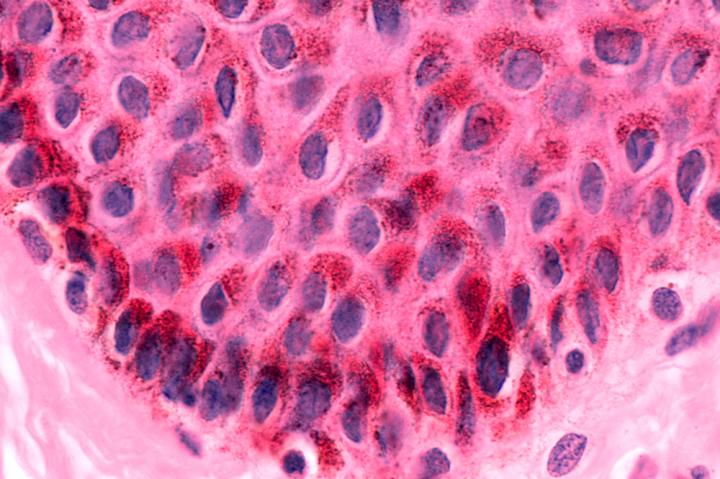
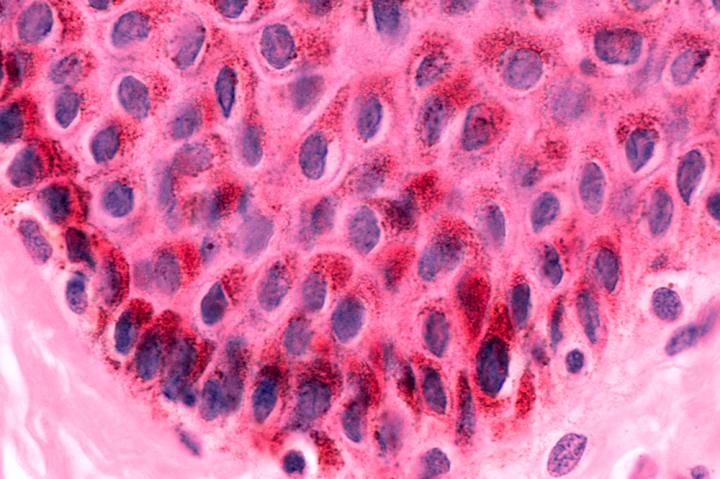
IMAGE

Credit: The Rockefeller University

Keratinocyte skin cells are common targets of the beta subtype of human papilloma virus. This usually harmless infection causes skin disease in people with rare gene mutations.[/caption]

You're probably infected with one or more subtypes of the human papilloma virus–and, as alarming as that may sound, odds are you will never show any symptoms. The beta subtype of the virus, ß-HPV, is widespread in the general population and the least pathogenic; in fact, most carriers don't even know that they have it.

Yet, in people with the rare disease epidermodysplasia verruciformis (EV), some of these viruses cause skin lesions known as flat warts; later in life they can also cause to skin cancer.

Led by Rockefeller scientist Jean-Laurent Casanova, head of the St. Giles Laboratory of Human Genetics of Infectious Diseases, a group of researchers recently elucidated the molecular mechanisms that make people with EV vulnerable to ß-HPVs. In a new study, published in the Journal of Experimental Medicine, the scientists trace the disease to changes in a group of proteins that normally protect skin cells from the viruses.

Cracks in the armor

In patients with EV, ß-HPVs infect skin cells known as keratinocytes and provoke their proliferation. Searching for genetic causes of the disease, Casanova's team found that it is sometimes associated with mutations in a human gene coding for the protein CIB1.

They observed that individuals with CIB1 deficiency have symptoms identical to those with mutations to EVER1 or EVER2, two genes previously linked to EV. The researchers also noted that patients with EVER1 or EVER2 mutations have very low levels of CIB1, suggesting that the three proteins interact.

The scientists concluded that EVER1, EVER2, and CIB1 form a protein unit that, when functioning correctly, protects keratinocytes from ß-HPVs. If any part of this unit is compromised, however, the viruses are able to replicate and lead to pathological transformations of skin cells.

A flawed virus finds a hospitable host

ß-HPVs are, in a sense, defective: they fail to make two proteins, E5 or E8, which are produced by all other subtypes of HPVs and can occasionally cause common warts. Both E5 and E8 interact with CIB1. Without these proteins, Casanova says, ß-HPVs are no match for the CIB1-EVER1-EVER2 unit, which prevents them from harming cells.

Casanova posits that people with EV are vulnerable to ß-HPVs because their own genetic irregularities nullify those of the viruses. That is, the viruses can compensate for their missing proteins because the corresponding human defense mechanism is awry.

"When people have mutations in CIB1, EVER1 or EVER2, the ß-HPVs can promote the growth of keratinocytes–and can form warts and cancer–because there's nothing to stop them, even though they are intrinsically defective, lacking E5 and E8" he says.

###

Media Contact

Lori Chertoff
[email protected]
212-327-7741
@rockefelleruniv

http://www.rockefeller.edu

Original Source

https://www.rockefeller.edu/news/23487-researchers-uncover-molecular-mechanisms-rare-skin-disease/ http://dx.doi.org/10.1084/jem.20170308
Share12Tweet7Share2ShareShareShare1

Related Posts

Flame retardant BDE-209 targets molecularly linked to ulcerative colitis

July 6, 2026

Kidney transplant outcomes in older adults studied by German researchers

July 6, 2026

Salmonella protein SopB curbs early inflammation to slow disease progression

July 6, 2026

Multi-metal cooperation drives lung cancer chemoresistance, reversed by MiADMSA

July 6, 2026
Please login to join discussion

POPULAR NEWS

  • Detection of EDCs in Breast Milk and Infant Urine Up to Six Months Highlights Early Exposure Risks

    77 shares
    Share 31 Tweet 19
  • New Drug Candidate Developed at McMaster Shows Potential for Treating Brain Cancer

    58 shares
    Share 23 Tweet 15
  • Saying Goodbye to PGY-6: Pediatric Fellowship Realities

    103 shares
    Share 41 Tweet 26
  • KTU Researchers Explore Ultrasound’s Role in Enhancing Blood Flow Beyond Diagnostics

    53 shares
    Share 21 Tweet 13

About

We bring you the latest biotechnology news from best research centers and universities around the world. Check our website.

Follow us

Recent News

Flame retardant BDE-209 targets molecularly linked to ulcerative colitis

Ultra-high frequency particle impacts mimic rockbursts to shatter hard rock

Kidney transplant outcomes in older adults studied by German researchers

Subscribe to Blog via Email

Enter your email address to subscribe to this blog and receive notifications of new posts by email.

Join 83 other subscribers
  • Contact Us

Bioengineer.org © Copyright 2023 All Rights Reserved.

Welcome Back!

Login to your account below

Forgotten Password?

Retrieve your password

Please enter your username or email address to reset your password.

Log In
No Result
View All Result
  • Homepages
    • Home Page 1
    • Home Page 2
  • News
  • National
  • Business
  • Health
  • Lifestyle
  • Science

Bioengineer.org © Copyright 2023 All Rights Reserved.