

• HOME
  • NEWS
  • EXPLORE
    • CAREER
      • Companies
      • Jobs
    • EVENTS
    • iGEM
      • News
      • Team
    • PHOTOS
    • VIDEO
    • WIKI
  • BLOG
  • COMMUNITY
    • FACEBOOK
    • INSTAGRAM
    • TWITTER
Tuesday, July 7, 2026
BIOENGINEER.ORG
No Result
View All Result
  • Login
  • HOME
  • NEWS
  • EXPLORE
    • CAREER
      • Companies
      • Jobs
        • Lecturer
        • PhD Studentship
        • Postdoc
        • Research Assistant
    • EVENTS
    • iGEM
      • News
      • Team
    • PHOTOS
    • VIDEO
    • WIKI
  • BLOG
  • COMMUNITY
    • FACEBOOK
    • INSTAGRAM
    • TWITTER
  • HOME
  • NEWS
  • EXPLORE
    • CAREER
      • Companies
      • Jobs
        • Lecturer
        • PhD Studentship
        • Postdoc
        • Research Assistant
    • EVENTS
    • iGEM
      • News
      • Team
    • PHOTOS
    • VIDEO
    • WIKI
  • BLOG
  • COMMUNITY
    • FACEBOOK
    • INSTAGRAM
    • TWITTER
No Result
View All Result
Bioengineer.org
No Result
View All Result
Home NEWS Science News Health

Researchers study lingering Lyme disease symptoms

Bioengineer by Bioengineer
July 14, 2023
in Health
Reading Time: 2 mins read
0
Researchers
Share on FacebookShare on TwitterShare on LinkedinShare on RedditShare on Telegram

An estimated 1,200 Americans, on average, are diagnosed with Lyme disease each day. Some of those patients continue to experience negative effects, even after treatment.
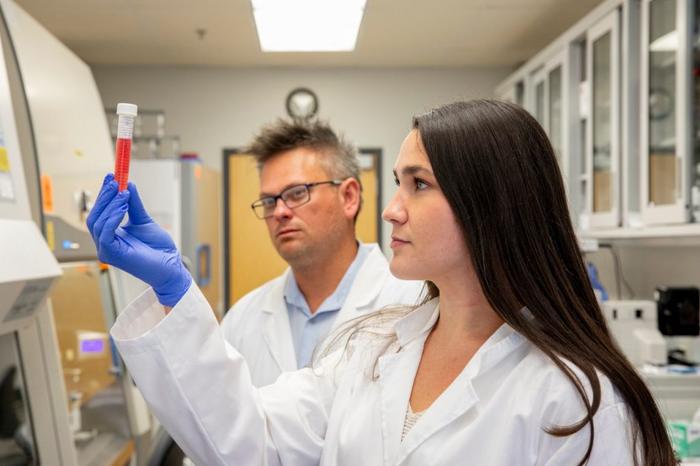
Researchers

Credit: Virginia Tech

An estimated 1,200 Americans, on average, are diagnosed with Lyme disease each day. Some of those patients continue to experience negative effects, even after treatment.

Lyme disease researcher Brandon Jutras, associate professor in the College of Agriculture and Life Sciences and affiliated faculty of the Fralin Life Sciences Institute, recently received a $2.7 million grant from the National Institute of Allergy and Infectious Diseases, part of the National Institutes of Health, to study what causes the disease to linger long after treatment.

“Using a series of sophisticated molecular techniques, in combination with both bacterial and host genetics, we’re working to understand why and how some patients respond to therapy, while others do not,” said Jutras, the lead investigator in the Department of Biochemistry and an affiliate faculty member in the Center for Emerging, Zoonotic, and Arthropod-borne Pathogens. “Our two-pronged approach looks at this problem from both sides: What unique chemical features of the bacterium’s cell wall are responsible for causing symptoms and what genetic factors from the host-response side play a role in sustained pathology”.

Previously, Jutras discovered that:

  • The disease-causing agent sheds part of its cell wall into its environment.
  • This molecule can be detected in patients’ months after antibiotic treatment.
  • The bacterium that causes Lyme disease has a highly unusual modification in its protective molecular bag that allows it to move easier.
  • And that the cell wall alone is capable of causing symptoms similar to those experience by patients.

This research builds upon the previous discoveries and will determine what about the cell wall makes patients sick and define new strategies, such as monoclonal antibody therapy, to improve Lyme disease patient health when previous treatments have failed.

“We recognize this is an issue and that patients have these long-term symptoms, but we don’t know why,” said Mecaila McClune, who is a key member of the research team and a graduate student in the Jutras lab. “This is what my research is trying to determine what’s going on and how we can treat the persistent effects of the disease, which will improve quality of life going forward.”

These new studies were facilitated by earlier support from the Global Lyme Alliance and Bay Area Lyme Foundation and continue an active collaboration with GlycoMIP, and both the University of Virginia and the Medical College of Wisconsin.



Share12Tweet8Share2ShareShareShare2

Related Posts

Flame retardant BDE-209 targets molecularly linked to ulcerative colitis

July 6, 2026

Kidney transplant outcomes in older adults studied by German researchers

July 6, 2026

Salmonella protein SopB curbs early inflammation to slow disease progression

July 6, 2026

Multi-metal cooperation drives lung cancer chemoresistance, reversed by MiADMSA

July 6, 2026

POPULAR NEWS

  • Detection of EDCs in Breast Milk and Infant Urine Up to Six Months Highlights Early Exposure Risks

    77 shares
    Share 31 Tweet 19
  • New Drug Candidate Developed at McMaster Shows Potential for Treating Brain Cancer

    58 shares
    Share 23 Tweet 15
  • Saying Goodbye to PGY-6: Pediatric Fellowship Realities

    103 shares
    Share 41 Tweet 26
  • KTU Researchers Explore Ultrasound’s Role in Enhancing Blood Flow Beyond Diagnostics

    53 shares
    Share 21 Tweet 13

About

We bring you the latest biotechnology news from best research centers and universities around the world. Check our website.

Follow us

Recent News

Flame retardant BDE-209 targets molecularly linked to ulcerative colitis

Ultra-high frequency particle impacts mimic rockbursts to shatter hard rock

Kidney transplant outcomes in older adults studied by German researchers

Subscribe to Blog via Email

Enter your email address to subscribe to this blog and receive notifications of new posts by email.

Join 83 other subscribers
  • Contact Us

Bioengineer.org © Copyright 2023 All Rights Reserved.

Welcome Back!

Login to your account below

Forgotten Password?

Retrieve your password

Please enter your username or email address to reset your password.

Log In
No Result
View All Result
  • Homepages
    • Home Page 1
    • Home Page 2
  • News
  • National
  • Business
  • Health
  • Lifestyle
  • Science

Bioengineer.org © Copyright 2023 All Rights Reserved.