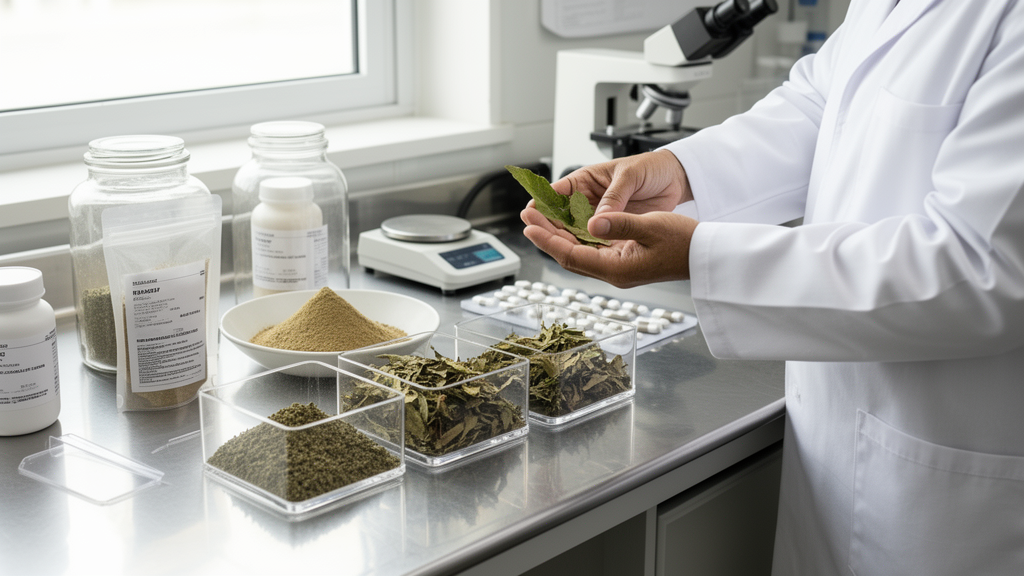
A 2026 perspective in Frontiers in Pharmacology argues that the fast-changing United States kratom market can no longer be governed under a single umbrella label. The authors recommend a four-part classification system that distinguishes traditional leaf and botanical preparations from concentrated extracts, natural-ratio isolates, altered alkaloid fractions and synthetic compounds. Their central recommendation is that products made from transformed or synthetic kratom alkaloids should be treated as novel, unapproved drugs, while properly identified leaf and traditional preparations remain eligible for regulation as dietary ingredients. The proposal is intended as a practical reference for manufacturers and federal, state and local agencies, rather than as a new clinical trial or laboratory study.
The need for clearer boundaries has been amplified by rapid product innovation. Kratom, derived from the tree Mitragyna speciosa, has long been consumed in Southeast Asia as fresh or dried leaves, including through chewing, brewing and aqueous preparations. Its contemporary US market is more diverse, extending to powders, capsules, tablets, gummies, tea bags, liquid shots and other formulations. The abstract cites an estimated 10 to 16 million US consumers. Surveys describe use for pain, mental health conditions, withdrawal symptoms and general wellness, but these reports are observational and often cannot identify the exact product involved. As a result, they cannot reliably establish which product composition is associated with any particular adverse outcome.
Native kratom leaf is chemically complex, containing alkaloids alongside flavonoids, polyphenolic compounds, triterpenoids, saponins, monoterpenes and secoiridoids. The proposed definition focuses on four principal alkaloids: mitragynine, paynantheine, speciogynine and speciociliatine. Mitragynine is generally the most abundant, representing a reported 51% to 82% of the alkaloid fraction, although it usually remains below 2.5% of total leaf weight. The framework sets an expected mitragynine range of 0.5% to 2.5% by dried leaf weight, with each of the other three major alkaloids at 0.1% to 1.0%. It also proposes a total alkaloid content below 3.0%.
A particularly consequential distinction concerns 7-hydroxymitragynine, or 7-HMG. It was initially considered a naturally occurring leaf constituent but is now recognized as an oxidative metabolite of mitragynine, detectable at trace levels in some post-harvest materials. The authors state that it should not exceed 0.01% by weight under their definition of unaltered leaf. This matters because its pharmacology differs sharply from that of mitragynine. A cited experimental study reported respiratory depression from 7-HMG comparable to morphine that was reversed by naloxone, whereas mitragynine increased respiratory frequency and was unaffected by naloxone. These are experimental findings about the compounds, not evidence that every kratom product produces those effects in users.
Category 1 covers traditional botanical preparations, including teas, decoctions and aqueous or aqueous-ethanol fluidized extracts containing less than 10% alkaloids. Category 2 covers more concentrated material, divided into semi-purified extracts with 10% to 40% alkaloids and purified extracts with 40% to 60%. Category 3 applies to isolates containing more than 60% alkaloids. Category 3a may qualify as a dietary ingredient when an isolate preserves the natural alkaloid ratios and no chemical alteration has occurred. Category 3b comprises isolated fractions or compounds that do not reflect the plant’s natural composition and that the authors recommend treating as novel drugs.
Category 4 covers substances that are not properly described as kratom: synthetic duplicates of natural alkaloids, chemically altered compounds and other novel drug molecules. Examples include semi-synthetic 7-HMG and mitragynine pseudoindoxyl, as well as synthetic alkaloids derived from 7-HMG or other kratom compounds. The authors argue that purity alone does not make an isolate natural. A product can be derived from the plant yet no longer preserve its chemical composition, which places it outside the scope of the traditional botanical. Their distinction also reflects a difference in evidentiary history: isolated pure kratom alkaloids do not have the same history of use in concentrated form as components commonly present in food, such as caffeine or vanilla.
The policy assessment places the proposal within a fragmented legal environment. The US Food and Drug Administration changed its treatment of kratom from an unapproved drug in 2012 to a dietary ingredient and new dietary ingredient in 2013. The Drug Enforcement Administration proposed scheduling mitragynine and 7-HMG in 2016 but later rescinded that action. In July 2025, the FDA recommended restricting 7-HMG products and proposed that the DEA schedule 7-HMG, while leaving kratom leaf products outside that recommendation; the perspective says no federal scheduling action had been taken by publication. State policies vary widely, encompassing bans, age restrictions, alkaloid limits, serving-size rules, labeling requirements and consumer-protection laws.
The authors reject what they describe as two equally inadequate extremes: blanket inaction and an unsupported ban on all kratom. They argue that inaction would leave concentrated, semi-synthetic and synthetic products exposed to consumers without the safety evidence or regulatory controls expected for conventional products. Conversely, they say available preclinical evidence, observational studies, Southeast Asian history of use and human clinical trials do not justify treating properly labeled leaf and traditional preparations as equivalent to Schedule I compounds. They also cite the World Health Organization’s conclusion that evidence was insufficient to recommend international scheduling. This is a policy assessment based on existing evidence, not a new demonstration that kratom is broadly safe or effective for any particular condition.
Manufacturing recommendations draw on the US dietary-supplement framework, including current good manufacturing practice requirements. Manufacturers would need written specifications for identity, purity, strength, composition and contaminants, supported by scientifically valid testing or examination. Required documentation would include test methods, evidence that those methods are suitable and valid, master manufacturing records, batch records and adverse-event collection. For leaf, Category 1 and Category 2 products, the authors also recommend visible serving measurements, limiting the number of servings in solid packages and providing a measured device for liquids. These measures are intended to reduce confusion and exposure from poorly controlled portions, rather than to imply that a standard serving eliminates risk.
Labeling proposals call for a supplement-facts panel showing the amount of each ingredient per serving and the percent daily value, with “no daily value established” displayed where appropriate for kratom. Labels should list ingredients in descending order of predominance and identify “kratom” in the ingredient list. Additional requested information includes serving size, daily serving recommendations, use instructions and duration, expiration date, a complete ingredient list, mitragynine percentage by weight and lot number. Products should also disclose 7-HMG content per serving or the method’s limit of detection. Suggested warnings cover pregnancy, breastfeeding, medical conditions, medication use, oral-only use, combining the product with alcohol or other drugs, possible physical dependence and discontinuation if adverse effects occur.
For properly prepared leaf and traditional Category 1 products, the perspective derives a recommended maximum of 40 mg mitragynine per serving and no more than two servings, or 80 mg, in 24 hours. The authors say this limit has reasonable assurance of safety when the products are prepared traditionally and used as directed, while stressing that it cannot automatically be applied to concentrated or altered products. For Category 2 extracts, they recommend that manufacturers demonstrate no chemical alteration during processing, obtain ingredient safety data and file the required new-dietary-ingredient notification. Absent such evidence, the same 40 mg limit may be considered only when mitragynine exceeds 40% of total alkaloids and 7-HMG remains below 0.01% on a dry-weight basis. No scientifically supported serving limits are proposed for Category 3b or Category 4 products, which the paper says should be regulated as unapproved drugs.
Subject of Research: Evidence-based product classification and regulation for kratom, extracts and synthetic alkaloid products in the United States
Article Title: Defining kratom: evidence-based policy guidelines for a rapidly evolving market
Article References: Berthold, E., Brown, P. N., Chan, M., Grundmann, O., McCurdy, C. R., Sharma, A., & Singh, D. (2026). Defining kratom: evidence-based policy guidelines for a rapidly evolving market. Frontiers in Pharmacology, 17, 1925809. https://doi.org/10.3389/fphar.2026.1925809
Image Credits: AI Generated
DOI: 10.3389/fphar.2026.1925809
Keywords: kratom, Mitragyna speciosa, mitragynine, 7-hydroxymitragynine, product regulation, dietary supplements, novel drugs, public health, adulteration, United States, Defining, evidence-based
News Source: Ophelia Keating. (October 22, 2026). Researchers propose product-based rules for changing kratom market. Scienmag.