• HOME
  • NEWS
  • EXPLORE
    • CAREER
      • Companies
      • Jobs
    • EVENTS
    • iGEM
      • News
      • Team
    • PHOTOS
    • VIDEO
    • WIKI
  • BLOG
  • COMMUNITY
    • FACEBOOK
    • INSTAGRAM
    • TWITTER
Tuesday, July 14, 2026
BIOENGINEER.ORG
No Result
View All Result
  • Login
  • HOME
  • NEWS
  • EXPLORE
    • CAREER
      • Companies
      • Jobs
        • Lecturer
        • PhD Studentship
        • Postdoc
        • Research Assistant
    • EVENTS
    • iGEM
      • News
      • Team
    • PHOTOS
    • VIDEO
    • WIKI
  • BLOG
  • COMMUNITY
    • FACEBOOK
    • INSTAGRAM
    • TWITTER
  • HOME
  • NEWS
  • EXPLORE
    • CAREER
      • Companies
      • Jobs
        • Lecturer
        • PhD Studentship
        • Postdoc
        • Research Assistant
    • EVENTS
    • iGEM
      • News
      • Team
    • PHOTOS
    • VIDEO
    • WIKI
  • BLOG
  • COMMUNITY
    • FACEBOOK
    • INSTAGRAM
    • TWITTER
No Result
View All Result
Bioengineer.org
No Result
View All Result
Home NEWS Science News Health

Researchers propose a new live-attenuated influenza A vaccine approach

Bioengineer by Bioengineer
July 4, 2022
in Health
Reading Time: 2 mins read
0
Schematic illustration of the generation of PROTAC viruses
Share on FacebookShare on TwitterShare on LinkedinShare on RedditShare on Telegram

A promising strategy to reduce the impact of viral infectious diseases, such as influenza, is the use of attenuated, live viruses as vaccines.
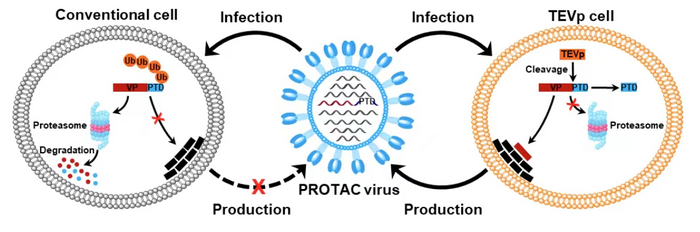
Schematic illustration of the generation of PROTAC viruses

Credit: SI Longlong

A promising strategy to reduce the impact of viral infectious diseases, such as influenza, is the use of attenuated, live viruses as vaccines.

However, the usefulness of traditional live-attenuated virus vaccines has often been limited by suboptimal immunogenicity, safety concerns, or cumbersome manufacturing processes and techniques. In addition, immune escape due to rapid viral evolution poses a further challenge for traditional influenza vaccines.

Recently, a research team led by Prof. SI Longlong from the Shenzhen Institute of Advanced Technology (SIAT) of the Chinese Academy of Sciences has proposed a new live-attenuated influenza vaccine approach — generating proteolysis-targeting chimeric (PROTAC) influenza A virus as a live-attenuated vaccine by utilizing the endogenous ubiquitin-proteasome system of host cells to degrade viral proteins.

The results were published in Nature Biotechnology on July 4.

Given that virus replication depends on virally encoded proteins, manipulation of viral protein stability by utilizing the protein degradation machinery of the host cell may represent a potential approach to switch the viral life cycle on and off for vaccine development. Thus, the researchers designed proteolysis-targeting chimeric (PROTAC) viruses by fusing a conditionally removable proteasome-targeting domain (PTD) to influenza viral proteins.

The PTD was designed to contain a proteasome-targeting peptide and a tobacco etch virus cleavage site (TEVcs) linker. It was used to selectively induce proteasomal degradation of viral proteins of interest; however, the TEVcs linker could be selectively cleaved by the tobacco etch virus protease (TEVp) to separate the viral proteins from the PTD, thus sparing them from degradation.

Accordingly, the researchers engineered the genome of influenza A viruses in TEVp-expressing stable cell lines engineered for virus production to introduce the conditionally removable PTD, generating fully infective PROTAC viruses that were live-attenuated by the host protein degradation machinery upon infection.

In mouse and ferret models, PROTAC viruses were sufficiently attenuated but able to elicit robust and broad humoral, mucosal, and cellular immunity. As a result, they provided broad protection against homologous and heterologous virus challenges.

“This PROTAC vaccine technology could also be useful for generating live-attenuated vaccines against other types of pathogens,” said Prof. SI.


Journal

Nature Biotechnology

DOI

10.1038/s41587-022-01381-4

Article Publication Date

4-Jul-2022

Share12Tweet8Share2ShareShareShare2

Related Posts

GSA Report Spotlights Brain Health Breakthroughs and Primary Care Challenges

July 14, 2026

People With Disabilities Face Much Higher Rates of Alcohol Use Disorder

July 14, 2026

First Space Diagnostic X-rays Signal a New Era for Astronaut Health

July 14, 2026

Treatment delays in colorectal cancer linked to higher metastasis risk thresholds

July 14, 2026

POPULAR NEWS

  • New Drug Candidate Developed at McMaster Shows Potential for Treating Brain Cancer

    58 shares
    Share 23 Tweet 15
  • Detection of EDCs in Breast Milk and Infant Urine Up to Six Months Highlights Early Exposure Risks

    77 shares
    Share 31 Tweet 19
  • Experimental Therapy Simultaneously Destroys Prostate Tumor Cells and Reactivates Antitumor Immunity

    46 shares
    Share 18 Tweet 12
  • 高齢者の骨粗鬆症治療の持続性比較

    51 shares
    Share 20 Tweet 13

About

We bring you the latest biotechnology news from best research centers and universities around the world. Check our website.

Follow us

Recent News

Study finds most pregnant people fail recommended seatbelt placement, despite safety need

Sustained virtual smoking cessation doubles quit rates for cancer patients

Global study links ultrafine air particles to nearly two million premature deaths annually

Subscribe to Blog via Email

Enter your email address to subscribe to this blog and receive notifications of new posts by email.

Join 85 other subscribers
  • Contact Us

Bioengineer.org © Copyright 2023 All Rights Reserved.

Welcome Back!

Login to your account below

Forgotten Password?

Retrieve your password

Please enter your username or email address to reset your password.

Log In
No Result
View All Result
  • Homepages
    • Home Page 1
    • Home Page 2
  • News
  • National
  • Business
  • Health
  • Lifestyle
  • Science

Bioengineer.org © Copyright 2023 All Rights Reserved.