• HOME
  • NEWS
  • EXPLORE
    • CAREER
      • Companies
      • Jobs
    • EVENTS
    • iGEM
      • News
      • Team
    • PHOTOS
    • VIDEO
    • WIKI
  • BLOG
  • COMMUNITY
    • FACEBOOK
    • INSTAGRAM
    • TWITTER
Thursday, March 26, 2026
BIOENGINEER.ORG
No Result
View All Result
  • Login
  • HOME
  • NEWS
  • EXPLORE
    • CAREER
      • Companies
      • Jobs
        • Lecturer
        • PhD Studentship
        • Postdoc
        • Research Assistant
    • EVENTS
    • iGEM
      • News
      • Team
    • PHOTOS
    • VIDEO
    • WIKI
  • BLOG
  • COMMUNITY
    • FACEBOOK
    • INSTAGRAM
    • TWITTER
  • HOME
  • NEWS
  • EXPLORE
    • CAREER
      • Companies
      • Jobs
        • Lecturer
        • PhD Studentship
        • Postdoc
        • Research Assistant
    • EVENTS
    • iGEM
      • News
      • Team
    • PHOTOS
    • VIDEO
    • WIKI
  • BLOG
  • COMMUNITY
    • FACEBOOK
    • INSTAGRAM
    • TWITTER
No Result
View All Result
Bioengineer.org
No Result
View All Result
Home NEWS Science News

Researchers observe new isotope of fluorine

Bioengineer by Bioengineer
March 30, 2021
in Science News
Reading Time: 2 mins read
0
IMAGE
Share on FacebookShare on TwitterShare on LinkedinShare on RedditShare on Telegram

IMAGE

Credit: Image courtesy of Robert J. Charity, Washington University in St. Louis

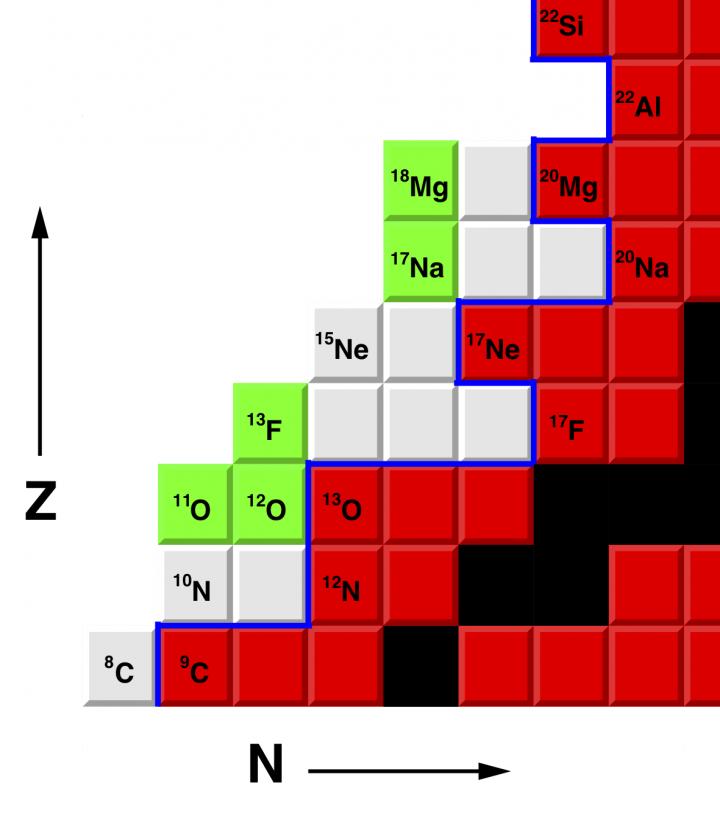
Researchers at Washington University in St. Louis reported the first observations of a new form of fluorine, the isotope 13F, described in the journal Physical Review Letters.

They made their discovery as part of an experiment conducted at the National Superconducting Cyclotron Laboratory at Michigan State University (MSU).

Fluorine is the most chemically reactive element on the periodic table. Only one isotope of fluorine occurs naturally, the stable isotope 19F. The new isotope, 13F, is four neutrons removed from the proton drip line, the boundary that delimits the zone beyond which atomic nuclei decay by the emission of a proton.

Robert J. Charity, research professor of chemistry in Arts & Sciences, and Lee G. Sobotka, professor of chemistry and of physics, worked in collaboration with groups from MSU, Western Michigan University and University of Connecticut to make this discovery.

“Study of exotic nuclei with such large excesses of neutrons or protons is of considerable interest in understanding the synthesis of elements, even though their lifetimes are extremely short,” Charity said. “Many of these isotopes have exotic properties.”

The isotope 13F is the fifth new isotope that Charity and Sobotka have discovered together.

“All the new isotopes are very proton-rich and unstable to the emission of protons,” Charity said. “The highest-energy protons inside these isotopes can tunnel through the Coulomb barrier and escape.”

The initial purpose of the experiment, Charity said, was to make a new isotope of oxygen, dubbed “featherweight oxygen,” a technical achievement previously reported in Physical Review Letters. After making that discovery, the researchers went through their data again with great care and teased out evidence for 13F.

The new isotope of fluorine was created via a charge-exchange reaction with a beam of 13O. (A neutron in the 13O is removed and replaced by a proton.)

“Such charge-exchange reactions have not typically been used for the creation of the very proton-rich isotopes in the past,” Charity said. “However, we are already planning a search for another new isotope using this reaction mechanism.”

###

Media Contact
Talia Ogliore
[email protected]

Original Source

https://source.wustl.edu/2021/03/researchers-observe-new-isotope-of-fluorine/

Related Journal Article

http://dx.doi.org/10.1103/PhysRevLett.126.132501

Tags: Atomic PhysicsAtomic/Molecular/Particle PhysicsChemistry/Physics/Materials SciencesIndustrial Engineering/ChemistryNuclear PhysicsParticle Physics
Share13Tweet8Share2ShareShareShare2

Related Posts

Microtubules Found to Actively Ensure Accurate Chromosome Distribution During Cell Division

March 25, 2026

Aversive Learning Hijacks Brain Sugar Sensor

March 25, 2026

Isolated H2-Reduced Clusters Boost CO2-to-Methanol Catalysis

March 25, 2026

In-Sensor Cryptography Links Physical Process to Digital Identity

March 25, 2026
Please login to join discussion

POPULAR NEWS

  • blank

    Revolutionary AI Model Enhances Precision in Detecting Food Contamination

    96 shares
    Share 38 Tweet 24
  • Imagine a Social Media Feed That Challenges Your Views Instead of Reinforcing Them

    1003 shares
    Share 397 Tweet 248
  • Uncovering Functions of Cavernous Malformation Proteins in Organoids

    54 shares
    Share 22 Tweet 14
  • Promising Outcomes from First Clinical Trials of Gene Regulation in Epilepsy

    51 shares
    Share 20 Tweet 13

About

We bring you the latest biotechnology news from best research centers and universities around the world. Check our website.

Follow us

Recent News

In-Sensor Cryptography Links Physical Process to Digital Identity

Can Psychosocial Factors Influence Cancer Risk?

Depression Factors in Elderly: Pre vs. Post-COVID Analysis

Subscribe to Blog via Email

Success! An email was just sent to confirm your subscription. Please find the email now and click 'Confirm' to start subscribing.

Join 78 other subscribers
  • Contact Us

Bioengineer.org © Copyright 2023 All Rights Reserved.

Welcome Back!

Login to your account below

Forgotten Password?

Retrieve your password

Please enter your username or email address to reset your password.

Log In
No Result
View All Result
  • Homepages
    • Home Page 1
    • Home Page 2
  • News
  • National
  • Business
  • Health
  • Lifestyle
  • Science

Bioengineer.org © Copyright 2023 All Rights Reserved.