• HOME
  • NEWS
  • EXPLORE
    • CAREER
      • Companies
      • Jobs
    • EVENTS
    • iGEM
      • News
      • Team
    • PHOTOS
    • VIDEO
    • WIKI
  • BLOG
  • COMMUNITY
    • FACEBOOK
    • INSTAGRAM
    • TWITTER
Monday, June 15, 2026
BIOENGINEER.ORG
No Result
View All Result
  • Login
  • HOME
  • NEWS
  • EXPLORE
    • CAREER
      • Companies
      • Jobs
        • Lecturer
        • PhD Studentship
        • Postdoc
        • Research Assistant
    • EVENTS
    • iGEM
      • News
      • Team
    • PHOTOS
    • VIDEO
    • WIKI
  • BLOG
  • COMMUNITY
    • FACEBOOK
    • INSTAGRAM
    • TWITTER
  • HOME
  • NEWS
  • EXPLORE
    • CAREER
      • Companies
      • Jobs
        • Lecturer
        • PhD Studentship
        • Postdoc
        • Research Assistant
    • EVENTS
    • iGEM
      • News
      • Team
    • PHOTOS
    • VIDEO
    • WIKI
  • BLOG
  • COMMUNITY
    • FACEBOOK
    • INSTAGRAM
    • TWITTER
No Result
View All Result
Bioengineer.org
No Result
View All Result
Home NEWS Science News

Researchers imitate molecular crowding in cells

Bioengineer by Bioengineer
March 1, 2017
in Science News
Reading Time: 2 mins read
0
Share on FacebookShare on TwitterShare on LinkedinShare on RedditShare on Telegram
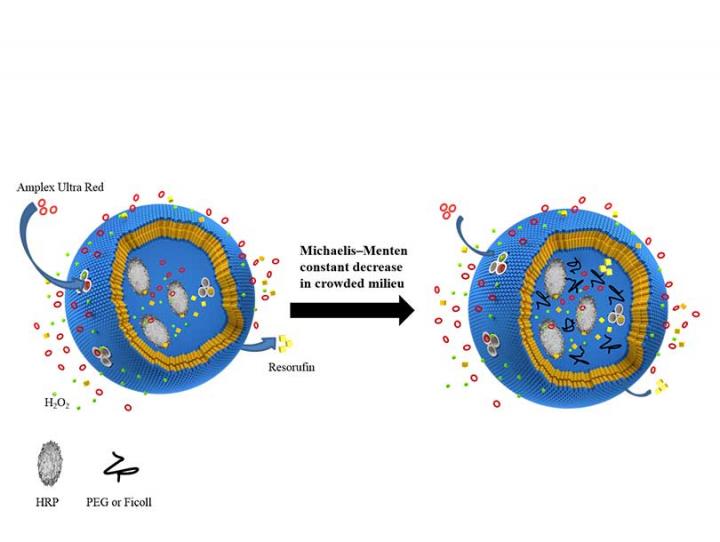
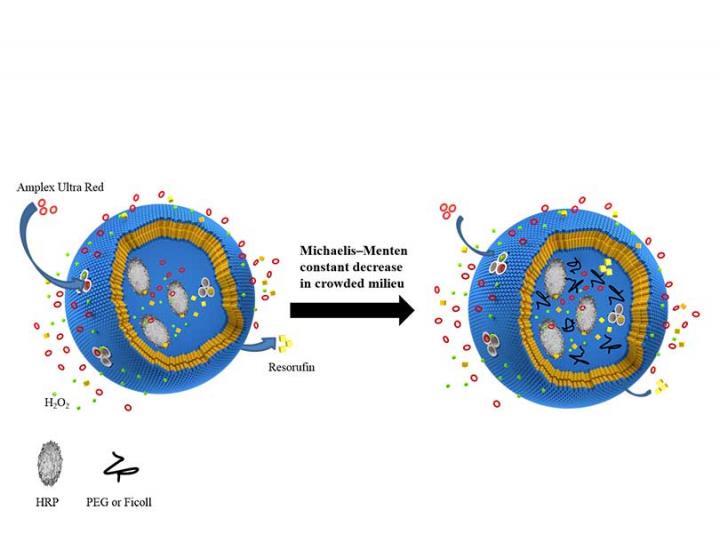
IMAGE

Credit: University of Basel, Department of Chemistry

Enzymes behave differently in a test tube compared with the molecular scrum of a living cell. Chemists from the University of Basel have now been able to simulate these confined natural conditions in artificial vesicles for the first time. As reported in the academic journal Small, the results are offering better insight into the development of nanoreactors and artificial organelles.

The cell interior is densely crowded with hundreds of thousands of macromolecules like proteins, DNA, RNA and smaller molecules forming viscous water solution. In science, this constriction is called "molecular crowding". The effect can lead to fundamental changes in several of a molecule's characteristics.

The behavior of a "free" protein or enzyme in a test tube does not necessarily follow natural processes, as the cell provides high viscos environment and confined space. In the lab, it had previously only been possible to simulate confined space but not crowded milieu simultaneously.

Imitating mother nature

A team of researchers led by Professor Wolfgang Meier of the University of Basel has now developed a system that comes a significant step closer to the natural model, as for the first time it simulated the crowding effect inside a closed vesicle. "The environment inside a cell has a major effect on the chemical reactions that take place there, so we wanted to copy this in a way coming close to nature as possible," said Professor Meier.

To create the cellular surroundings, the researchers from the Department of Chemistry made nanoscopic vesicles, so-called polymersomes, and loaded these with the horseradish peroxidase enzyme and a highly viscous solution as crowding components. The kinetics of chemical reactions by a given enzyme could thus be determined for the first time, taking "molecular crowding" into account.The results show that both factors have a strong influence on enzymatic kinetics.

Controlling the speed of chemical reactions

"Our design takes into account the natural environmental factors that influence enzymes' performance, and therefore brings us significantly further forward in the development of nanoreactors," said Professor Meier. The results demonstrate that the behavior of enzymes can be specifically controlled using the crowding effect – an important factor in developing artificial organelles for enzyme replacement therapy.

###

Media Contact

Prof. Dr. Wolfgang P. Meier
[email protected]
0041-612-073-802
@UniBasel_en

http://www.unibas.ch/

############

Story Source: Materials provided by Scienmag

Share12Tweet8Share2ShareShareShare2

Related Posts

3D Printing Biocemented Porous Structures with Precision — Technology and Engineering

3D Printing Biocemented Porous Structures with Precision

June 15, 2026
Activating Light Switch Protein Enhances Cancer’s Vulnerability to Treatment — Chemistry

Activating Light Switch Protein Enhances Cancer’s Vulnerability to Treatment

June 15, 2026

Sympathetic Signaling Eases ARDS via HDC/SLC7A11 Axis

June 15, 2026

Glyphosate Exposure Linked to Pregnancy Hormone Disruption

June 15, 2026
Please login to join discussion

POPULAR NEWS

  • ESMO 2025: mRNA COVID Vaccines Enhance Efficacy of Cancer Immunotherapy

    325 shares
    Share 130 Tweet 81
  • Saying Goodbye to PGY-6: Pediatric Fellowship Realities

    100 shares
    Share 40 Tweet 25
  • Multi-Hospital Study Reveals Long Covid Burden Is Twice as High as Current Estimates

    91 shares
    Share 36 Tweet 23
  • Detection of EDCs in Breast Milk and Infant Urine Up to Six Months Highlights Early Exposure Risks

    71 shares
    Share 28 Tweet 18

About

We bring you the latest biotechnology news from best research centers and universities around the world. Check our website.

Follow us

Recent News

3D Printing Biocemented Porous Structures with Precision

Activating Light Switch Protein Enhances Cancer’s Vulnerability to Treatment

Sympathetic Signaling Eases ARDS via HDC/SLC7A11 Axis

Subscribe to Blog via Email

Enter your email address to subscribe to this blog and receive notifications of new posts by email.

Join 82 other subscribers
  • Contact Us

Bioengineer.org © Copyright 2023 All Rights Reserved.

Welcome Back!

Login to your account below

Forgotten Password?

Retrieve your password

Please enter your username or email address to reset your password.

Log In
No Result
View All Result
  • Homepages
    • Home Page 1
    • Home Page 2
  • News
  • National
  • Business
  • Health
  • Lifestyle
  • Science

Bioengineer.org © Copyright 2023 All Rights Reserved.