• HOME
  • NEWS
  • EXPLORE
    • CAREER
      • Companies
      • Jobs
    • EVENTS
    • iGEM
      • News
      • Team
    • PHOTOS
    • VIDEO
    • WIKI
  • BLOG
  • COMMUNITY
    • FACEBOOK
    • INSTAGRAM
    • TWITTER
Sunday, May 3, 2026
BIOENGINEER.ORG
No Result
View All Result
  • Login
  • HOME
  • NEWS
  • EXPLORE
    • CAREER
      • Companies
      • Jobs
        • Lecturer
        • PhD Studentship
        • Postdoc
        • Research Assistant
    • EVENTS
    • iGEM
      • News
      • Team
    • PHOTOS
    • VIDEO
    • WIKI
  • BLOG
  • COMMUNITY
    • FACEBOOK
    • INSTAGRAM
    • TWITTER
  • HOME
  • NEWS
  • EXPLORE
    • CAREER
      • Companies
      • Jobs
        • Lecturer
        • PhD Studentship
        • Postdoc
        • Research Assistant
    • EVENTS
    • iGEM
      • News
      • Team
    • PHOTOS
    • VIDEO
    • WIKI
  • BLOG
  • COMMUNITY
    • FACEBOOK
    • INSTAGRAM
    • TWITTER
No Result
View All Result
Bioengineer.org
No Result
View All Result
Home NEWS Science News Biology

Researchers identify active compounds in giant hornet queen sex pheromones

Bioengineer by Bioengineer
March 14, 2022
in Biology
Reading Time: 2 mins read
0
Giant hornet males mating with a queen
Share on FacebookShare on TwitterShare on LinkedinShare on RedditShare on Telegram

In a correspondence published in Current Biology, researchers have identified three active compounds in sex pheromones produced by virgin queens of the species Vespa mandarinia, the world’s largest hornet. When placed in field traps, synthetic compounds of these compounds and a queen-equivalent mixture rapidly attracted hundreds of males instead of females or other species.
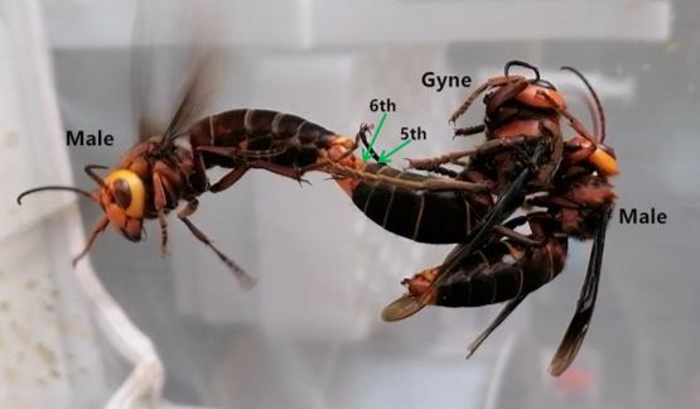
Giant hornet males mating with a queen

Credit: XTBG

In a correspondence published in Current Biology, researchers have identified three active compounds in sex pheromones produced by virgin queens of the species Vespa mandarinia, the world’s largest hornet. When placed in field traps, synthetic compounds of these compounds and a queen-equivalent mixture rapidly attracted hundreds of males instead of females or other species.

Vespa mandarinia has been recently found outside its native range and may threaten native bees and honeybees as well as harm bee-pollinated crop production. Therefore, controlling its reproduction by learning more about the giant hornet’s reproductive biology and developing trapping methods to locate its nests is a matter of great urgency.

In this study, researchers from the Xishuangbanna Tropical Botanical Garden (XTBG) of the Chinese Academy of Sciences and their collaborators collected sexually mature virgin queens and drones with insect nets as they emerged from three colonies in Yunnan, China.

“When we placed a queen inside a cage with males, the males immediately clustered around the queen and intensively antennated and tried to mate with her,” said DONG Shihao of XTBG.

Using coupled gas chromatography electroantennogram detection, they found that all three major pheromone components identified by the study—hexanoic acid, octanoic acid, and decanoic acid—elicited strong responses from male antennae. Pure synthetic compounds or a queen-equivalent mixture also elicited strong responses from male antennae.

In addition, the researchers tried to determine whether the identified compounds would help trap males in the field. Their results showed significant success.

“Given the urgent need to monitor the spread of V. mandarinia in North America and control its reproduction, we suggest that immediate testing of these sex pheromone components and their mixture would be beneficial, while studies to identify additional queen sex pheromone components are being carried out,” said TAN Ken of XTBG.


Journal

Current Biology

Method of Research

Observational study

Subject of Research

Animals

Article Title

Identification of giant hornet Vespa mandarinia queen sex pheromone components

Article Publication Date

14-Mar-2022

Share12Tweet8Share2ShareShareShare2

Related Posts

Successful Birth Following Uterus Transplant Marks Medical Breakthrough — Biology

Successful Birth Following Uterus Transplant Marks Medical Breakthrough

May 1, 2026
Cockatoos Mimic Peers to Sharpen Adaptation Skills, Study Finds — Biology

Cockatoos Mimic Peers to Sharpen Adaptation Skills, Study Finds

May 1, 2026

Gut Microbe’s Sulfated Bile Acid Eases Pediatric Sepsis

May 1, 2026

AI Breakthrough Solves One of Science’s Most Challenging Math Problems

May 1, 2026

POPULAR NEWS

  • Research Indicates Potential Connection Between Prenatal Medication Exposure and Elevated Autism Risk

    833 shares
    Share 333 Tweet 208
  • New Study Reveals Plants Can Detect the Sound of Rain

    716 shares
    Share 286 Tweet 179
  • Scientists Investigate Possible Connection Between COVID-19 and Increased Lung Cancer Risk

    67 shares
    Share 27 Tweet 17
  • Salmonella Haem Blocks Macrophages, Boosts Infection

    61 shares
    Share 24 Tweet 15

About

We bring you the latest biotechnology news from best research centers and universities around the world. Check our website.

Follow us

Recent News

Brain Complexity Enhances Premature Newborns’ Maturity Evaluation

Axon Pathways Connect Small Gestational Age to Lung Restrictions

Purslane and Metformin Improve Diabetes-Linked Cognitive Decline

Subscribe to Blog via Email

Success! An email was just sent to confirm your subscription. Please find the email now and click 'Confirm' to start subscribing.

Join 82 other subscribers
  • Contact Us

Bioengineer.org © Copyright 2023 All Rights Reserved.

Welcome Back!

Login to your account below

Forgotten Password?

Retrieve your password

Please enter your username or email address to reset your password.

Log In
No Result
View All Result
  • Homepages
    • Home Page 1
    • Home Page 2
  • News
  • National
  • Business
  • Health
  • Lifestyle
  • Science

Bioengineer.org © Copyright 2023 All Rights Reserved.