• HOME
  • NEWS
  • EXPLORE
    • CAREER
      • Companies
      • Jobs
    • EVENTS
    • iGEM
      • News
      • Team
    • PHOTOS
    • VIDEO
    • WIKI
  • BLOG
  • COMMUNITY
    • FACEBOOK
    • INSTAGRAM
    • TWITTER
Monday, June 8, 2026
BIOENGINEER.ORG
No Result
View All Result
  • Login
  • HOME
  • NEWS
  • EXPLORE
    • CAREER
      • Companies
      • Jobs
        • Lecturer
        • PhD Studentship
        • Postdoc
        • Research Assistant
    • EVENTS
    • iGEM
      • News
      • Team
    • PHOTOS
    • VIDEO
    • WIKI
  • BLOG
  • COMMUNITY
    • FACEBOOK
    • INSTAGRAM
    • TWITTER
  • HOME
  • NEWS
  • EXPLORE
    • CAREER
      • Companies
      • Jobs
        • Lecturer
        • PhD Studentship
        • Postdoc
        • Research Assistant
    • EVENTS
    • iGEM
      • News
      • Team
    • PHOTOS
    • VIDEO
    • WIKI
  • BLOG
  • COMMUNITY
    • FACEBOOK
    • INSTAGRAM
    • TWITTER
No Result
View All Result
Bioengineer.org
No Result
View All Result
Home NEWS Science News Chemistry

Researchers home in on extremely rare nuclear process

Bioengineer by Bioengineer
September 25, 2019
in Chemistry
Reading Time: 2 mins read
0
IMAGE
Share on FacebookShare on TwitterShare on LinkedinShare on RedditShare on Telegram

The complete data from the EXO-200 experiment provide new information on neutrinoless double beta decay and set the stage for future experiments that will search for the hypothetical process
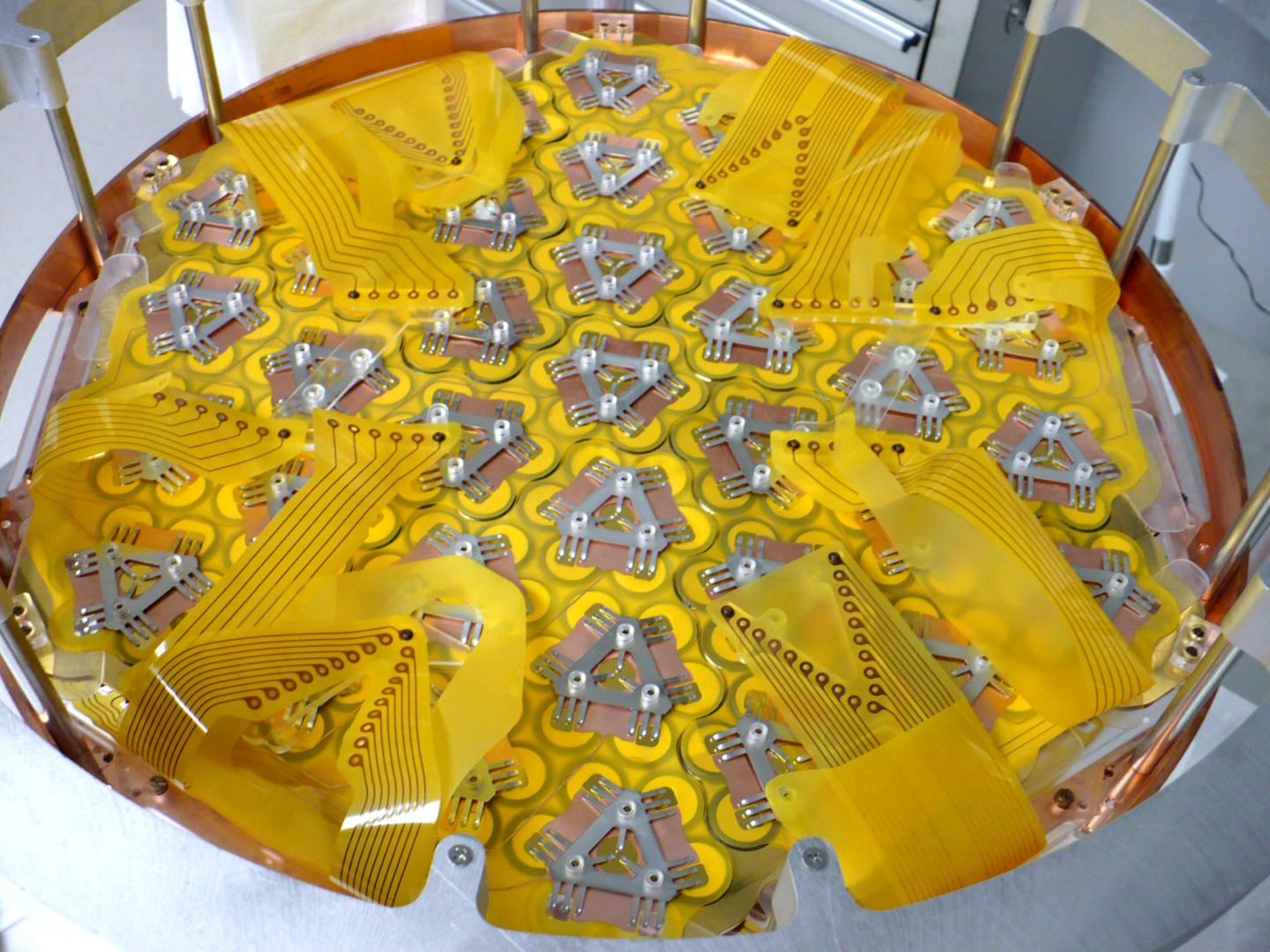
IMAGE

Credit: EXO-200 Collaboration

A hypothetical nuclear process known as neutrinoless double beta decay ought to be among the least likely events in the universe. Now the international EXO-200 collaboration, which includes researchers from the Department of Energy’s SLAC National Accelerator Laboratory, has determined just how unlikely it is: In a given volume of a certain xenon isotope, it would take more than 35 trillion trillion years for half of its nuclei to decay through this process – an eternity compared to the age of the universe, which is “only” 13 billion years old.

If discovered, neutrinoless double beta decay would prove that neutrinos – highly abundant elementary particles with extremely small mass – are their own antiparticles. That information would help researchers determine how heavy neutrinos actually are and how they acquire their mass. Although the EXO-200 experiment did not observe the decay, its complete data set, published on the arXiv repository and accepted for publication in Physical Review Letters, defined some of the strongest limits yet for the decay’s half-life and for the mass neutrinos may have.

EXO-200 operated at the Waste Isolation Pilot Plant (WIPP) in New Mexico from 2011 to 2018. Within its first months of operations, it discovered another rare process: the two-neutrino double beta decay of the same xenon isotope. EXO-200 was an important precursor for next-generation experiments, such as the proposed nEXO, that would have a much better chance of discovering the neutrinoless decay.

###

U.S. funding for EXO-200 comes from the DOE Office of Science and the National Science Foundation. The data analysis was partially done using resources of the National Energy Research Scientific Computing Center (NERSC), a DOE Office of Science user facility. Martin Breidenbach is the principal investigator of SLAC’s EXO-200 team.

Citation: EXO-200 Collaboration, accepted in Physical Review Letters (arXiv:1906.02723v2)

SLAC is a vibrant multiprogram laboratory that explores how the universe works at the biggest, smallest and fastest scales and invents powerful tools used by scientists around the globe. With research spanning particle physics, astrophysics and cosmology, materials, chemistry, bio- and energy sciences and scientific computing, we help solve real-world problems and advance the interests of the nation.

SLAC is operated by Stanford University for the U.S. Department of Energy’s Office of Science. The Office of Science is the single largest supporter of basic research in the physical sciences in the United States and is working to address some of the most pressing challenges of our time. For more information, visit energy.gov/science.

Media Contact
Manuel Gnida
[email protected]

Original Source

https://www6.slac.stanford.edu/news/2019-09-24-brief-researchers-home-extremely-rare-nuclear-process.aspx

Tags: Atomic/Molecular/Particle PhysicsChemistry/Physics/Materials SciencesParticle Physics
Share12Tweet8Share2ShareShareShare2

Related Posts

Professor Kaneko’s Sake and Wine Win Top Honors at French-Japanese Sake Competition for the Second Year Running — Chemistry

Professor Kaneko’s Sake and Wine Win Top Honors at French-Japanese Sake Competition for the Second Year Running

June 7, 2026
Distinct Energetic Blueprints Expand Conserved Protein Functions — Chemistry

Distinct Energetic Blueprints Expand Conserved Protein Functions

June 7, 2026

Catalytic Endo-Stereoselective [2+2] Norbornadiene-Alkyne Cycloaddition

June 6, 2026

Cyclophane Shields Singly Dispersed Graphene Nanoribbons

June 6, 2026
Please login to join discussion

POPULAR NEWS

  • ESMO 2025: mRNA COVID Vaccines Enhance Efficacy of Cancer Immunotherapy

    323 shares
    Share 129 Tweet 81
  • Multi-Hospital Study Reveals Long Covid Burden Is Twice as High as Current Estimates

    89 shares
    Share 35 Tweet 22
  • Saying Goodbye to PGY-6: Pediatric Fellowship Realities

    83 shares
    Share 33 Tweet 21
  • Common Food Preservatives Associated with Elevated Blood Pressure and Increased Heart Disease Risk

    58 shares
    Share 23 Tweet 15

About

BIOENGINEER.ORG

We bring you the latest biotechnology news from best research centers and universities around the world. Check our website.

Follow us

Recent News

Machine Learning Predicts Power Converter Lifespan

Dental Care Gaps Linked to Systemic Diseases in Homebound Patients

Weight Loss Treatments Associated with Reduced Risk of Obesity-Related Cancers in Non-Diabetic Individuals

Subscribe to Blog via Email

Enter your email address to subscribe to this blog and receive notifications of new posts by email.

Join 82 other subscribers
  • Contact Us

Bioengineer.org © Copyright 2023 All Rights Reserved.

Welcome Back!

Login to your account below

Forgotten Password?

Retrieve your password

Please enter your username or email address to reset your password.

Log In
No Result
View All Result
  • Homepages
    • Home Page 1
    • Home Page 2
  • News
  • National
  • Business
  • Health
  • Lifestyle
  • Science

Bioengineer.org © Copyright 2023 All Rights Reserved.