• HOME
  • NEWS
  • EXPLORE
    • CAREER
      • Companies
      • Jobs
    • EVENTS
    • iGEM
      • News
      • Team
    • PHOTOS
    • VIDEO
    • WIKI
  • BLOG
  • COMMUNITY
    • FACEBOOK
    • INSTAGRAM
    • TWITTER
Sunday, October 4, 2026
BIOENGINEER.ORG
No Result
View All Result
  • Login
  • HOME
  • NEWS
  • EXPLORE
    • CAREER
      • Companies
      • Jobs
        • Lecturer
        • PhD Studentship
        • Postdoc
        • Research Assistant
    • EVENTS
    • iGEM
      • News
      • Team
    • PHOTOS
    • VIDEO
    • WIKI
  • BLOG
  • COMMUNITY
    • FACEBOOK
    • INSTAGRAM
    • TWITTER
  • HOME
  • NEWS
  • EXPLORE
    • CAREER
      • Companies
      • Jobs
        • Lecturer
        • PhD Studentship
        • Postdoc
        • Research Assistant
    • EVENTS
    • iGEM
      • News
      • Team
    • PHOTOS
    • VIDEO
    • WIKI
  • BLOG
  • COMMUNITY
    • FACEBOOK
    • INSTAGRAM
    • TWITTER
No Result
View All Result
Bioengineer.org
No Result
View All Result
Home NEWS Science News Chemistry

Researchers extend the life of a dipolar molecule

Bioengineer by Bioengineer
April 5, 2021
in Chemistry
Reading Time: 2 mins read
0
IMAGE
Share on FacebookShare on TwitterShare on LinkedinShare on RedditShare on Telegram

Static, long-lasting molecules are key to molecule-based quantum simulation and information processing
IMAGE

Credit: Photo courtesy of the Ni group

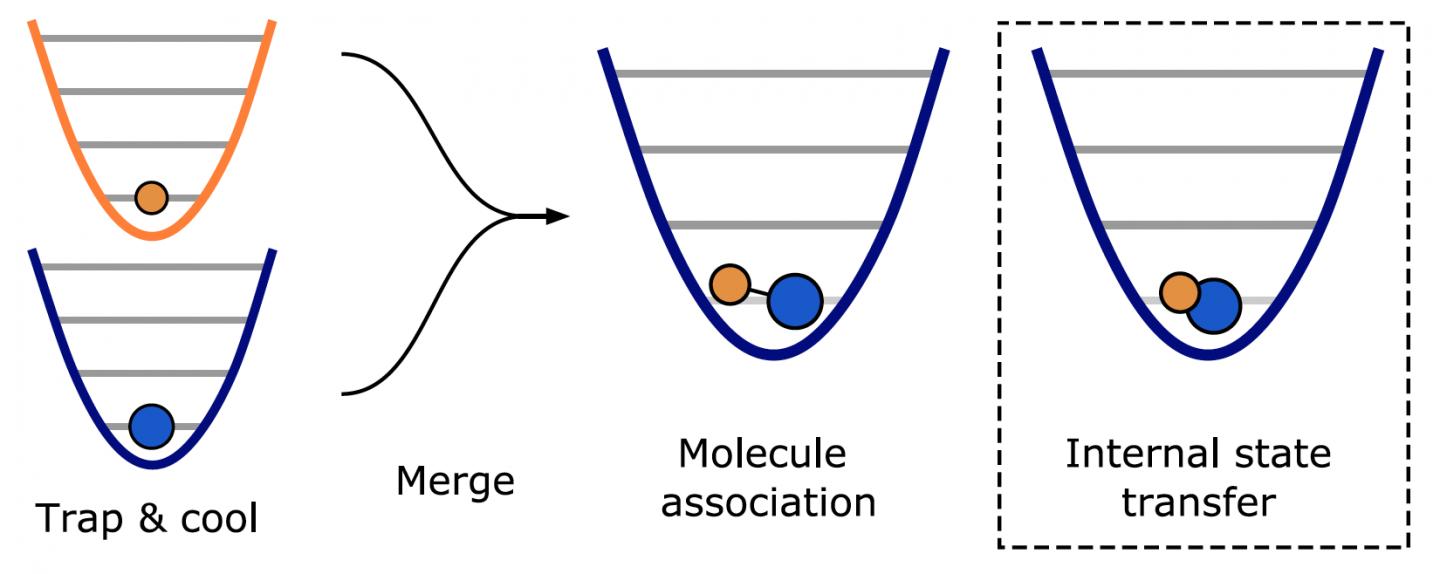
In 2018, Kang-Kuen Ni and her lab earned the cover of Science with an impressive feat: They took two individual atoms, a sodium and a cesium, and forged them into a single dipolar molecule, sodium cesium.

Sodium and cesium normally ignore each other in the wild; but in the Ni lab’s carefully calibrated vacuum chamber, she and her team captured each atom using lasers and then forced them to react, a capability that gifted scientists with a new method to study one of the most basic and ubiquitous processes on Earth: the formation of a chemical bond. With Ni’s invention, scientists could not only discover more about our chemical underpinnings, they could start creating bespoke molecules for novel uses like qubits for quantum computers.

But there was one flaw in their original sodium cesium molecule: “That molecule was lost soon after it’s made,” said Ni, the Morris Kahn associate professor of chemistry and chemical biology and of physics. Now, in a new study published in Physics Review Letters, Ni and her team report a new feat: They granted their molecule an extended lifetime of up to almost three and a half seconds–a luxury of time in the quantum realm–by controlling all the degrees of freedom (including its motion) of an individual dipolar molecule for the first time. During those precious seconds, the researchers can maintain the full quantum control necessary for stable qubits, the building blocks for a wide variety of exciting quantum applications.

According to the paper, “These long-lived, fully quantum state-controlled individual dipolar molecules provide a key resource for molecule-based quantum simulation and information processing.” For example, such molecules could accelerate progress toward quantum simulation of new phases of matter (faster than any known computer), high-fidelity quantum information processing, precision measurements, and basic research in the field of cold chemistry (one of Ni’s specialties).

And, by forming obedient molecules in their quantum ground states (basically, their simplest, most pliant form), the researchers created more reliable qubits with electric handles, which, like the magnetic handles of a magnet, allow researchers to interact with them in new ways (for example, with microwaves and electric fields).

Next, the team is working on scaling their process: They plan to assemble not just one molecule from two atoms but force larger collections of atoms to interact and form molecules in parallel. In so doing, they can also start to perform long-range entanglement interactions between molecules, the basis for information transfer in quantum computing.

“With the addition of microwave and electric field control,” said Ni, “molecular qubits for quantum computing applications and simulations that further our understanding of quantum phases of matter are within experimental reach.”

###

Media Contact
Caitlin McDermott-Murphy
[email protected]

Original Source

https://chemistry.harvard.edu/news/researchers-extend-life-dipolar-molecule

Related Journal Article

http://dx.doi.org/10.1103/PhysRevLett.126.123402

Tags: Chemistry/Physics/Materials SciencesElectrical Engineering/ElectronicsMolecular PhysicsTechnology/Engineering/Computer ScienceTheory/Design
Share12Tweet8Share2ShareShareShare2

Related Posts

Plant-Powered Nanoparticles Push Corrosion Protection Toward 99 Percent

Plant-Powered Nanoparticles Push Corrosion Protection Toward 99 Percent

October 4, 2026
Green Solvent and Supercomputer Simulations Unlock a Stubborn Tea Enzyme

Green Solvent and Supercomputer Simulations Unlock a Stubborn Tea Enzyme

October 4, 2026

Artificial Bees Crack the Rubber Blend Puzzle for Cheaper, Tougher Car Parts

October 4, 2026

Silver Nanowires Wrapped in Zinc and Nickel Oxides Show Boosted Catalytic and Energy-Storage Power

October 4, 2026
Please login to join discussion

POPULAR NEWS

  • Alloys That Shrink Their Own Grains: New PIX Mechanism Refines Metals With Heat Alone

    Alloys That Shrink Their Own Grains: New PIX Mechanism Refines Metals With Heat Alone

    29 shares
    Share 12 Tweet 7
  • Endurance Exercise Reshapes the Liver in Males and Females Through Distinct Molecular Routes

    29 shares
    Share 12 Tweet 7
  • Single Transcription Factor PU.1 Rapidly Converts Fibroblasts into Macrophage-Lineage Cells

    29 shares
    Share 12 Tweet 7
  • New Scale Measures How Ready Nurse Educators Really Are for the AI Era

    29 shares
    Share 12 Tweet 7

About

We bring you the latest biotechnology news from best research centers and universities around the world. Check our website.

Follow us

Recent News

Alloys That Shrink Their Own Grains: New PIX Mechanism Refines Metals With Heat Alone

Endurance Exercise Reshapes the Liver in Males and Females Through Distinct Molecular Routes

Single Transcription Factor PU.1 Rapidly Converts Fibroblasts into Macrophage-Lineage Cells

Subscribe to Blog via Email

Enter your email address to subscribe to this blog and receive notifications of new posts by email.

Join 85 other subscribers
  • Contact Us

Bioengineer.org © Copyright 2023 All Rights Reserved.

Welcome Back!

Login to your account below

Forgotten Password?

Retrieve your password

Please enter your username or email address to reset your password.

Log In
No Result
View All Result
  • Homepages
    • Home Page 1
    • Home Page 2
  • News
  • National
  • Business
  • Health
  • Lifestyle
  • Science

Bioengineer.org © Copyright 2023 All Rights Reserved.