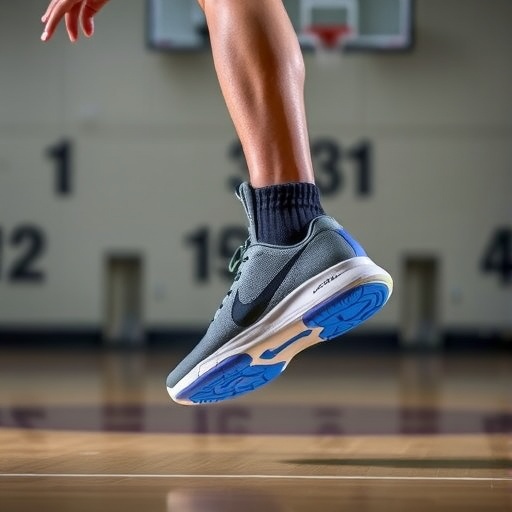
When a basketball player plants a foot and cuts sharply to the left or right, the entire lateral stability of the ankle—and often the knee—hangs on a single geometric property of the shoe beneath it: the balance between how wide the shoe’s wall is and how thick its sole. A new study published in the Annals of Biomedical Engineering has turned that intuitive observation into a rigorous, quantitative design principle, and the results are striking. After evaluating nine commercially available men’s basketball shoes against the new criterion, researchers found that not a single model passed for all documented loading conditions, and two exhibited fundamental instabilities that make them prone to tipping at the forefoot or heel under realistic cutting loads.
The research team, led by co-first authors Yara Izhiman of the University of Cincinnati and Lindee B. Calvert of Purdue University, together with senior author Eric A. Nauman, set out to address one of the most persistent injury problems in court sports. Basketball is often described as a non-contact sport, yet it produces a substantial injury burden, with lower limb injuries accounting for roughly 64 percent of all reported cases. Cutting maneuvers—the sudden twists and turns performed with the foot planted—alone account for about 30 percent of basketball injuries, and these frequently occur when the ankle rolls outward under a large lateral ground reaction force. Ankle sprains damage the soft tissue structures on the lateral side of the joint, including the superior and inferior extensor retinaculum, and athletes who have suffered one sprain become considerably more susceptible to future ones. Residual symptoms can persist for up to eight months, and ligament ruptures at the knee, such as those involving the anterior cruciate ligament, generally require surgical intervention.
The researchers approached ankle rolling not as a physiological mystery but as a classical mechanical stability problem, analogous to the tipping analysis engineers routinely apply to rigid bodies. During a cutting maneuver, an athlete’s foot exerts a vertical force and a mediolateral force on the inside of the shoe. If friction between the sole and the court is sufficient to prevent slipping, the shoe can tip over its outermost ground-contact point instead. By summing moments about that tipping point and assuming static equilibrium immediately before instability, the team derived an elegantly simple dimensionless expression: the critical ratio, equal to the product of the vertical force and the wall thickness divided by the product of the mediolateral force and the sole thickness. When this ratio falls below one, the shoe is unstable and will tip, placing the player at risk of an ankle or knee injury. The wall thickness represents the horizontal distance between the inner edge of the sole and the outermost ground-contact point, while the sole thickness is the vertical distance from the ground to the top of the insole, excluding the removable insole itself.
What makes the criterion particularly useful is that it can be evaluated in two ways. The force terms can be drawn from published biomechanical studies of real cutting maneuvers, while the geometric terms require nothing more sophisticated than calipers and a loaded footprint. The team compiled ground reaction force data from four previously published investigations of basketball cutting movements, covering the V-cut, the lateral cut, and a generic change-of-direction maneuver, performed by subjects ranging from recreational players to professionals. Across the six loading cases extracted from the literature, vertical forces ranged from 2.03 to 3.00 times body weight, while mediolateral forces ranged from 0.61 to 1.90 times body weight. Because the ratio of vertical to mediolateral force was consistently most demanding during the initial impact peak rather than the propulsion peak, only impact-phase data were used. Meanwhile, the team measured wall and sole thicknesses at both the heel and forefoot of nine men’s size 12 basketball shoes from major manufacturers including Nike, Adidas, and Under Armour, using tempera paint imprints under an 890-newton load to capture the shoe-ground contact area.
The results were sobering for the footwear industry. None of the nine models achieved a critical ratio greater than one across all six documented loading conditions. At the heel, five models passed two of the cases, while one shoe, designated S7, was deemed fundamentally unstable because its outermost ground-contact point lay directly beneath the inner edge of the sole, yielding a critical ratio of zero. At the forefoot, seven models passed at least one case, but another shoe, S1, was classified as fundamentally unstable in that region. The pattern behind the failures was clear: the least stable shoes combined thin walls with thick soles, a geometry that drastically shortens the moment arm resisting tipping while lengthening the moment arm driving it. The shoe masses ranged from 0.405 to 0.490 kilograms, wall thicknesses from minus 0.20 to 1.89 centimeters—the negative value reflecting a wall that angled inward beyond the ground-contact edge—and sole thicknesses from 1.88 to 3.56 centimeters.
To validate the theoretical criterion experimentally, the researchers built a custom mechanical ankle model consisting of a size 12 prosthetic foot mounted on a double-U-joint and steel shaft, with a load cell readout capturing forces and center of pressure during simulated lateral ankle rolls. The lower U-joint was locked so that motion occurred only about the upper joint, mimicking mediolateral ankle tipping. The apparatus was tested both unweighted and loaded with 50 pounds on an embedded AMTI dual-force platform, while sixteen reflective markers tracked the three-dimensional motion at 240 hertz using infrared cameras. Forces were filtered with a zero-phase fourth-order Butterworth low-pass filter at a 50 hertz cutoff. Two of the nine shoe models, S8 and S9, were subjected to this experimental evaluation, with the apparatus pushed medially at approximately 30 degrees until the shoe tipped.
The experimental data supported the validity of the instability envelope. At the instant of tipping, the vertical-to-mediolateral force ratios measured for the unweighted model averaged 6.83 for S8 and 9.01 for S9, with even higher values under the 50-pound load. These ratios exceed the most severe ratio documented in human subjects—4.87, recorded in professional club players—because the prosthetic foot lacks the anatomical mobility and force distribution of a living foot, making the model a deliberately conservative worst-case scenario. Both shoes registered critical ratios below one and failed the stability criterion, with S9 showing a slightly higher ratio than S8, indicating superior stability. Center of pressure trajectories reinforced this hierarchy: S9 sustained a larger vertical force at the moment of tipping and exhibited smaller mediolateral center-of-pressure translation, both signatures of a more stable platform. The team also observed a shift of the foot’s center of pressure anterolateral to the shoe midline during simulated rolls, consistent with instability patterns previously identified in individuals with chronic ankle instability.
The researchers acknowledge several simplifications in their analysis. The critical ratio assumes the foot exerts the entire force at the inner edge of the sole, whereas in reality the center of pressure may sit closer to the shoe’s midline, slightly increasing the effective wall thickness. The quasi-static experimental loading cannot fully reproduce the dynamic muscle activity, ligament engagement, and contact forces of an on-court cut, and the U-joint system, lacking restorative moments from ligaments and musculature, collapses at a lower critical ratio than a real ankle would. Shoe size was standardized at men’s 12 across all brands for consistency, and the wall thickness was measured at a single representative location despite its non-uniform geometry. Even so, the team argues that these limitations do not alter the central conclusion, since the shoes failed the criterion so pervasively that fundamental geometric changes—specifically, increasing the ratio of wall thickness to sole thickness—are required before finer refinements become worthwhile.
The implications extend beyond basketball. Because cleats are not a viable footwear solution on hard courts, players in basketball, tennis, and similar sports depend entirely on shoe geometry and upper construction for lateral stability, and instability at the ankle propagates through the entire kinetic chain to affect the knee and hip. The stability criterion offers designers an easily implementable target that relates applied loads directly to measurable sole and wall dimensions, and the authors note that small modifications would suffice to render the tested shoes stable as defined by the criterion. Future work will extend the analysis to women’s basketball shoes and tennis footwear, map pressure distributions across the entire sole, examine scaling with shoe size, and explore sex-specific variability and skill-level differences in cutting mechanics. The data could also drive models of tissue strain in the knee and hip, and ultimately, epidemiological studies will be needed to determine whether shoes engineered to satisfy the criterion translate into measurable reductions in injury rates on the court.
For now, the study delivers a rare and valuable commodity in sports science: a simple, falsifiable number that any manufacturer can compute from a pair of calipers, a paint imprint, and published force data—and a demonstration that the current generation of basketball shoes, however sophisticated their cushioning systems and uppers, falls short of a first-principles standard for keeping athletes’ ankles underneath them during the sport’s most dangerous movements.
Subject of Research: Development and experimental validation of a mechanical stability criterion for men’s basketball shoes during mediolateral cutting maneuvers, aimed at reducing ankle and knee injuries in court sports.
Subject of Research: Medicine
Article Title: Development of a Stability Criterion for Men’s Basketball Shoes During Mediolateral Cutting Maneuvers
Article References: Izhiman, Y., Calvert, L. B., Meehan-Numminen, L. T. K., Ahsan, Z., Bigler, B., & Nauman, E. A. (2026). Development of a Stability Criterion for Men’s Basketball Shoes During Mediolateral Cutting Maneuvers. Annals of Biomedical Engineering. https://doi.org/10.1007/s10439-026-04298-0
Image Credits: AI Generated
DOI: 10.1007/s10439-026-04298-0
Keywords: basketball shoe stability, ankle sprains, cutting maneuvers, critical ratio, mediolateral force, sole thickness, wall thickness, tipping analysis, shoe biomechanics, lateral ankle stability, injury prevention, mechanical stability criterion
Cite Scienmag News
APA MLA Chicago
Ophelia Keating. (September 4, 2026). Researchers Establish Stability Standard for Basketball Shoes in Side-Cutting Moves. Scienmag. https://scienmag.com/researchers-establish-stability-standard-for-basketball-shoes-in-side-cutting-moves/
Ophelia Keating. “Researchers Establish Stability Standard for Basketball Shoes in Side-Cutting Moves.” Scienmag, 4 September 2026, https://scienmag.com/researchers-establish-stability-standard-for-basketball-shoes-in-side-cutting-moves/. Accessed 4 September 2026.
Ophelia Keating. “Researchers Establish Stability Standard for Basketball Shoes in Side-Cutting Moves.” Scienmag. September 4, 2026. https://scienmag.com/researchers-establish-stability-standard-for-basketball-shoes-in-side-cutting-moves/
Copy citation Download RIS
Tags: analysis of commercially available basketball shoesBasketball shoe stability standardsbiomechanical assessment of basketball footwearbiomechanical assessment of sports shoe stabilitybiomechanics of side-cutting maneuversdesign improvements for reducing basketball-related injuriesevaluation of commercial basketball shoes for stabilityfootwear design for basketball playersfootwear safety standards for high-impact sportsfootwear stability testing methodsgeometric design principles for athletic shoesgeometric properties of sports footwearimpact of shoe design on knee and ankle injuriesimpact of shoe sole thickness and wall widthinjury prevention in basketball playersinjury prevention in court sportsinjury risk factors in basketballlateral ankle and knee injury preventionlateral ankle stability in sports footwearpreventing tipping and instability during rapid cutsresearch on injury risk factors in basketballside-cutting movement biomechanicsstructural analysis of basketball shoe soles and walls