• HOME
  • NEWS
  • EXPLORE
    • CAREER
      • Companies
      • Jobs
    • EVENTS
    • iGEM
      • News
      • Team
    • PHOTOS
    • VIDEO
    • WIKI
  • BLOG
  • COMMUNITY
    • FACEBOOK
    • INSTAGRAM
    • TWITTER
Saturday, February 7, 2026
BIOENGINEER.ORG
No Result
View All Result
  • Login
  • HOME
  • NEWS
  • EXPLORE
    • CAREER
      • Companies
      • Jobs
        • Lecturer
        • PhD Studentship
        • Postdoc
        • Research Assistant
    • EVENTS
    • iGEM
      • News
      • Team
    • PHOTOS
    • VIDEO
    • WIKI
  • BLOG
  • COMMUNITY
    • FACEBOOK
    • INSTAGRAM
    • TWITTER
  • HOME
  • NEWS
  • EXPLORE
    • CAREER
      • Companies
      • Jobs
        • Lecturer
        • PhD Studentship
        • Postdoc
        • Research Assistant
    • EVENTS
    • iGEM
      • News
      • Team
    • PHOTOS
    • VIDEO
    • WIKI
  • BLOG
  • COMMUNITY
    • FACEBOOK
    • INSTAGRAM
    • TWITTER
No Result
View All Result
Bioengineer.org
No Result
View All Result
Home NEWS Science News Biology

Researchers double sorghum grain yield to improve food supply

Bioengineer by Bioengineer
October 30, 2019
in Biology
Reading Time: 2 mins read
0
IMAGE
Share on FacebookShare on TwitterShare on LinkedinShare on RedditShare on Telegram

IMAGE

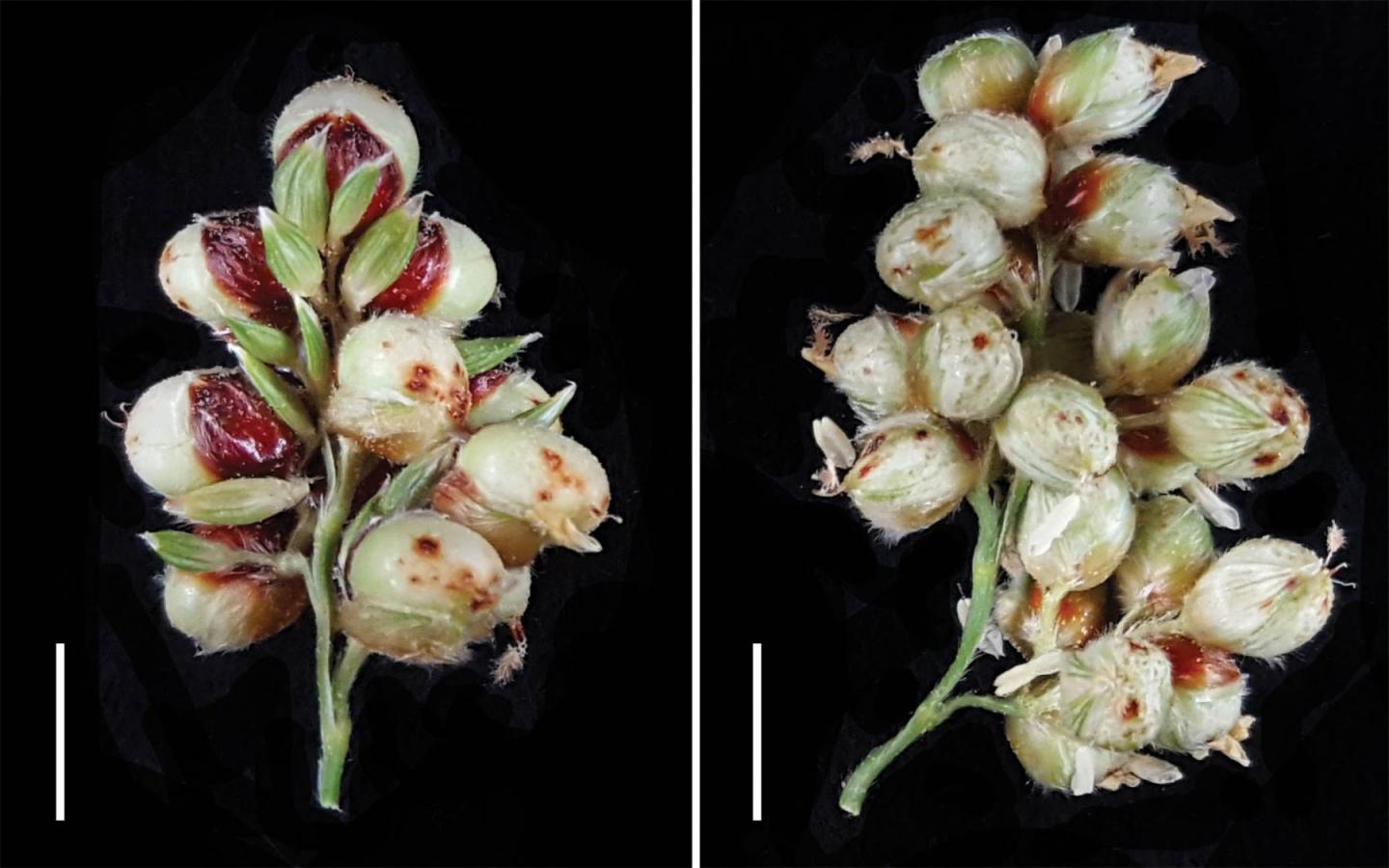
Credit: Ware lab/CSHL, 2019


Plant scientists at Cold Spring Harbor Laboratory (CSHL) and USDA’s Agricultural Research Service (ARS), in their search for solutions to global food production challenges, have doubled the amount of grains that a sorghum plant can yield.

Sorghum, one of the world’s most important sources of food, animal feed, and biofuel, is considered a model crop for research because it has a high tolerance to drought, heat, and high-salt conditions. Increasing the grain yield has become even more important to plant breeders, farmers, and researchers as they try to address and overcome food security issues related to climate change, growing populations, and land and water shortages.

Led by Doreen Ware, CSHL Adjunct Professor and research scientist at the U.S. Department of Agriculture, and USDA colleague Zhanguo Xin, Ph.D, the research team identified novel genetic variations that occurred in sorghum’s MSD2 gene, increasing the grain yield 200 percent. MSD2 is part of a gene line that boosts flower fertility by lowering the amount of jasmonic acid, a hormone that controls the development of seeds and flowers.

“When this hormone is decreased, you have a release of development that does not normally occur,” said Nicholas Gladman, a postdoctoral fellow in Ware’s lab and first author on the study, recently published in The International Journal of Molecular Sciences. “That allows for the full formation of the female sex organs in these flowers, which then allows for increased fertility”

MSD2 is regulated by MSD1, a gene discovered by Ware’s team last year. Manipulating either gene increases seed and flower production.

“Major cereal crops are very close to each other evolutionarily. A lot of the genes that they share have similar functions,” said Yinping Jiao, a postdoctoral associate in the Ware Lab and an author on the study. “This gene that plays an important role controlling the sorghum yield may also help us improve the yield of other crops like maize or rice.”

Ware’s lab uses this type of genetic research to understand how plants have changed over time.

“These genetic analyses actually give us the molecular mechanisms that provide more opportunities to engineer crops in the future,” she said.

###

The team is now looking to work with collaborators, such as the United States Department of Agriculture, to see if one of the genes–MSD2 or MSD1–can be used to improve sorghum yield in large field trials.

Media Contact
Sara Roncero-Menendez
[email protected]
516-367-6866

Original Source

https://www.cshl.edu/researchers-double-sorghum-grain-yield-to-improve-food-supply/

Tags: Agricultural Production/EconomicsAgricultureBiologyFood/Food ScienceGeneticsPlant Sciences
Share13Tweet8Share2ShareShareShare2

Related Posts

New Study Uncovers Mechanism Behind Burn Pit Particulate Matter–Induced Lung Inflammation

New Study Uncovers Mechanism Behind Burn Pit Particulate Matter–Induced Lung Inflammation

February 6, 2026

DeepBlastoid: Advancing Automated and Efficient Evaluation of Human Blastoids with Deep Learning

February 6, 2026

Navigating the Gut: The Role of Formic Acid in the Microbiome

February 6, 2026

AI-Enhanced Optical Coherence Photoacoustic Microscopy Revolutionizes 3D Cancer Model Imaging

February 6, 2026
Please login to join discussion

POPULAR NEWS

  • Robotic Ureteral Reconstruction: A Novel Approach

    Robotic Ureteral Reconstruction: A Novel Approach

    82 shares
    Share 33 Tweet 21
  • Digital Privacy: Health Data Control in Incarceration

    63 shares
    Share 25 Tweet 16
  • Study Reveals Lipid Accumulation in ME/CFS Cells

    57 shares
    Share 23 Tweet 14
  • Breakthrough in RNA Research Accelerates Medical Innovations Timeline

    53 shares
    Share 21 Tweet 13

About

We bring you the latest biotechnology news from best research centers and universities around the world. Check our website.

Follow us

Recent News

Oxygen-Enhanced Dual-Section Microneedle Patch Improves Drug Delivery and Boosts Photodynamic and Anti-Inflammatory Treatment for Psoriasis

Scientists Identify SARS-CoV-2 PLpro and RIPK1 Inhibitors Showing Potent Synergistic Antiviral Effects in Mouse COVID-19 Model

Neg-Entropy: The Key Therapeutic Target for Chronic Diseases

Subscribe to Blog via Email

Enter your email address to subscribe to this blog and receive notifications of new posts by email.

Join 73 other subscribers
  • Contact Us

Bioengineer.org © Copyright 2023 All Rights Reserved.

Welcome Back!

Login to your account below

Forgotten Password?

Retrieve your password

Please enter your username or email address to reset your password.

Log In
No Result
View All Result
  • Homepages
    • Home Page 1
    • Home Page 2
  • News
  • National
  • Business
  • Health
  • Lifestyle
  • Science

Bioengineer.org © Copyright 2023 All Rights Reserved.