• HOME
  • NEWS
  • EXPLORE
    • CAREER
      • Companies
      • Jobs
    • EVENTS
    • iGEM
      • News
      • Team
    • PHOTOS
    • VIDEO
    • WIKI
  • BLOG
  • COMMUNITY
    • FACEBOOK
    • INSTAGRAM
    • TWITTER
Monday, May 11, 2026
BIOENGINEER.ORG
No Result
View All Result
  • Login
  • HOME
  • NEWS
  • EXPLORE
    • CAREER
      • Companies
      • Jobs
        • Lecturer
        • PhD Studentship
        • Postdoc
        • Research Assistant
    • EVENTS
    • iGEM
      • News
      • Team
    • PHOTOS
    • VIDEO
    • WIKI
  • BLOG
  • COMMUNITY
    • FACEBOOK
    • INSTAGRAM
    • TWITTER
  • HOME
  • NEWS
  • EXPLORE
    • CAREER
      • Companies
      • Jobs
        • Lecturer
        • PhD Studentship
        • Postdoc
        • Research Assistant
    • EVENTS
    • iGEM
      • News
      • Team
    • PHOTOS
    • VIDEO
    • WIKI
  • BLOG
  • COMMUNITY
    • FACEBOOK
    • INSTAGRAM
    • TWITTER
No Result
View All Result
Bioengineer.org
No Result
View All Result
Home NEWS Science News Chemistry

Researchers discover the science behind giving up

Bioengineer by Bioengineer
July 25, 2019
in Chemistry
Reading Time: 3 mins read
0
IMAGE
Share on FacebookShare on TwitterShare on LinkedinShare on RedditShare on Telegram

Study published in Cell reveals activity of nociceptin neurons
IMAGE

Credit: Max Hunter

What happens when we give up?

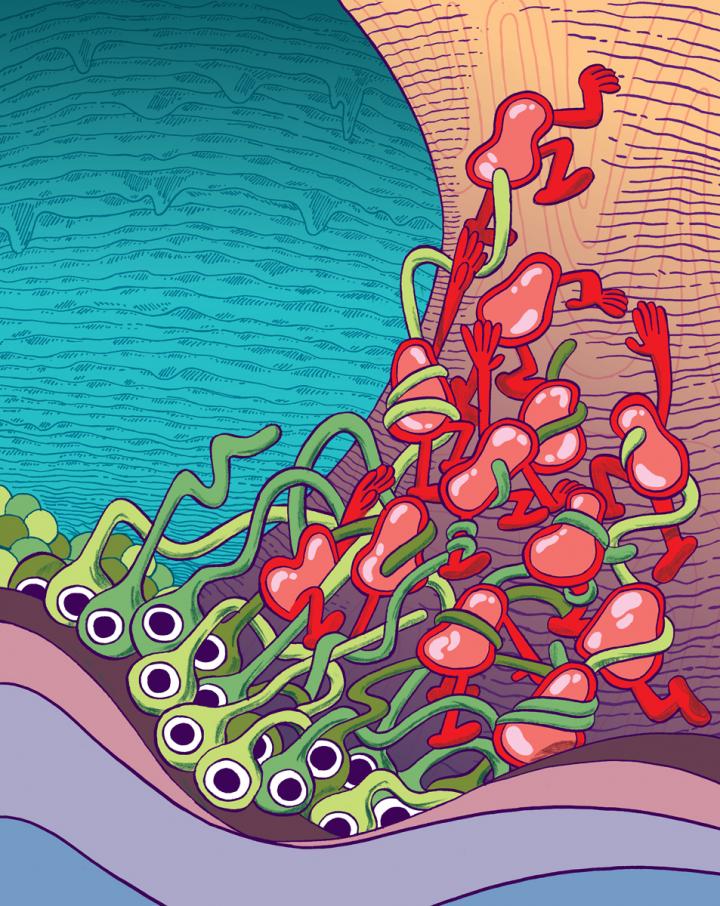
Inside the brain, a group of cells known as nociceptin neurons get very active before a mouse’s breakpoint. They emit nociceptin, a complex molecule that suppresses dopamine, a chemical largely associated with motivation.

The findings, reported July 25 in Cell, offer new insight into the complex world of motivation and reward.

The nociceptin neurons are located near an area of the brain known as the ventral tegmental area. The VTA contains neurons that release dopamine during pleasurable activities. Although scientists have previously studied the effects of fast, simple neurotransmitters on dopamine neurons, this study is among the first to describe the effects of this complex nociception modulatory system.

“We are taking an entirely new angle on an area of the brain known as VTA,” said co-lead author Christian Pedersen, a fourth-year Ph.D. student in bioengineering at the University of Washington School of Medicine and the UW College of Engineering.

Researchers at the UW School of Medicine and at Washington University School of Medicine as well as colleagues at other universities, spent four years looking at the role of nociceptin in regulating motivation.

“The big discovery is that large complex neurotransmitters known as neuropeptides have a very robust effect on animal behavior by acting on the VTA,” said Pedersen.

The researchers said this discovery could lead to helping people find motivation when they are depressed and conversely decrease motivation for drugs in substance- abuse disorders, like addiction.

The discovery came by looking at the neurons in mice seeking sucrose. The mice had to poke their snout into a port to get sucrose. At first it was easy, then it became two pokes, then five, increasing exponentially, and so on. Eventually, all the mice gave up. Neural activity recordings revealed that these “demotivation” or “frustration” neurons became most active when mice stopped seeking sucrose.

In mammals, the neural circuits that underlie reward seeking are regulated by mechanisms to keep homeostasis – the tendency to maintain internal stability to compensate for environmental changes. In the wild, animals are less motivated to seek rewards in environments where resources are scarce. Persistence in seeking uncertain rewards can be disadvantageous due to risky exposure to predators or from energy expenditure, the researchers noted.

Deficits within these regulatory processes in humans can manifest as behavioral dysfunctions, including depression, addiction, and eating disorders.

Senior author Michael Bruchas, professor of anesthesiology and pain medicine and of pharmacology at the University of Washington School of Medicine is one of the principal faculty in UW’s new Center for Neurobiology of Addiction, Pain, and Emotion. He said the findings could go a long way into finding help for patients whose motivation neurons are not functioning correctly.

“We might think of different scenarios where people aren’t motivated like depression and block these neurons and receptors to help them feel better,” he said. “That’s what’s powerful about discovering these cells. Neuropsychiatric diseases that impact motivation could be improved.”

Looking to the future, he said, these neurons could perhaps be modified in people seeking drugs or those that have other addictions.

###

Media Contact
Bobbi Nodell
[email protected]

Related Journal Article

http://dx.doi.org/10.1016/j.cell.2019.06.034

Tags: AddictionDepression/AngerPharmaceutical ScienceSocial/Behavioral Science
Share12Tweet8Share2ShareShareShare2

Related Posts

Miniature Sensor Uses Light to Detect Touch — Chemistry

Miniature Sensor Uses Light to Detect Touch

May 8, 2026
Iron Minerals Determine Whether Dissolved Organic Matter Fuels Microbes or Becomes Long-Term Carbon Storage — Chemistry

Iron Minerals Determine Whether Dissolved Organic Matter Fuels Microbes or Becomes Long-Term Carbon Storage

May 8, 2026

Kate Evans Appointed Associate Lab Director for Biological and Environmental Systems Science at ORNL

May 8, 2026

Advancing Multiscale Modeling and Overcoming Operational Challenges in Autothermal COâ‚‚-to-Methanol Reactors

May 8, 2026
Please login to join discussion

POPULAR NEWS

  • Research Indicates Potential Connection Between Prenatal Medication Exposure and Elevated Autism Risk

    840 shares
    Share 336 Tweet 210
  • New Study Reveals Plants Can Detect the Sound of Rain

    727 shares
    Share 290 Tweet 181
  • Salmonella Haem Blocks Macrophages, Boosts Infection

    61 shares
    Share 24 Tweet 15
  • Breastmilk Balances E. coli and Beneficial Bacteria in Infant Gut Microbiomes

    57 shares
    Share 23 Tweet 14

About

We bring you the latest biotechnology news from best research centers and universities around the world. Check our website.

Follow us

Recent News

New Post-Hoc Analysis Explores Daily Oral Orforglipron Use in Adults Over 65 with Obesity, Regardless of Diabetes Status

Evaluating Digoxin Use in Patients with Symptomatic Rheumatic Heart Disease

Evaluating the Effectiveness and Safety of Digitalis Glycosides in Treating Heart Failure

Subscribe to Blog via Email

Enter your email address to subscribe to this blog and receive notifications of new posts by email.

Join 82 other subscribers
  • Contact Us

Bioengineer.org © Copyright 2023 All Rights Reserved.

Welcome Back!

Login to your account below

Forgotten Password?

Retrieve your password

Please enter your username or email address to reset your password.

Log In
No Result
View All Result
  • Homepages
    • Home Page 1
    • Home Page 2
  • News
  • National
  • Business
  • Health
  • Lifestyle
  • Science

Bioengineer.org © Copyright 2023 All Rights Reserved.