• HOME
  • NEWS
  • EXPLORE
    • CAREER
      • Companies
      • Jobs
    • EVENTS
    • iGEM
      • News
      • Team
    • PHOTOS
    • VIDEO
    • WIKI
  • BLOG
  • COMMUNITY
    • FACEBOOK
    • INSTAGRAM
    • TWITTER
Saturday, February 7, 2026
BIOENGINEER.ORG
No Result
View All Result
  • Login
  • HOME
  • NEWS
  • EXPLORE
    • CAREER
      • Companies
      • Jobs
        • Lecturer
        • PhD Studentship
        • Postdoc
        • Research Assistant
    • EVENTS
    • iGEM
      • News
      • Team
    • PHOTOS
    • VIDEO
    • WIKI
  • BLOG
  • COMMUNITY
    • FACEBOOK
    • INSTAGRAM
    • TWITTER
  • HOME
  • NEWS
  • EXPLORE
    • CAREER
      • Companies
      • Jobs
        • Lecturer
        • PhD Studentship
        • Postdoc
        • Research Assistant
    • EVENTS
    • iGEM
      • News
      • Team
    • PHOTOS
    • VIDEO
    • WIKI
  • BLOG
  • COMMUNITY
    • FACEBOOK
    • INSTAGRAM
    • TWITTER
No Result
View All Result
Bioengineer.org
No Result
View All Result
Home NEWS Science News Biology

Researchers discover new mechanism that regulates the spread of breast cancer

Bioengineer by Bioengineer
October 18, 2021
in Biology
Reading Time: 2 mins read
0
Malignant breast cancer cell
Share on FacebookShare on TwitterShare on LinkedinShare on RedditShare on Telegram

Researchers have known for decades that human cells migrate by circulating cell surface adhesion receptors from one part of the cell to another. These adhesion receptors, called integrins, are important for normal cell motility, for example, during wound healing. Earlier studies have also shown that cancer cells have developed particularly efficient ways to circulate these receptors in order to spread to the surrounding tissue and to metastasise to other organs.
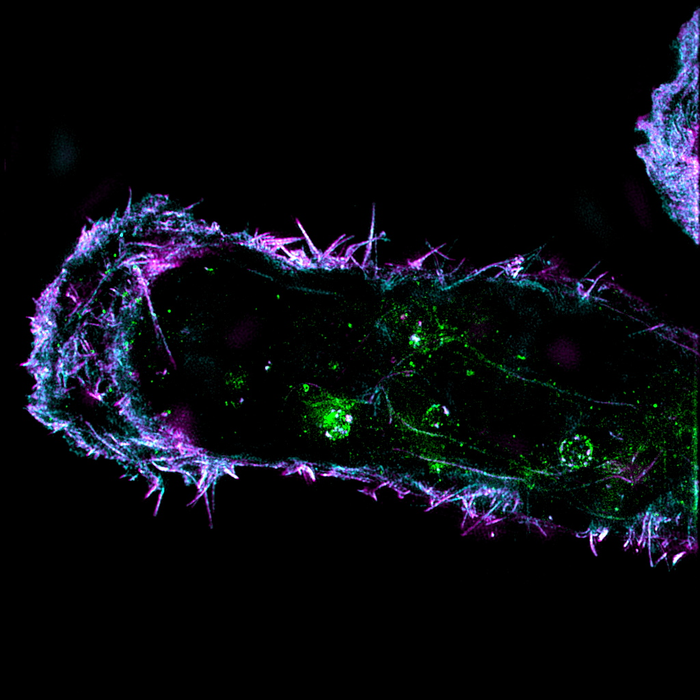
Malignant breast cancer cell

Credit: Paulina Moreno-Layseca and Turku Bioimaging

Researchers have known for decades that human cells migrate by circulating cell surface adhesion receptors from one part of the cell to another. These adhesion receptors, called integrins, are important for normal cell motility, for example, during wound healing. Earlier studies have also shown that cancer cells have developed particularly efficient ways to circulate these receptors in order to spread to the surrounding tissue and to metastasise to other organs.

Professor Johanna Ivaska’s research group at the University of Turku, Finland, has discovered a new mechanism that highly aggressive, so-called triple-negative breast cancer cells use to circulate integrins and migrate in the tissue.

“Human cells constantly renew their surface by first absorbing parts of the cell membrane and then recycling it. This so-called CG endocytosis mechanism is like a constantly moving conveyor belt that also transports soluble nutrients into cells,” Professor Ivaska explains.

Post-doc Researcher Paulina Moreno-Layseca and Doctoral Candidate Niklas Jäntti in Professor Ivaska’s research group discovered that breast cancer cells use the molecule swiprosin-1 to direct the integrin adhesion receptors onto this conveyor belt. By hijacking this conveyor belt mechanism, cancer cells can promote the circulation of integrins, thus increasing cell migration and the formation of metastases.

By studying hundreds of breast cancer specimens, the researchers discovered that a high expression of the swiprosin-1 molecule in the tumour correlates significantly with the formation of metastases and with the malignancy of the breast cancer.

“Our findings open up an entirely new perspective into the function of integrins and reveal a new mechanism which cancer cells can use to spread throughout the body. These results will impact the direction of cancer studies in the future,” says Professor Ivaska.

###


Journal

Nature Cell Biology

DOI

10.1038/s41556-021-00767-x

Article Title

Cargo-specific recruitment in clathrin- and dynamin-independent endocytosis

Article Publication Date

6-Oct-2021

Share13Tweet8Share2ShareShareShare2

Related Posts

New Study Uncovers Mechanism Behind Burn Pit Particulate Matter–Induced Lung Inflammation

New Study Uncovers Mechanism Behind Burn Pit Particulate Matter–Induced Lung Inflammation

February 6, 2026

DeepBlastoid: Advancing Automated and Efficient Evaluation of Human Blastoids with Deep Learning

February 6, 2026

Navigating the Gut: The Role of Formic Acid in the Microbiome

February 6, 2026

AI-Enhanced Optical Coherence Photoacoustic Microscopy Revolutionizes 3D Cancer Model Imaging

February 6, 2026

POPULAR NEWS

  • Robotic Ureteral Reconstruction: A Novel Approach

    Robotic Ureteral Reconstruction: A Novel Approach

    82 shares
    Share 33 Tweet 21
  • Digital Privacy: Health Data Control in Incarceration

    63 shares
    Share 25 Tweet 16
  • Study Reveals Lipid Accumulation in ME/CFS Cells

    57 shares
    Share 23 Tweet 14
  • Breakthrough in RNA Research Accelerates Medical Innovations Timeline

    53 shares
    Share 21 Tweet 13

About

We bring you the latest biotechnology news from best research centers and universities around the world. Check our website.

Follow us

Recent News

Neg-Entropy: The Key Therapeutic Target for Chronic Diseases

Multidisciplinary Evidence-Based Guidelines for Therapeutic Drug Monitoring of Biologics in Inflammatory Bowel Disease

Early Tuberculosis Treatment Lowers Sepsis Mortality in People with HIV

Subscribe to Blog via Email

Enter your email address to subscribe to this blog and receive notifications of new posts by email.

Join 73 other subscribers
  • Contact Us

Bioengineer.org © Copyright 2023 All Rights Reserved.

Welcome Back!

Login to your account below

Forgotten Password?

Retrieve your password

Please enter your username or email address to reset your password.

Log In
No Result
View All Result
  • Homepages
    • Home Page 1
    • Home Page 2
  • News
  • National
  • Business
  • Health
  • Lifestyle
  • Science

Bioengineer.org © Copyright 2023 All Rights Reserved.