• HOME
  • NEWS
  • EXPLORE
    • CAREER
      • Companies
      • Jobs
    • EVENTS
    • iGEM
      • News
      • Team
    • PHOTOS
    • VIDEO
    • WIKI
  • BLOG
  • COMMUNITY
    • FACEBOOK
    • INSTAGRAM
    • TWITTER
Friday, June 26, 2026
BIOENGINEER.ORG
No Result
View All Result
  • Login
  • HOME
  • NEWS
  • EXPLORE
    • CAREER
      • Companies
      • Jobs
        • Lecturer
        • PhD Studentship
        • Postdoc
        • Research Assistant
    • EVENTS
    • iGEM
      • News
      • Team
    • PHOTOS
    • VIDEO
    • WIKI
  • BLOG
  • COMMUNITY
    • FACEBOOK
    • INSTAGRAM
    • TWITTER
  • HOME
  • NEWS
  • EXPLORE
    • CAREER
      • Companies
      • Jobs
        • Lecturer
        • PhD Studentship
        • Postdoc
        • Research Assistant
    • EVENTS
    • iGEM
      • News
      • Team
    • PHOTOS
    • VIDEO
    • WIKI
  • BLOG
  • COMMUNITY
    • FACEBOOK
    • INSTAGRAM
    • TWITTER
No Result
View All Result
Bioengineer.org
No Result
View All Result
Home NEWS Science News Science

Researchers discover CP violation in charm meson decays

Bioengineer by Bioengineer
April 5, 2019
in Science
Reading Time: 2 mins read
0
Share on FacebookShare on TwitterShare on LinkedinShare on RedditShare on Telegram

Researchers from the Higher School of Economics and Yandex, as part of the LHCb collaboration at CERN, have been the first to discover CP violation in charm meson decays. On March 21, representatives of the LHCb collaboration spoke about this recent breakthrough at the Conference on Electroweak Interactions and Unified Theories in La Thuile.

This discovery may become a key to solving the mystery of matter-antimatter asymmetry in the universe.

One of the unsolved problems in physics concerns the abundance of matter over antimatter in the universe. During the first split seconds after the Big Bang, matter and antimatter appeared in equal shares. Today, the observed quantity of antimatter in the universe around us is negligibly small. The physicists are trying to understand where it has gone. According to Soviet academician Andrey Sakharov’s hypothesis from 1967, the matter-antimatter imbalance could have evolved as a result of CP invariance violation (particle-antiparticle symmetry).

In 1973, Makoto Kobayashi and Toshihide Maskawa proposed that a natural explanation for CP violation effect. According to the Kobayashi-Maskawa theory, in the Standard Model of fundamental interaction, CP violation happens through a single phase. However, the manifestation of this effect in the decay of particles containing various heavy quarks strongly depends on the other features of the Standard Model of elementary particles. CP violation in charm D meson decays was expected to come to around 0.1-0.01%.

The LHCb (Large Hadron Collider beauty) experiment was carried out at CERN to study B mesons, unstable particles, in the decay of which the matter-antimatter asymmetry manifests particularly well. Scholars analyzed the data received in an LHCb experiment in 2011-2018 and found that the total number of decays of anti-D0 mesons exceeded the total number of decays of D0 mesons. The result has a statistical significance of 5.3 standard deviations, exceeding the threshold of five standard deviations used by particle physicists to claim a discovery.

‘Studying CP violation is extremely important for understanding the mechanisms of our universe’s evolution,’ explained Denis Derkach, Senior Research Fellow at the Faculty of Computer Science Laboratory of Methods for Big Data Analysis (LAMBDA), adding: ‘The discovery of CP violation in charm meson decays is a big step in the study of this phenomenon in heavy meson decays’.

Furthermore, researchers from HSE and Yandex School of Data Analysis applied AI tools in the study, which improved the quality of LHCb experiment data selection and analysis. Yandex’s computation capacities have also been used to model the LHCb experiment events, which is essential for correct interpretation of the physical results.

‘Thanks to our team efforts, the effectiveness of the trigger used to select significant events was increased by 40% on average,’ said Fedor Ratnikov, Senior Research Fellow at LAMBDA Laboratory. He noted: ‘With the use of neural network Bayesian approaches, we have improved the algorithm for detecting the type of particles observed by the detector. We have also developed a “smart” system for quality monitoring of detector operations’.

###

Media Contact
Liudmila Mezentseva
[email protected]
https://iq.hse.ru/en/news/259717062.html

Tags: Atomic/Molecular/Particle PhysicsComputer ScienceTechnology/Engineering/Computer Science
Share13Tweet8Share2ShareShareShare2

Related Posts

Five or more hours of smartphone usage per day may increase obesity

July 25, 2019
IMAGE

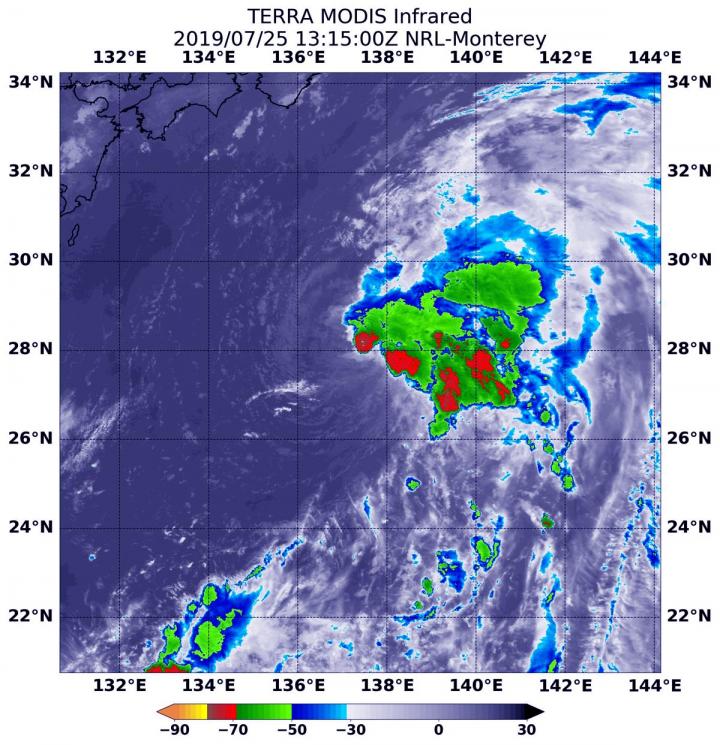
NASA’s terra satellite finds tropical storm 07W’s strength on the side

July 25, 2019

NASA finds one burst of energy in weakening Depression Dalila

July 25, 2019

Researcher’s innovative flood mapping helps water and emergency management officials

July 25, 2019
Please login to join discussion

POPULAR NEWS

  • Saying Goodbye to PGY-6: Pediatric Fellowship Realities

    103 shares
    Share 41 Tweet 26
  • Multi-Hospital Study Reveals Long Covid Burden Is Twice as High as Current Estimates

    92 shares
    Share 36 Tweet 23
  • Detection of EDCs in Breast Milk and Infant Urine Up to Six Months Highlights Early Exposure Risks

    77 shares
    Share 31 Tweet 19
  • New Drug Candidate Developed at McMaster Shows Potential for Treating Brain Cancer

    58 shares
    Share 23 Tweet 15

About

We bring you the latest biotechnology news from best research centers and universities around the world. Check our website.

Follow us

Recent News

Tracking Lanthanide-Labeled Microplastics in Plants

POSTECH Researchers Slash Cost of Reconstituted Cell-Free Systems by 95%

AI and Physics Collaborate to Design Advanced Hydrogen Storage Materials

Subscribe to Blog via Email

Success! An email was just sent to confirm your subscription. Please find the email now and click 'Confirm' to start subscribing.

Join 82 other subscribers
  • Contact Us

Bioengineer.org © Copyright 2023 All Rights Reserved.

Welcome Back!

Login to your account below

Forgotten Password?

Retrieve your password

Please enter your username or email address to reset your password.

Log In
No Result
View All Result
  • Homepages
    • Home Page 1
    • Home Page 2
  • News
  • National
  • Business
  • Health
  • Lifestyle
  • Science

Bioengineer.org © Copyright 2023 All Rights Reserved.