Credit: Washington State University
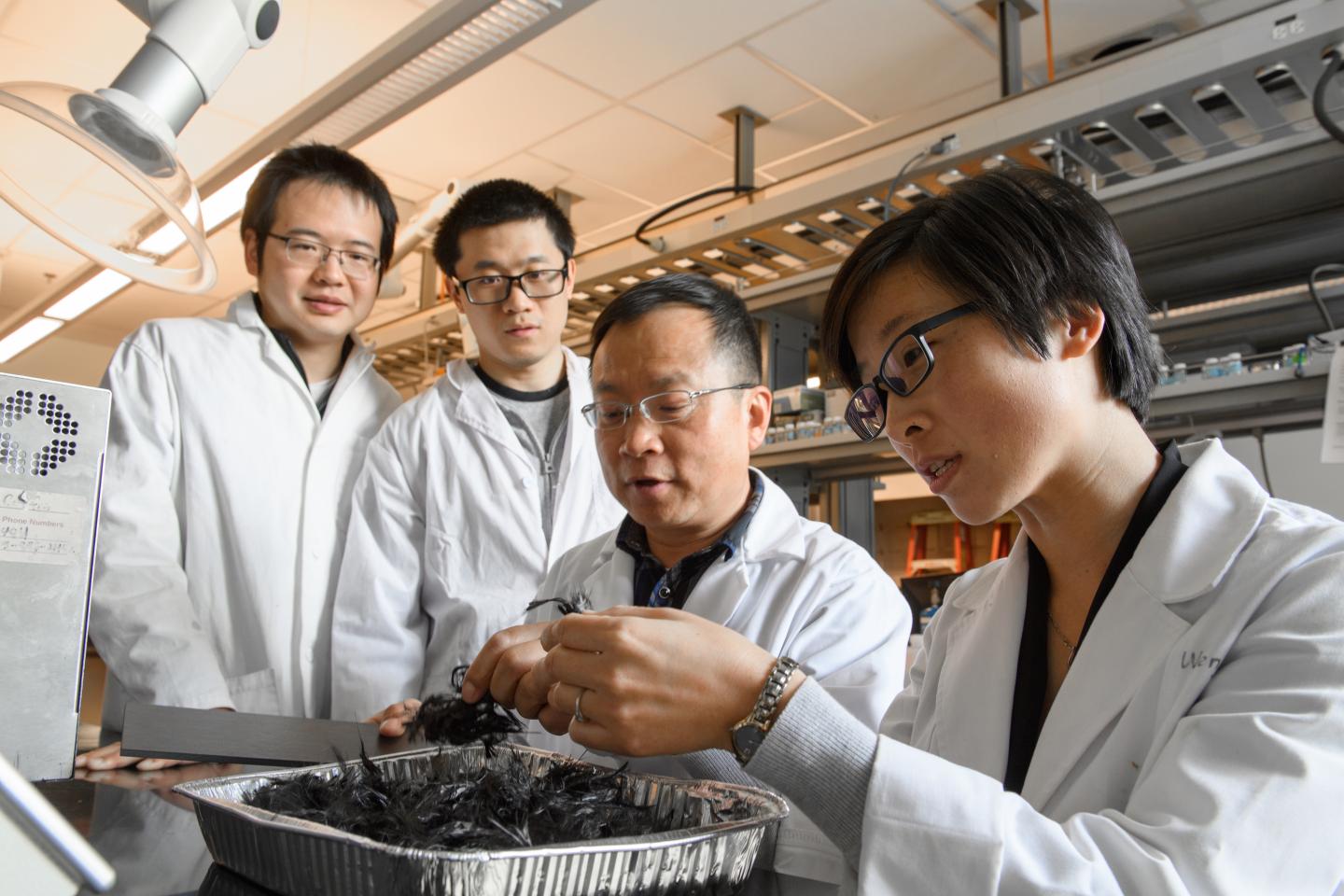
PULLMAN, Wash. – A WSU research team for the first time has developed a promising way to recycle the popular carbon fiber plastics that are used in everything from modern airplanes and sporting goods to the wind energy industry.
The work, reported in Polymer Degradation and Stability, provides an efficient way to re-use the expensive carbon fiber and other materials that make up the composites.
Planes, windmills, many products
Carbon fiber reinforced plastics are increasingly popular in many industries, particularly aviation, because they are light and strong. They are, however, very difficult to break down or recycle, and disposing of them has become of increasing concern. While thermoplastics, the type of plastic used in milk bottles, can be melted and easily re-used, most composites used in planes are thermosets. These types of plastics are cured and can't easily be undone and returned to their original materials.
Caustic chemicals eliminated
To recycle them, researchers mostly have tried grinding them down mechanically or breaking them down with very high temperatures or harsh chemicals to recover the expensive carbon fiber. Oftentimes, however, the carbon fiber is damaged in the process. The caustic chemicals used are hazardous and difficult to dispose of. They also destroy the matrix resin materials in the composites, creating a messy mixture of chemicals and an additional waste problem.
Mild chemicals, low temperatures
In their project, Jinwen Zhang, a professor in the School of Mechanical and Materials Engineering, and his team developed a new chemical recycling method that used mild acids as catalysts in liquid ethanol at a relatively low temperature to break down the thermosets. In particular, it was the combination of chemicals that proved effective, said Zhang, who has a chemistry background. To break down cured materials effectively, the researchers raised the temperature of the material so that the catalyst-containing liquid can penetrate into the composite and break down the complex structure. Zhang used ethanol to make the resins expand and zinc chloride to break down critical carbon-nitrogen bonds.
"It is critical to develop efficient catalytic systems that are capable of permeating into the cured resins and breaking down the chemical bonds of cured resins," he said.
Preserving fibers for re-use
The researchers were able to preserve the carbon fibers as well as the resin material in a useful form that could be easily re-used. They have filed for a patent and are working to commercialize their methods.
###
The work was funded by the Joint Center for Aerospace Technology Innovation (JCATI) in collaboration with industry partner, Global Fiberglass Solutions. The state-funded JCATI works to support the Washington's aerospace industry by pursuing research that is relevant to aerospace companies and by providing industry-focused research opportunities. In addition to Zhang, researchers on the project included Junna Xin, assistant research professor, Tuan Liu, postdoctoral research associate, and graduate student Xiaolong Guo. The research is in keeping with WSU's Grand Challenges initiative stimulating research to address some of society's most complex issues. It is particularly relevant to the challenge of "Smart Systems" and its theme of foundational and emergent materials.
Media Contact
Jinwen Zhang, WSU professor
[email protected]
509-335-8723
@WSUNews
############
Story Source: Materials provided by Scienmag