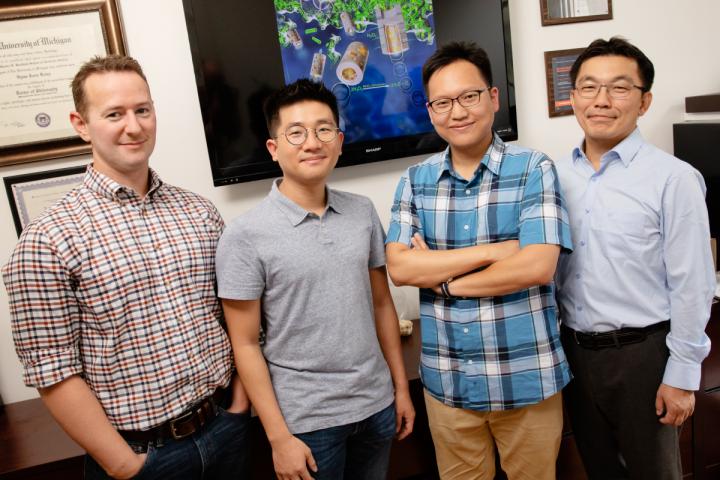
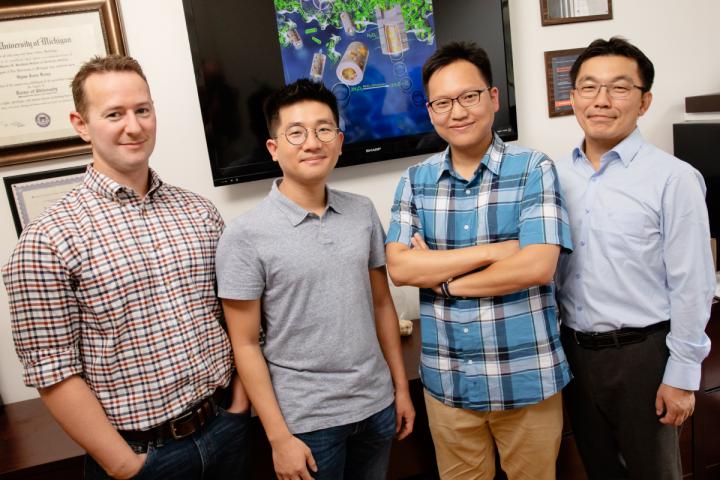
Credit: Photo by L. Brain Stauffer
CHAMPAIGN, Ill. — Stiff microbial films often coat medical devices, household items and infrastructure such as the inside of water supply pipes, and can lead to dangerous infections. Researchers have developed a system that harnesses the power of bubbles to propel tiny particles through the surfaces of these tough films and deliver an antiseptic deathblow to the microbes living inside.
Biofilms are slimy colonies of microbes held together by internal scaffolds, clinging to anything they touch. About 80 percent of all medical infections originate from biofilms that invade the inner workings of hospital devices and implants inside patients. Eradication is difficult because traditional disinfectants and antibiotics cannot effectively penetrate a biofilm's tough surface, the researchers said.
In the journal Applied Materials and Interfaces, a team led by researchers at the University of Illinois at Urbana-Champaign describes how they used diatoms – the tiny skeletons of algae – loaded with an oxygen-generating chemical to destroy microbes.
"Most of us get those black or yellow spots in our showers at home," said co-author Hyunjoon Kong, a professor of chemical and biomolecular engineering and a Carle Illinois College of Medicine affiliate. "Those spots are biofilms and most of us know it takes a lot of energy to scrub them away. Imagine trying to do this inside the confined space of the tubing of a medical device or implant. It would be very difficult."
Looking to nature and basic mechanics for a solution, the researchers developed a system that uses naturally abundant diatoms along with hydrogen peroxide and tiny oxygen-generating sheets of the compound manganese oxide.
"We could have fabricated a particle using 3D printers, but luckily nature already provided us with a cheap and abundant option in diatoms," said co-author and postdoctoral researcher Yongbeom Seo. "The species of diatom we selected are hollow, highly porous and rod-shaped, providing a lot of surface area for the bubbles to form and a channel for the bubbles to escape."
The chemical reaction between the hydrogen peroxide and manganese oxide nanosheets takes place within the empty space inside the diatom. The result is a flourish of microbubbles that flow through the tiny channel, propelling the rigid diatoms forward with enough force to break up the surface and internal structure of the biofilms, the researchers said.
To see a video of the microbubblers in action, click here.
"We dope the particles with nanosheets of manganese oxide, then mix them with hydrogen peroxide and apply that to the surface of the biofilm," Kong said. "Once the diatoms break through to the internal structure of the biofilm, they continue to expel bubbles and facilitate the entry of hydrogen peroxide, which is an effective disinfectant against bacteria and fungus."
The researchers believe that their success is a result of a decision to focus on the mechanical aspects of biofilm destruction, not the chemical aspects of simply killing microbes.
"We have arrived at a mechanistic solution for this problem and the possibilities for this technology are endless," said co-author Simon Rogers, a professor of chemical and biomolecular engineering. "We are discussing our research with clinicians who have many exciting ideas of how to use this system that we did not even think of originally, such as the removal of dental plaque."
###
U. of I. researchers Jiayu Leong, Jun Dong Park, Yu-Tong Hong, Yu-Heng Deng, Vitaliy Dushnov and Joonghui Soh also contributed to this study. Additional co-authors include Sang-Hyon Chu of the National Institute of Aerospace, Cheol Park of the NASA Langley Research Center, Dong Hyun Kim of the Korea Institute of Industrial Technology and Yi Yan-Yang of the Institute of Bioengineering and Nanotechnology in Singapore.
The National Institutes of Health, the National Science Foundation and the Korea Institute of Industrial Technology supported this research.
Editor's notes:
To reach Hyunjoon Kong, call 217-333-1178; [email protected].
The paper "Diatom microbubbler for active biofilm removal in confined spaces" is available online and from the U. of I. News Bureau. DOI: 10.1021/acsami.8b08643
Media Contact
Lois Yoksoulian
[email protected]
217-244-2788
@NewsAtIllinois
http://www.illinois.edu
Original Source
https://news.illinois.edu/view/6367/696123 http://dx.doi.org/10.1021/acsami.8b08643