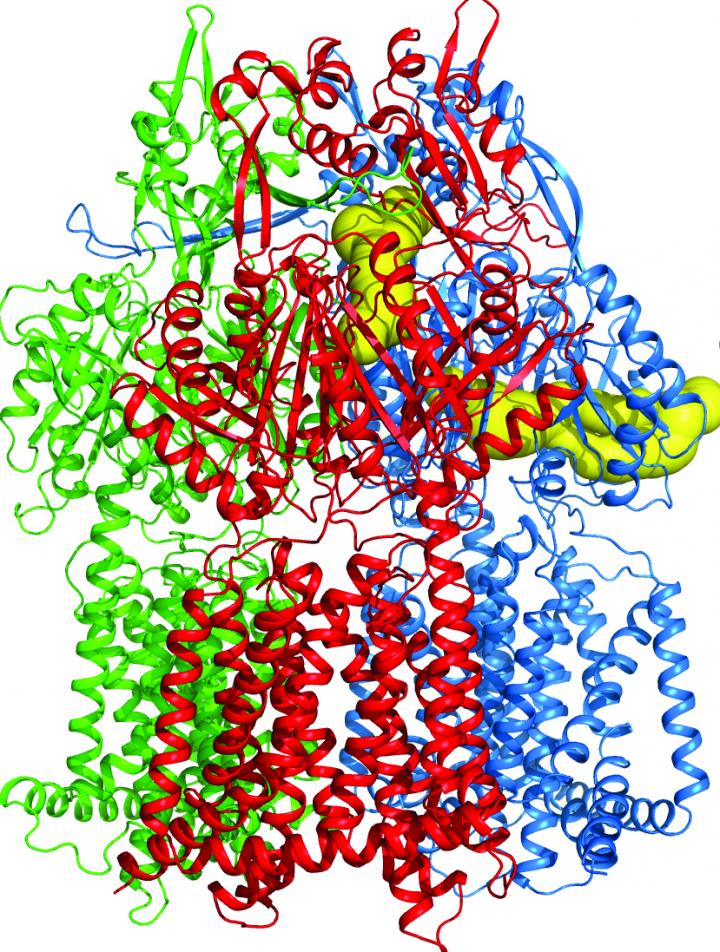

Credit: Edward Yu/Iowa State University
AMES, Iowa – Two new discoveries from Edward Yu's Iowa State University laboratory are adding to the scientific understanding of how bacteria resist antibiotics.
Yu and his research group have just described two structures and mechanisms – efflux pumps and reinforced cell walls – that certain disease-causing bacteria use to keep antibiotics away. That understanding could one day lead to new treatments that disable the structures and restore the effectiveness of drugs.
"We study a lot of efflux pumps to understand antibiotic resistance," said Yu, an Iowa State professor with appointments in physics and astronomy; chemistry; biochemistry, biophysics and molecular biology; and the U.S. Department of Energy's Ames Laboratory. "Cell wall remodeling is also a major mechanism to work against antibacterial drugs.
"The structure and mechanism depend on the bacteria you're talking about – and the bacteria will find a way."
Two journals have just published the latest findings by Yu's research group:
- A paper published online by Nature Communications describes how the Campylobacter jejuni bacterium, which causes a digestive tract inflammation (enterocolitis) and associated diarrhea, uses a three-molecule efflux pump to extrude antibacterial drugs. The project is a collaboration of Yu; Yeon-Kyun Shin, Iowa State's Roy J. Carver Professor of Biochemistry, Biophysics and Molecular Biology; and Qijing Zhang, an Iowa State associate dean of veterinary medicine and the Dr. Frank K. Ramsey Endowed Chair in Veterinary Research. Chih-Chia "Jack" Su, an Iowa State associate scientist; Linxiang Yin, an Iowa State graduate student; and Nitin Kumar, an Iowa State doctoral student; are first authors.
Previous studies reported the three molecules of the pump worked in a synchronized rotation – one molecule accessing, one molecule binding and one molecule extruding – to pump antibiotics from the cell. Yu's research group found that each part of the pump worked independently of the others, essentially creating three pumps in one structure.
"The three independent pumps make it a more powerful multidrug efflux pump," Yu said.
- A paper published online by the Proceedings of the National Academy of Sciences Early Edition describes how the Burkholderia multivorans bacterium, which can cause pneumonia in people with immune deficiencies or lung diseases such as cystic fibrosis, is able to remodel and strengthen its cell wall, closing the door to a range of antimicrobial drugs. Kumar and Su are first authors.
The paper focuses on how these bacteria transport hopanoid lipid compounds to their outer cell membranes. The compounds contribute to membrane stability and stiffness.
"Overall our data suggest a novel mechanism for hopanoid transport involved in cell wall remodeling, which is critical for mediating multidrug resistance in Burkholderia," the authors wrote in a project summary.
Grants from the National Institutes of Health supported both studies. Grants from the U.S. Department of Energy also supported ultra-bright, high-energy X-ray experiments at the Advanced Photon Source at Argonne National Laboratory in Illinois.
Yu and his research group have a long history of successfully using X-ray crystallography to describe and understand the structure of pumps, transporters and regulators in bacteria. A gallery on his research group's website shows ribbon diagrams of 21 different structures.
Because of Yu's significant contribution to the understanding of antimicrobial resistance in bacteria, the American Academy of Microbiology elected him to be an academy fellow earlier this year.
With that comprehensive understanding of the structures and mechanisms behind bacterial resistance to antibiotics, Yu said his research group is beginning to look at how the pumps and transporters can be turned off.
"We're trying to find an inhibitor compound," Yu said. "We're thinking about doing a little more translational science. We have a lot of rich information about the structure and function of these pumps. Why not use it?"
###
Media Contact
Edward Yu
[email protected]
515-294-4955
@IowaStateUNews
http://www.iastate.edu
Related Journal Article
http://dx.doi.org/10.1038/s41467-017-00217-z