• HOME
  • NEWS
  • EXPLORE
    • CAREER
      • Companies
      • Jobs
    • EVENTS
    • iGEM
      • News
      • Team
    • PHOTOS
    • VIDEO
    • WIKI
  • BLOG
  • COMMUNITY
    • FACEBOOK
    • INSTAGRAM
    • TWITTER
Friday, August 28, 2026
BIOENGINEER.ORG
No Result
View All Result
  • Login
  • HOME
  • NEWS
  • EXPLORE
    • CAREER
      • Companies
      • Jobs
        • Lecturer
        • PhD Studentship
        • Postdoc
        • Research Assistant
    • EVENTS
    • iGEM
      • News
      • Team
    • PHOTOS
    • VIDEO
    • WIKI
  • BLOG
  • COMMUNITY
    • FACEBOOK
    • INSTAGRAM
    • TWITTER
  • HOME
  • NEWS
  • EXPLORE
    • CAREER
      • Companies
      • Jobs
        • Lecturer
        • PhD Studentship
        • Postdoc
        • Research Assistant
    • EVENTS
    • iGEM
      • News
      • Team
    • PHOTOS
    • VIDEO
    • WIKI
  • BLOG
  • COMMUNITY
    • FACEBOOK
    • INSTAGRAM
    • TWITTER
No Result
View All Result
Bioengineer.org
No Result
View All Result
Home NEWS Science News Biology

Researchers analyze artifacts to better understand ancient dietary practices

Bioengineer by Bioengineer
December 11, 2019
in Biology
Reading Time: 3 mins read
0
IMAGE
Share on FacebookShare on TwitterShare on LinkedinShare on RedditShare on Telegram

IMAGE

Credit: Shanti Morell-Hart

New research from anthropologists at McMaster University and California State University, San Bernardino (CSUSB), is shedding light on ancient dietary practices, the evolution of agricultural societies and ultimately, how plants have become an important element of the modern diet.

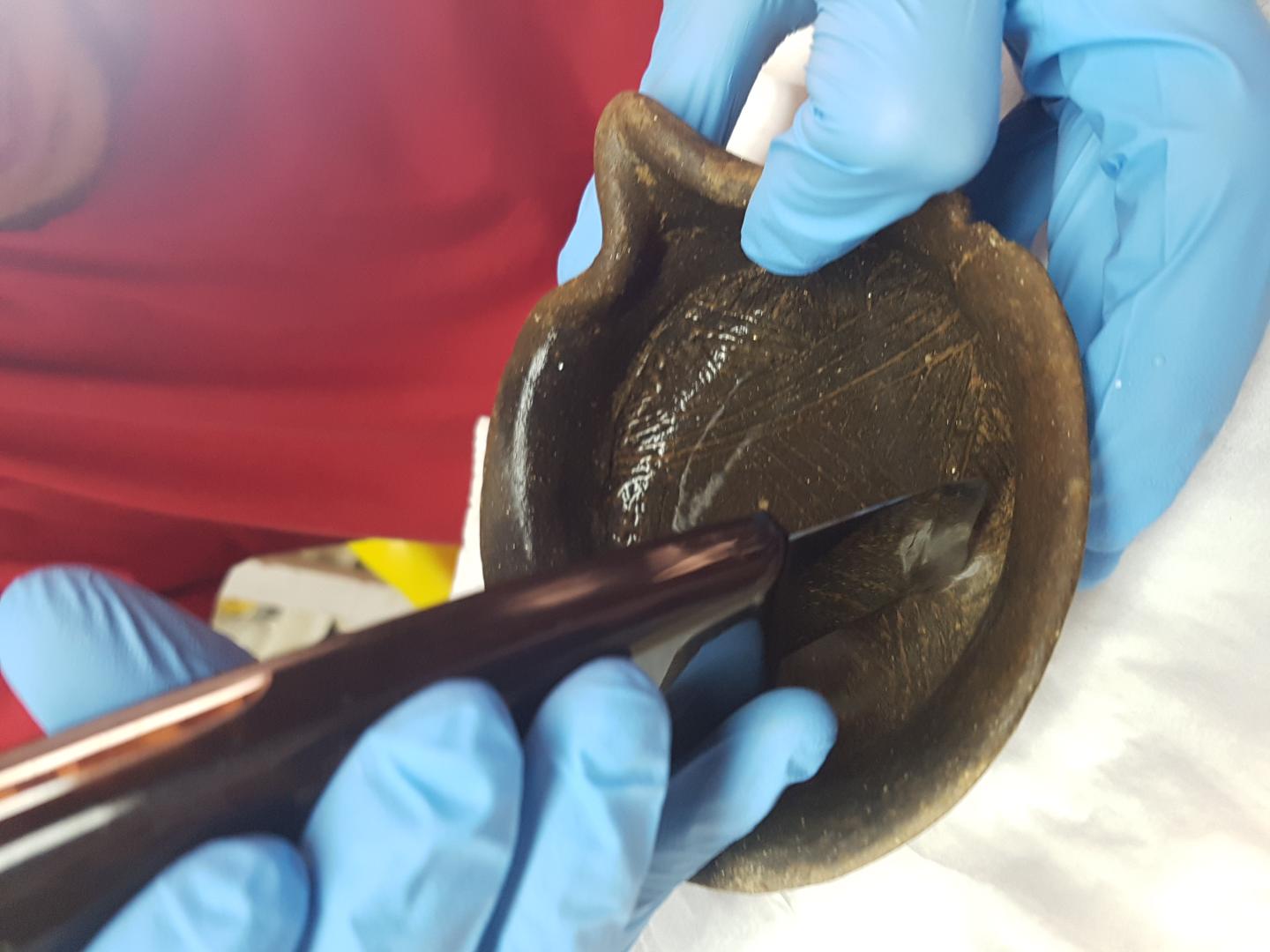
Researchers examined plant remains found on ceramic artifacts such as bowls, bottles and jars, and stone tools such as blades and drills, dating to the Early Formative period (2000-1000 BCE), which were excavated from the village site of La Consentida, located in the coastal region of Oaxaca in southwest Mexico.

They focused on remnants of starch grains, which are where plants store energy, and phytoliths, also known as ‘microfossils,’ a rigid, microscopic structure made of silica which is produced by plants and can survive the decay process. Both types of microbotanical remains are routinely recovered from artifacts to analyze ancient foodways.

A careful analysis found the remains of flowering plants, wild bean families and grasses, including maize. The findings support existing evidence that the village was transitioning from a broad, Archaic period (7000-2000 BCE) diet to one based on agriculture.

“This is an important piece of the puzzle. The work provides us with a better idea of how plants became cultivated and how they made their way to our plates,” explains Éloi Bérubé, a graduate student in the Department of Anthropology at McMaster University, who conducted the work with advisor Shanti Morell-Hart, an assistant professor of anthropology.

“It gives us a more complete understanding of the daily activities that played a significant role in ancient societies,” he says.

For example, researchers found maize microfossils pointing to the storage and processing of different parts of the plant, as well as indications of heat damage, likely caused by cooking. Evidence of maize and wild beans was also found in artifacts used for burial offerings.

“The Early Formative was a key moment of social transformation for native peoples of Mesoamerica,” says Guy Hepp, director of the La Consentida Archaeological Project and assistant professor of anthropology at CSUSB. “La Consentida was among Mesoamerica’s earliest villages, and these new dietary results help us better understand some of the changes the community was experiencing, including a shift toward permanent settlements and the beginnings of social complexity.”

Combined with other evidence from the site, including variations in burial offerings and the diversity of human depictions in small-scale ceramic figurines, this study suggests that the community was in the early stages of establishing a complex social organization.

The artifacts considered for the study come from a variety of contexts at La Consentida, including mounded earthen architecture, the spaces around ancient houses, and even human burials.

Pottery from the site includes jars used in domestic and communal cooking events and likely also for storage. Some of the jars were later reused as offerings with human burials. Decorative bowls were likely used for serving foods at communal feasts. Ceramic bottles, also found in feasting refuse, likely held beverages brewed from maize and possibly even cacao.

###

The research is published in the Journal of Archaeological Science: Reports.

Media Contact
Michelle Donovan
[email protected]
905-525-9140

Related Journal Article

http://dx.doi.org/10.1016/j.jasrep.2019.102047

Tags: AgricultureArchaeologyFood/Food ScienceOld WorldPlant Sciences
Share12Tweet8Share2ShareShareShare2

Related Posts

Machine learning reveals HLA-DQ2.5’s impact on naïve T-cell receptors in celiac disease

Machine learning reveals HLA-DQ2.5’s impact on naïve T-cell receptors in celiac disease

August 28, 2026
Combining noncoding RNA profiles and HPV genotyping improves cervical cancer risk assessment

Combining noncoding RNA profiles and HPV genotyping improves cervical cancer risk assessment

August 28, 2026

Scientists develop reporter strain to detect inhibition of bacterial cell-wall biosynthesis

August 28, 2026

Scientists characterize soybean alien addition lines and phenotypic variation from intersubgeneric crosses

August 28, 2026
Please login to join discussion

POPULAR NEWS

  • Supporting Behavior Change in a New Era of Obesity Care

    29 shares
    Share 12 Tweet 7
  • BioFire Respiratory Panel Improves Syndromic Diagnosis of Suspected COVID-19 Infections in Madagascar

    29 shares
    Share 12 Tweet 7
  • Balancing Brain and Lung Care: Strategies for ARDS in Acute Brain Injury

    29 shares
    Share 12 Tweet 7
  • Review maps statistical methods for harmonizing historical longitudinal epidemiological data

    29 shares
    Share 12 Tweet 7

About

We bring you the latest biotechnology news from best research centers and universities around the world. Check our website.

Follow us

Recent News

Supporting Behavior Change in a New Era of Obesity Care

BioFire Respiratory Panel Improves Syndromic Diagnosis of Suspected COVID-19 Infections in Madagascar

Balancing Brain and Lung Care: Strategies for ARDS in Acute Brain Injury

Subscribe to Blog via Email

Enter your email address to subscribe to this blog and receive notifications of new posts by email.

Join 85 other subscribers
  • Contact Us

Bioengineer.org © Copyright 2023 All Rights Reserved.

Welcome Back!

Login to your account below

Forgotten Password?

Retrieve your password

Please enter your username or email address to reset your password.

Log In
No Result
View All Result
  • Homepages
    • Home Page 1
    • Home Page 2
  • News
  • National
  • Business
  • Health
  • Lifestyle
  • Science

Bioengineer.org © Copyright 2023 All Rights Reserved.