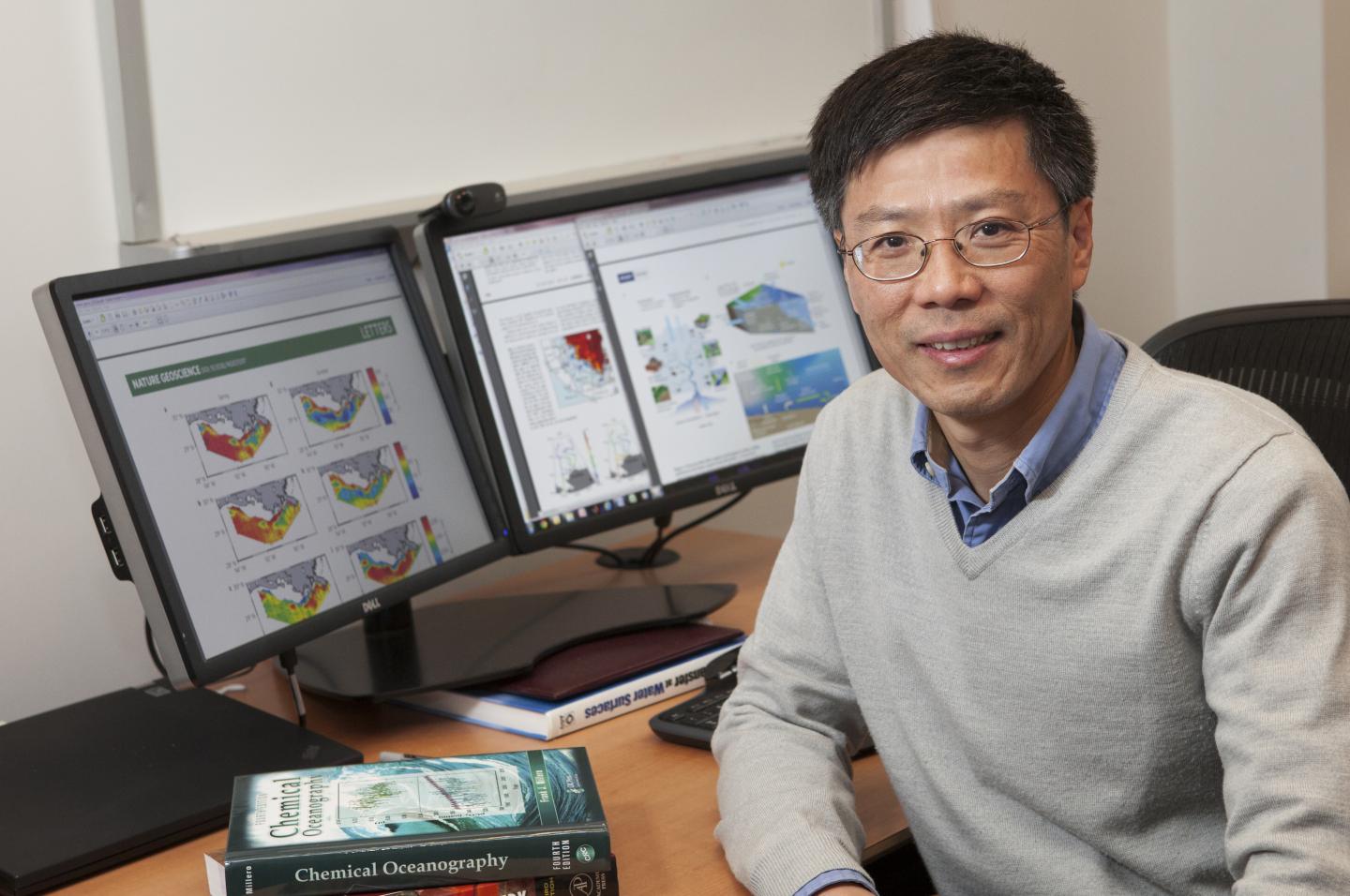
Credit: University of Delaware
University of Delaware Prof. Wei-Jun Cai, who has done pioneering work on carbon biogeochemistry in estuaries and coastal waters, has been named to the American Geophysical Union's 2017 Class of Fellows.
Cai is the Mary A.S. Lighthipe Professor in the College of Earth, Ocean, and Environment.
Designation as a fellow honors those who have made exceptional scientific contributions and "gained prominence" in the fields of earth and space sciences.
The elite appointment distinguishes Cai among his peers as only one in a thousand members are elected for fellowship annually. He is among 61 new fellows selected in 2017 from 10 countries.
"Dr. Cai's election recognizes his remarkable career investigating carbon cycling and reflects positively on our programs and the University," said Mark Moline, director of the School of Marine Science and Policy in UD's College of Earth, Ocean, and Environment.
Cai was selected for "ground-breaking research and scientific leadership on estuarine and coastal biogeochemical processes and their relationship to the global carbon cycle."
His pioneering work on carbon biogeochemistry in estuarine and coastal waters significantly advanced what scientists know about how coastal processes affect the global carbon budget. Understanding how carbon flows between land, air and water is key to predicting how much greenhouse gas emissions the earth, atmosphere and ocean can tolerate over a given time period to keep global warming and climate change at thresholds considered tolerable.
In particular, Cai's work has focused on collecting and analyzing copious amounts of data to develop conceptual models that can help scientists better predict, understand and accurately quantify the changes being observed in the coastal and global ocean.
Prior to joining UD in 2013, Cai spent nearly two decades exploring how carbon dioxide and oxygen levels varied with physical and biological processes in estuarine and continental shelf waters in the U.S. Southeast and the Gulf of Mexico, as well as in the coastal seas of China. Following the 2010 Deepwater Horizon oil spill in the Gulf of Mexico, he developed a method for identifying the impact oil — and the carbon inherently contained within it — has on ocean acidification levels. A paper led by Cai was published in the journal Nature Geosciences in 2010.
At UD, Cai's research has explored how changes in land use and energy consumption elevate carbon and nutrient levels in estuaries and the coastal ocean. Along with several UD colleagues, Cai is interested in understanding the biogeochemical processes that contribute to coastal ocean acidification in bottom waters and sediments and what effect this change in water chemistry may have on bottom dwelling organisms, since increases in acidity in the water can affect the ability of some marine organisms, such as shellfish, to create and maintain their shells.
Over the past 10 years, Cai has led an international team of collaborators that is studying how melting sea ice will affect the ocean's ability to sequester carbon dioxide in a warmer climate. The team's most recent work reported that ocean acidification is spreading rapidly in Arctic Ocean in area and depth. The study, published in the journal Nature Climate Changes (March 2017), showed that the Western Arctic Ocean is the first open-ocean region where scientists have directly observed large scale expansion of acidified water in the upper water column. The work raises new questions and emphasizes the need to better understand the relationship between climate change and the impact that ocean acidification may have on the global ocean.
Cai and the other 2017 fellows will be recognized at the AGU Fall meeting in New Orleans in December. AGU boasts a global membership of more than 60,000 members.
At UD, Cai joins George Luther, Maxwell P. and Mildred H. Harrington Professor of Oceanography, who was named an AGU fellow in 2012. Luther was selected for "his pioneering research in redox reactions, trace element speciation and development of novel in situ electrochemical methods."
###
Media Contact
Peter Bothum
[email protected]
302-831-1418
@UDResearch
http://www.udel.edu