Kamaʻehuakanaloa (formerly Lōʻihi Seamount), a submarine Hawaiian volcano located about 20 miles off the south coast of the Big Island of Hawai‘i, has erupted at least five times in the last 150 years, according to new research led by Earth scientists at the University of Hawai‘i at Mānoa. For the first time, scientists were able to estimate the ages of the most recent eruptions of Kamaʻehu, as well as the ages of eight additional older eruptions at this volcano going back about 2,000 years. Their findings were published recently in Geology.
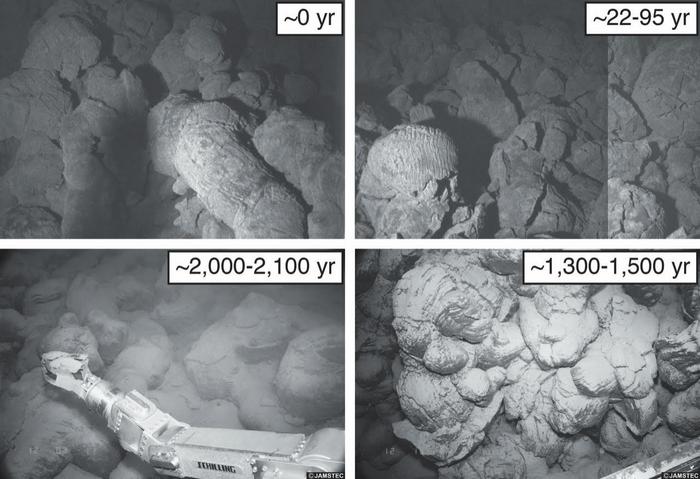
Credit: The two images on the bottom are courtesy of JAMSTEC.
Kamaʻehuakanaloa (formerly Lōʻihi Seamount), a submarine Hawaiian volcano located about 20 miles off the south coast of the Big Island of Hawai‘i, has erupted at least five times in the last 150 years, according to new research led by Earth scientists at the University of Hawai‘i at Mānoa. For the first time, scientists were able to estimate the ages of the most recent eruptions of Kamaʻehu, as well as the ages of eight additional older eruptions at this volcano going back about 2,000 years. Their findings were published recently in Geology.
Hawaiian volcanoes are thought to transition through a series of growth stages. Kamaʻehu is currently in the earliest submarine “pre-shield” stage of growth, whereas the active neighboring volcano Kīlauea is in its main shield-building stage.
“Kamaʻehu is the only active and exposed example of a pre-shield Hawaiian volcano,” said Aaron Pietruszka, lead author of the study and associate professor in the Department of Earth Sciences at the UH Mānoa School of Ocean and Earth Science and Technology (SOEST). “On the other Hawaiian volcanoes, this early part of the volcanic history is covered by the great outpouring of lava that occurs during the shield stage. Thus, there is great interest in learning about the growth and evolution of Kama‘ehu.”
Kama‘ehu’s history revealed with chemistry and underwater videos
Previously, the only known and confirmed eruption of Kamaʻehu was the one that occurred in 1996, an event that was only discovered because it coincided with a large swarm of earthquakes that were detected remotely by seismometers on the Big Island.
“Seismometers can only be used to detect the ongoing active eruptions of submarine volcanoes because earthquakes are transient,” said Pietruszka. “In order to determine the ages of older eruptions at Kamaʻehu, we took a different approach. We used a mass spectrometer to measure tiny amounts of the isotope radium-226 in pieces of quenched glassy lava that were sampled from the seafloor outcrops of Kamaʻehu using a submersible.”
Magma naturally contains radium-226, which radioactively decays at a predictable rate. So, Pietruzska and co-authors used the amount of radium-226 in each sample to infer the approximate time elapsed since the lava was erupted on the seafloor, that is, the eruption age of the sample.
Pietruszka started this investigation many years ago as a postdoctoral researcher at the Carnegie Institution for Science, just after finishing his doctoral degree in Earth science from SOEST. Once he returned to UH Mānoa in 2019, he got access to submersible dive videos and photos around Kama‘ehu and had the information he needed to finish connecting the dots.
“The submersible dive images and videos provided independent confirmation of our estimates of eruption ages,” said Pietruszka. “The lavas with the freshest appearance also had the most radium-226, and vice versa for the lavas with the ‘older’ appearance, that is, fractured and broken, and/or covered with marine sediment. I was surprised to discover that Kama’ehu had erupted five times within the last ~150 years, which implies a frequency of ~30 years between eruptions at this volcano. This is much slower than at Kīlauea, which erupts almost continuously (with infrequent pauses of only a few years).”
Chemical changes in lava over time
The chemistry of the lava erupted from Hawaiian volcanoes changes over time. The new eruption ages for the lavas from Kama‘ehu, coupled with measurements of lava chemistry, reveal that the timescale of variation in lava chemistry at this pre-shield volcano is about 1200 years. In contrast, Kīlauea lava chemistry changes over a timescale of only a few years to decades, with a complete cycle over about 200 years.
“We think that the origin of this difference is related to the position of the two volcanoes over the Hawaiian hotspot,” said Pietruszka. “This is an area of Earth’s mantle that is rising toward the surface—a “mantle plume” that ultimately melts to form the magma that supplies Hawaiian volcanoes. Models and other isotope data from thorium-230 suggest that the center of a mantle plume should rise faster than its margin. Our results—specifically, the factor of six longer timescale of variation in lava chemistry at Kama’ehu—provides independent confirmation of this idea.”
The research team hopes to better understand how Hawaiian volcanoes work from their earliest growth stages to their full, and frequently active, maturity to help them understand the deep controls on volcanic eruptions that initiate within the mysterious, upwelling mantle plume under the Hawaiian hotspot.
Journal
Geology
DOI
10.1130/G51350.1
Method of Research
Data/statistical analysis
Subject of Research
Not applicable
Article Title
Slow changes in lava chemistry at Kama‘ehuakanaloa linked to sluggish mantle upwelling on the margin of the Hawaiian plume
Article Publication Date
26-May-2023
COI Statement
Authors report, “there is not a duality of interest.”