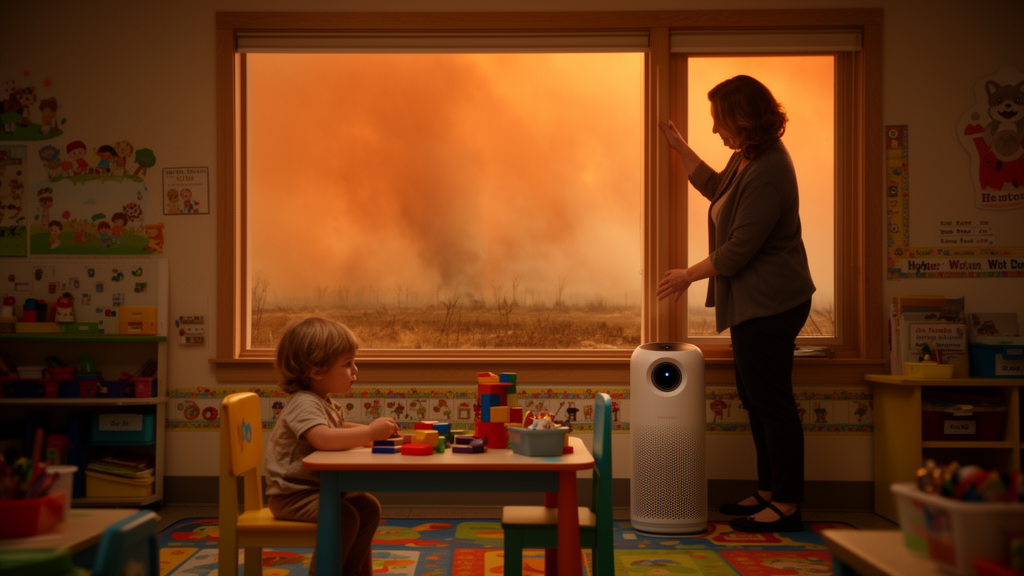
Wildfire smoke does not stay outdoors. A study of Oklahoma Head Start centers serving children from birth to age five found that indoor fine particulate matter (PM2.5) rose on days when smoke plumes passed over the region, and that greater regional wildfire activity was linked to higher odds of sick-related absences among enrolled children. The findings, published in the Journal of Exposure Science & Environmental Epidemiology, address a population and a region that wildfire-air-quality research has largely overlooked: early care and education classrooms outside the western United States.
The analysis drew on Cohort 1 of the OK-AIR trial, a cluster-randomized 2×2 factorial study conducted during 2023–2024. Five centers, 20 classrooms, and 204 children took part. Classrooms were randomized to one of four conditions: control, portable HEPA filtration, upper-room ultraviolet germicidal irradiation (UVGI), or a combination of HEPA and UVGI. Indoor PM2.5 was monitored continuously in the classrooms and paired with hourly outdoor PM2.5 data from the US Environmental Protection Agency.
To classify smoke exposure, the researchers used the National Oceanic and Atmospheric Administration’s Hazard Mapping System, identifying wildfire smoke-impacted and non-impacted days in February and March 2024.
The intervention analysis produced a notable but carefully qualified result. After adjusting for outdoor PM2.5, the intervention-period indicator was associated with 29.0% lower indoor PM2.5 during smoke-impacted days, with a 95% confidence interval of 22.8–34.7%. However, the authors emphasized that this comparison pooled the Baseline and Intervention periods across all randomized arms, including control classrooms. It therefore cannot isolate the effect of HEPA filtration, UVGI, or their combination; it should be read as a period association rather than an arm-specific estimate of any single technology’s benefit.
The absenteeism analysis took a different approach. Using data from four centers and 16 classrooms, the researchers modeled sick-related absences with a binomial generalized linear model, pairing daily attendance records with a seven-day rolling average of a regional fire-detection metric derived from NASA’s FIRMS/VIIRS satellite instrument. Each increase of 100 fire detections in the rolling mean was associated with higher odds of a sick-related absence (odds ratio 1.106, 95% CI 1.018–1.201, p = 0.018). The association was modest but statistically reliable, suggesting that regional wildfire activity tracks with illness-driven absences in these early childhood settings.
The study also probed whether the intervention changed the relationship between wildfire activity and absences. Here the data were less conclusive: the wildfire-by-period interaction was imprecise, and the authors state that the study was insufficient to detect or exclude meaningful effect modification. In other words, the trial could not determine whether the filtration and UVGI measures altered the link between smoke and sickness.
The technical design reflects the challenges of measuring smoke exposure in real classrooms.
Why does this matter for the youngest children? Yet the authors note that evidence on wildfire smoke in ECE settings has been sparse, particularly for non-Western US regions and for smoke-mitigation strategies tested directly in childcare classrooms.
The study’s limitations are clearly stated. With only five centers and 20 classrooms in Cohort 1, and a smoke-impacted window confined to February and March 2024, the statistical power was limited, particularly for interaction terms. The pooled-period design means the 29% reduction cannot be attributed to any specific device.
Even with those caveats, the findings carry practical weight. They document that wildfire smoke measurably degrades air inside early childhood classrooms in a region rarely studied, that in-building interventions coincided with substantially lower indoor PM2.5 during smoke events, and that satellite-based fire metrics can flag periods of elevated illness-related absenteeism. For Head Start programs and childcare operators far from the western fire frontier, the study offers both a warning and a starting point: smoke reaches their classrooms, and mitigation strategies may help, though which specific technology delivers the benefit remains an open question for future arm-specific analyses.
Subject of Research: Wildfire smoke exposure, indoor and outdoor PM2.5, and sick-related absenteeism in Oklahoma Head Start early care and education centers
Article Title: Wildfire smoke, indoor and outdoor PM2.5, and sick-related absenteeism in Oklahoma Head Start early care and education centers
Article References: Fan, H.-C., Zhu, Y., Zhu, M., Van Pay, C. K., Horm, D., & Cai, C. (2026). Wildfire smoke, indoor and outdoor PM2.5, and sick-related absenteeism in Oklahoma Head Start early care and education centers. Journal of Exposure Science & Environmental Epidemiology. https://doi.org/10.1038/s41370-026-00993-1
Image Credits: AI Generated
DOI: 10.1038/s41370-026-00993-1
Keywords: wildfire smoke, PM2.5, indoor air quality, Head Start, early care and education, HEPA filtration, UVGI, absenteeism, children's health, Oklahoma, NOAA Hazard Mapping System, FIRMS VIIRS
News Source: Courtney Benton. (October 27, 2026). Research report: Wildfire smoke, indoor and outdoor PM2.5, and sick-related absenteeism in Oklahoma Head Start early care and education centers. Scienmag.