


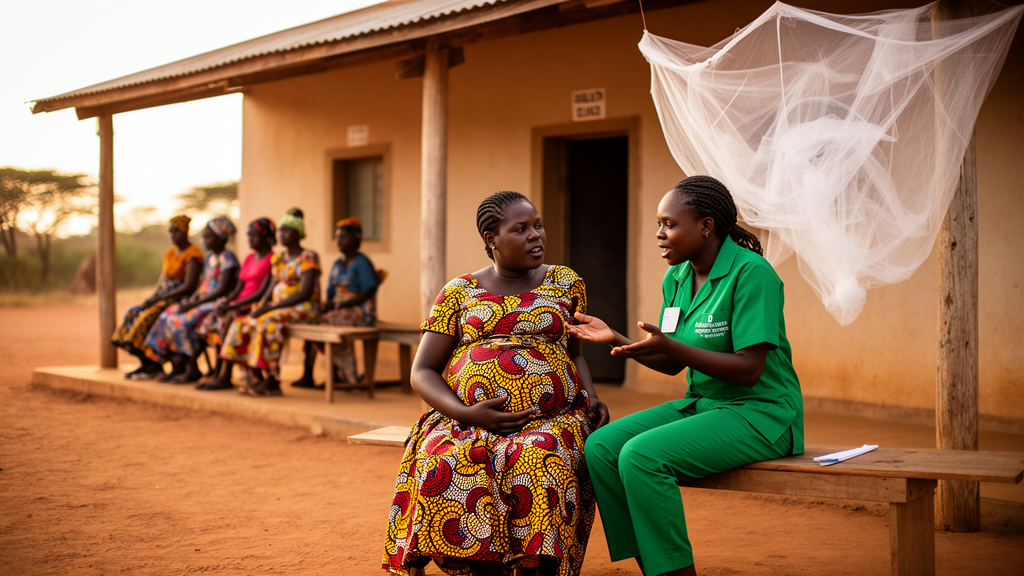
More than four in ten pregnant women in four of sub-Saharan Africa’s highest malaria-burden countries report never being exposed to malaria messages, according to an analysis of recent Malaria Indicator Surveys from Uganda, Tanzania, Ghana and Burkina Faso. The study, published open access in Archives of Public Health, found that 56.4 percent of pregnant women — 1,440 of a weighted sample of 2,552 — had been reached by malaria communication, leaving a substantial gap in a group that is especially vulnerable to the disease.
Malaria remains a critical public health challenge in sub-Saharan Africa, and social and behaviour change communication is considered one of the cornerstones of effective malaria control strategies. Pregnant women are more vulnerable to malaria than other sub-populations, yet exposure to malaria messages is not evenly distributed among them, and the potential determinants of that uneven reach had been unclear. The new study set out to measure the prevalence of message exposure among pregnant women in the four countries, quantify wealth-related inequalities in that exposure, and identify associated factors.
The researchers used data from the national Malaria Indicator Surveys of Burkina Faso, Ghana, Tanzania and Uganda, restricting the sample to women who were pregnant at the time of the survey. That yielded a weighted sample of 2,552 pregnant women. To identify factors linked to exposure, they fitted a multilevel mixed-effects logistic regression model, testing associations at the 5 percent significance level while accounting for clustering at community and country levels.
The headline finding is a wide geographic spread in reach. Ghana recorded the highest exposure rate at 88.4 percent, followed by Burkina Faso at 63.9 percent. Uganda and Tanzania showed strikingly similar and much lower levels, at 48.3 percent and 48.1 percent respectively. In other words, in two of the four countries, fewer than half of pregnant women reported encountering malaria messages, despite all four nations carrying a high malaria burden.
The inequality analysis showed that exposure was largely concentrated among richer women. The unstandardized concentration index was 0.075, statistically significant at p < 0.001, indicating a pro-rich distribution of malaria message exposure across the pooled sample.
The regression analysis identified two individual-level factors associated with exposure. Women aged 35 to 49 years had significantly higher odds of exposure than younger women, with an adjusted odds ratio of 1.42 (95 percent confidence interval: 1.16 to 1.74). Women with secondary or higher education had more than double the odds of exposure, with an adjusted odds ratio of 2.70 (95 percent confidence interval: 1.17 to 6.25). The authors’ conclusion also notes that wealthier women and those with a previous birth history were mainly among those exposed, and that the study revealed considerable variation in factors at both the community and country levels, which the multilevel model was designed to capture.
Taken together, the results indicate that malaria communication in these four countries is not reaching the full population of pregnant women, and that its reach is skewed toward those who are older, better educated and wealthier. The authors summarize the situation as less than three in five pregnant women being exposed to malaria messages across the studied settings. Because the analysis is cross-sectional, drawing on surveys conducted at single points in time, it identifies associations rather than causal effects, and the findings apply to the surveyed pregnant women in these four countries rather than to sub-Saharan Africa as a whole.
The study’s practical implication, as the authors state, is that malaria communication strategies should be targeted for better reach and impact. The concentration of exposure among advantaged groups, combined with the large differences between countries — from 88.4 percent in Ghana to under 49 percent in Uganda and Tanzania — points to substantial room for tailoring channels and content to women who are currently missed, particularly younger, less educated and poorer pregnant women in the lower-coverage settings.
The considerable variation in associated factors at community and country levels suggests that a single national messaging approach is unlikely to close the gap uniformly, and that local-level determinants shape who hears about malaria prevention during pregnancy. The study, shared early as a citable, peer-reviewed accepted version with a permanent DOI and subject to further edits before the final version of record, documents the prevalence of malaria message exposure among pregnant women in Burkina Faso, Ghana, Tanzania and Uganda, along with the wealth-related inequality in that exposure.
Subject of Research: Wealth-related inequalities and correlates of exposure to malaria messages among pregnant women in Uganda, Tanzania, Ghana and Burkina Faso
Article Title: Wealth-related inequalities and correlates of malaria message exposure among pregnant women in four malaria high-burden countries in sub-Saharan Africa: evidence from recent malaria indicator surveys
Article References: Mwebesa, E., Musinguzi, B., Agbi, D. M., Bagenzi, B., Sampa, M., Izudi, J., Kerich, G., & Mwangi, A. (2026). Wealth-related inequalities and correlates of malaria message exposure among pregnant women in four malaria high-burden countries in sub-Saharan Africa: evidence from recent malaria indicator surveys. Archives of Public Health. https://doi.org/10.1186/s13690-026-02123-7
Image Credits: AI Generated
DOI: 10.1186/s13690-026-02123-7
Keywords: malaria, pregnant women, sub-Saharan Africa, health communication, wealth inequality, Malaria Indicator Surveys, concentration index, multilevel regression, Uganda, Tanzania, Ghana, Burkina Faso
News Source: Harold Sullivan. (October 28, 2026). Research report: Wealth-related inequalities and correlates of malaria message exposure among pregnant women in four malaria high-burden countries in sub-Saharan Africa: evidence from recent malaria indicator surveys. Scienmag.



