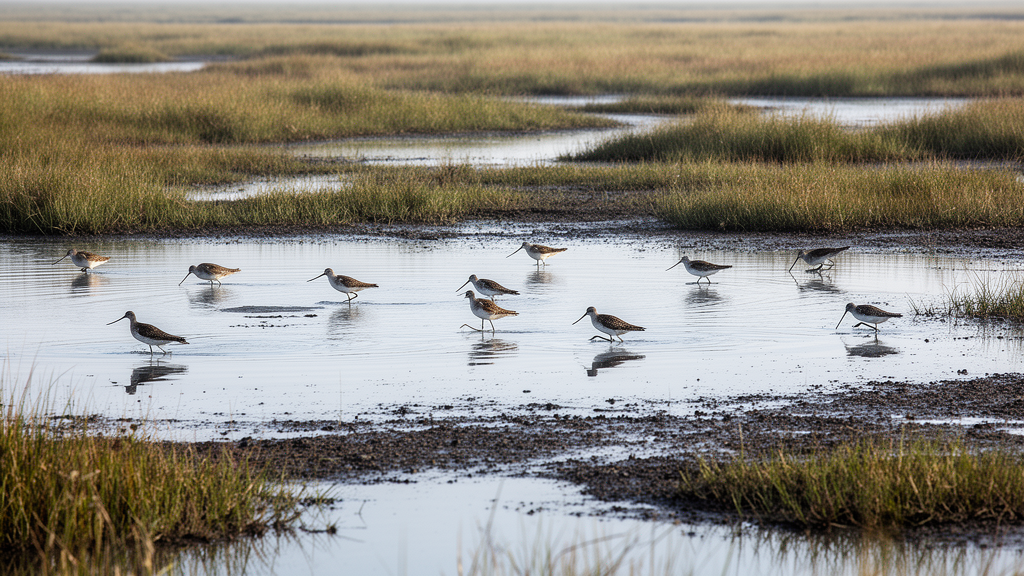
A synthesis of individual-based modeling studies shows how wading birds nesting in the Everglades respond to a prey landscape that shifts across space and through the nesting season as hydrology changes. The models indicate that successful nesting depends not only on the presence of suitable habitat, but also on whether parent birds can obtain enough prey to meet the energetic demands of raising nestlings. The work traces a series of modeling efforts prompted by the twentieth-century decline of wading birds in their traditional colonial nesting grounds in the Everglades.
Earlier habitat-quality models helped define environmental characteristics associated with successful nesting, but individual-based modeling added a different level of detail: the ability of each bird to exploit prey whose location and abundance change over time. In an initial model, reproductive success depended on the spatial distribution of high prey densities around a nesting site. Parent birds nesting near productive foraging areas were therefore better positioned to meet their offspring’s energetic needs than birds farther from those resources.
Subsequent models examined the daily foraging strategies available to individual birds when prey is distributed unevenly across the landscape. These simulations compared alternative strategies for exploiting that dynamic resource pattern. The approach was then expanded into more spatially explicit individual-based and agent-based models representing nesting colonies containing many birds, each able to follow an individual strategy.
Modeling the colony in this way allowed researchers to include social interactions in the analysis of feeding rather than assuming that every bird foraged independently. The results identified two social effects with practical consequences for the simulations. Cue-following helped birds locate patches of high-quality prey, while interference among birds within prey patches altered individual prey intake.
Together, these processes influenced both how much food birds obtained during a day and which foraging strategy performed best. The models also demonstrated that social interactions could produce spatial distributions of foragers approaching an ideal free distribution, linking the behavior of individual birds to the allocation of feeding activity across the colony. The synthesis also covers the extension of agent-based modeling to multi-year simulations in which wading birds can migrate annually to and from the Everglades.
This addition connects environmental conditions encountered at the nesting grounds with movement patterns over longer timescales. The models do not establish a particular future migration outcome; instead, they provide a framework for estimating how environmental change could affect migratory patterns. By connecting individual energetic needs, colony-level interactions and seasonal movement, the modeling program presents the Everglades as a dynamic wetland landscape in which nesting success can depend on the combined effects of hydrology, prey distribution and bird behavior.
The review places these models within the broader literature on wading bird modeling, although its discussion of other models is explicitly not intended to be comprehensive.
Subject of Research: Individual-based modeling of wading bird nesting, foraging and migration in the Everglades.
Article Title: Wading birds on a dynamic wetland landscape: a synthesis of individual-based modeling methodology
Article References: DeAngelis, D. L., Yurek, S., Hessler, G., Zhang, B., & Lee, H. W. (2026). Wading birds on a dynamic wetland landscape: a synthesis of individual-based modeling methodology. Individual-based Ecology, 2, Article e203807. https://doi.org/10.3897/ibe.2.203807
Image Credits: AI Generated
DOI: 10.3897/ibe.2.203807
Keywords: wading birds, Everglades, individual-based modeling, agent-based modeling, foraging, nesting ecology, wetland hydrology, prey distribution, social interaction, bird migration, Wading, birds
News Source: Drew Townsend. (October 20, 2026). Research report: Wading birds on a dynamic wetland landscape: a synthesis of individual-based modeling methodology. Scienmag.