• HOME
  • NEWS
  • EXPLORE
    • CAREER
      • Companies
      • Jobs
    • EVENTS
    • iGEM
      • News
      • Team
    • PHOTOS
    • VIDEO
    • WIKI
  • BLOG
  • COMMUNITY
    • FACEBOOK
    • INSTAGRAM
    • TWITTER
Tuesday, October 27, 2026
BIOENGINEER.ORG
No Result
View All Result
  • Login
  • HOME
  • NEWS
  • EXPLORE
    • CAREER
      • Companies
      • Jobs
        • Lecturer
        • PhD Studentship
        • Postdoc
        • Research Assistant
    • EVENTS
    • iGEM
      • News
      • Team
    • PHOTOS
    • VIDEO
    • WIKI
  • BLOG
  • COMMUNITY
    • FACEBOOK
    • INSTAGRAM
    • TWITTER
No Result
View All Result
Bioengineer.org
No Result
View All Result
Home NEWS Science News Health

Research report: The impact of immersive virtual reality on students’ satisfaction and self-confidence in clinical nursing simulation: a cross-sectional study

by
October 27, 2026
in Health
Reading Time: 2 mins read
0
Research report: The impact of immersive virtual reality on students’ satisfaction and self-confidence in clinical nursing simulation: a cross-sectional study

Research report: The impact of immersive virtual reality on students’ satisfaction and self-confidence in clinical nursing simulation: a cross-sectional study

Share on FacebookShare on TwitterShare on LinkedinShare on RedditShare on Telegram

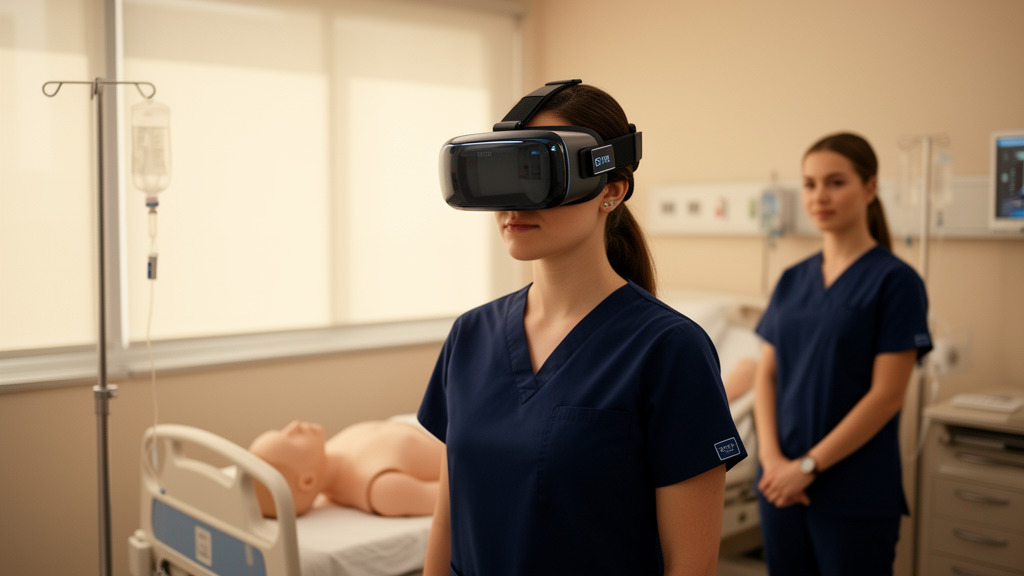
Nursing students who trained with a headset-based immersive virtual reality system reported near-perfect levels of satisfaction and self-confidence, according to a cross-sectional study published in BMC Nursing. The study involved 73 nursing students who each completed two simulation sessions using a head-mounted immersive virtual reality system. The scale yields a satisfaction score out of 25 points and a self-confidence score out of 40 points.

The results were strikingly high. In the first virtual reality scenario, students recorded a mean satisfaction score of 24.01 out of 25 (standard deviation 1.53), and in the second scenario the mean reached the maximum of 25.0 with no variation at all. Self-confidence followed the same pattern: 36.58 out of 40 (standard deviation 3.36) after the first session, climbing to 39.92 (standard deviation 0.28) after the second.

Statistical analysis confirmed that the improvement was not a matter of chance. Scores on the total scale and on both of its subscales — satisfaction and self-confidence — showed a statistically significant increase after students completed their second immersive virtual reality experience, with p-values below 0.001. In practical terms, the more exposure students had to the virtual clinical environment, the more satisfied and self-assured they became about their learning.

The authors conclude that nursing students perceived learning through immersive virtual reality as a route to greater satisfaction and self-confidence, and that the technology can be used to develop practical skills by placing participants in realistic simulated environments. This positions immersive virtual reality alongside the spectrum of simulation practices already used in nursing higher education, which ranges from low-fidelity setups to high-fidelity manikin-based training. The findings come with important caveats.

The study was descriptive and cross-sectional, relying on a single posttest measurement rather than a comparison group, so it captures student perceptions at one point in time rather than proving that virtual reality causes superior learning outcomes. Nevertheless, the consistently high scores — including a ceiling-level satisfaction mean in the second scenario — suggest that students found the immersive format highly acceptable as a clinical learning tool. The researchers suggest the approach can expose students to realistic simulated environments where practical skills can be rehearsed, complementing traditional simulation and clinical placement experiences in nurse education.

Subject of Research: Immersive virtual reality simulation in undergraduate nursing education

Article Title: The impact of immersive virtual reality on students’ satisfaction and self-confidence in clinical nursing simulation: a cross-sectional study

Article References: López-Medina, I. M., Álvarez-García, C., Hueso-Montoro, C., Esteban-Burgos, A. A., Sanz-Martos, S., Capilla-Díaz, C., & Álvarez-Nieto, C. (2026). The impact of immersive virtual reality on students’ satisfaction and self-confidence in clinical nursing simulation: a cross-sectional study. BMC Nursing. https://doi.org/10.1186/s12912-026-05542-7

Image Credits: AI Generated

DOI: 10.1186/s12912-026-05542-7

Keywords: immersive virtual reality, nursing education, clinical simulation, student satisfaction, self-confidence, cross-sectional study, simulation fidelity, nursing students, healthcare training, BMC Nursing, impact, immersive

News Source: Ophelia Keating. (October 27, 2026). Research report: The impact of immersive virtual reality on students’ satisfaction and self-confidence in clinical nursing simulation: a cross-sectional study. Scienmag.

Tags: BMC Nursingclinical simulationCross-sectional Studyhealthcare trainingimmersiveimmersive virtual realityimpactNursing educationnursing studentsself-confidencesimulation fidelityStudent satisfaction
Share12Tweet7Share2ShareShareShare1

Related Posts

Baby Boys Face Higher Odds of Acidemia and Neurological Complications at Birth, Swedish Cohort Finds

Baby Boys Face Higher Odds of Acidemia and Neurological Complications at Birth, Swedish Cohort Finds

October 27, 2026
Visceral Fat Linked to Higher Thyroid Nodule Risk in 21,000-Person Screening Study

Visceral Fat Linked to Higher Thyroid Nodule Risk in 21,000-Person Screening Study

October 27, 2026

Electrostimulation Adds No Extra Benefit to Pelvic Floor Exercises in Young Healthy Women, Trial Finds

October 27, 2026

Biallelic ATM Variants Behind Decades-Long Familial Dystonic Choreoathetosis

October 27, 2026

POPULAR NEWS

  • Beyond Earth: Why Deep-Space Medicine Must Be Rebuilt From First Principles

    Beyond Earth: Why Deep-Space Medicine Must Be Rebuilt From First Principles

    29 shares
    Share 12 Tweet 7
  • Dual-Stream AI Network Predicts Battery Heat and Health to Warn of Thermal Risks Early

    29 shares
    Share 12 Tweet 7
  • Baby Boys Face Higher Odds of Acidemia and Neurological Complications at Birth, Swedish Cohort Finds

    29 shares
    Share 12 Tweet 7
  • STAM protein suppresses kidney cancer through a dual EGFR and AKT mechanism

    29 shares
    Share 12 Tweet 7

About

We bring you the latest biotechnology news from best research centers and universities around the world. Check our website.

Follow us

Recent News

Beyond Earth: Why Deep-Space Medicine Must Be Rebuilt From First Principles

Dual-Stream AI Network Predicts Battery Heat and Health to Warn of Thermal Risks Early

Baby Boys Face Higher Odds of Acidemia and Neurological Complications at Birth, Swedish Cohort Finds

Subscribe to Blog via Email

Enter your email address to subscribe to this blog and receive notifications of new posts by email.

Join 85 other subscribers
  • Contact Us

Bioengineer.org © Copyright 2023 All Rights Reserved.

Welcome Back!

Login to your account below

Forgotten Password?

Retrieve your password

Please enter your username or email address to reset your password.

Log In
No Result
View All Result
  • Homepages
    • Home Page 1
    • Home Page 2
  • News
  • National
  • Business
  • Health
  • Lifestyle
  • Science

Bioengineer.org © Copyright 2023 All Rights Reserved.