Physicists and engineers working on the Future Circular Collider feasibility study have published a comprehensive account of how the proposed FCC-ee electron-positron collider would meet its detectors at the collision point, and the picture that emerges is one of extraordinary engineering tension.
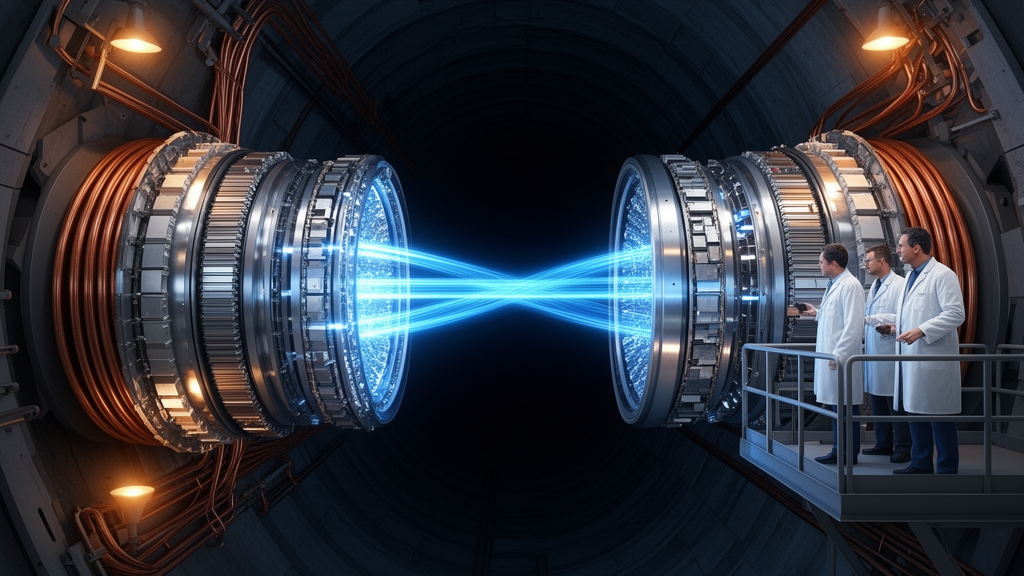
The design rests on the crab-waist collision scheme, in which two beams cross at a large horizontal angle of 30 milliradians and are focused to nanometre-scale spots at the interaction point. The two beams circulate in separate vacuum chambers that merge only 1.3 metres from the collision point, and the first superconducting final focus quadrupole sits 2.2 metres away, well inside the detector volume. Synchrotron radiation generated by the bending magnets near the interaction region is steered away from the central beam pipe, and both synchrotron radiation and beamstrahlung, the radiation emitted as bunches tear through the electromagnetic field of the opposing beam, are intercepted in dedicated dumps roughly 500 metres downstream of the collision point.
Perhaps the most delicate component is the central beam pipe itself. Because the first layer of the vertex detector must sit as close as possible to the collision point to sharpen the reconstruction of particle vertices, the smallest affordable beam pipe radius is just one centimetre. The engineered central chamber is an 18-centimetre-long cylinder built from two concentric layers of AlBeMet, a beryllium-aluminium alloy chosen for its mechanical properties, each only 0.35 millimetres thick and separated by a one-millimetre gap through which liquid paraffin coolant flows. A five-micrometre gold coating on the inner surface reduces electrical resistance and therefore beam-induced heating, while also shielding the vertex detector from stray synchrotron radiation photons.
Thermo-structural simulations of this assembly, assuming deposited powers of 54 watts on the central chamber and 130 watts on the surrounding conical chamber, predict peak temperatures of 29 and 50 degrees Celsius respectively. The maximum stress computed in the structure sits a factor of ten below the yield strength of AlBeMet, though the analysis flags buckling as the more critical failure mode, and experimental tests are under way to benchmark the simulations. The cooling system, the study notes, could tolerate roughly a 15 percent increase in heat load simply by raising the coolant flow rate.
The vertex detector itself comes in two competing flavours. The baseline design uses three concentric barrel layers of 50-micrometre-thick monolithic active pixel sensors mounted on carbon fibre supports, with the first layer at a radius of 13.7 millimetres and each layer contributing only 0.25 percent of a radiation length. Cooling relies on forced gas convection rather than liquid channels, since any additional material would erode physics performance, and computational fluid dynamics simulations of an azimuthal sector of the detector show temperature differences of about 15 degrees Celsius between the hottest sensors and the inlet air for the outer layers. An alternative ultra-light concept borrows curved, wafer-scale sensor technology developed for the ALICE ITS3 upgrade, cutting the material budget of a single layer to roughly 0.075 percent of a radiation length.
Surrounding the beam pipe, the luminosity calorimeter, or LumiCal, will measure the integrated luminosity by counting low-angle Bhabha scattering events, and its precision requirements are brutal. To reach a luminosity measurement accurate to about one part in ten thousand, the calorimeter’s inner radius must be known to within 1.5 micrometres, its outer radius to 3.5 micrometres, and the relative positioning of the two halves to 110 micrometres. Roughly 130 watts of heat must be extracted from each calorimeter side, and the temperature must be controlled to within one degree Celsius to preserve the required geometry.
Keeping all of this hardware aligned is its own research programme. Because no existing alignment system can simply be adapted to the FCC-ee interaction region, the team proposes a three-part scheme built around frequency-scanning interferometry. Optical fibres glued to the inner surface of the screening solenoid support would continuously monitor the deformation of that cylindrical reference surface, mirrors at the fibre ends would redirect laser beams to track the final focus quadrupoles, beam position monitors and calorimeters over short distances, and a network of long-range interferometric measurements would tie the two sides of the detector together and anchor them to the cavern survey network. Prototype testing has begun, with proof of concept established and validation testing ongoing.
The background environment inside the detectors may prove the defining challenge. Beamstrahlung alone carries power of the order of hundreds of kilowatts, peaking at the Z pole where beam currents are highest, and vertical offsets between colliding bunches can double the radiated power. Incoherent pair creation, in which beamstrahlung photons convert into electron-positron pairs during bunch crossings, drives the occupancy in the vertex detector: simulations with the latest lattice yield up to 20 parts per million occupancy in the first vertex layer, corresponding to hit rates of up to 170 megahertz per square centimetre and pointing to a requirement of around 100 megahertz per square centimetre for the detector electronics.
Radiation levels near the superconducting final focus quadrupoles are equally sobering. Radiative Bhabha electrons lost near the collision point concentrate their energy deposition on the inner side of the beam pipe, and simulations for the most exposed quadrupole segment at the Z pole predict annual doses of up to 27 megagrays per year, far beyond what the magnets could tolerate. The remedy appears remarkably simple: a cylindrical tungsten shield only two millimetres thick, interposed between the vacuum chamber and the magnet coils, cuts the peak dose by nearly a factor of ten, to about 3 megagrays per year, a level compatible with design limits adopted at the Large Hadron Collider.
Much remains open. Two competing optics designs, one with a local and one with a non-local solenoid compensation scheme, are still being compared, and the non-local option not only halves the synchrotron radiation generated inside the detector but could allow the detector solenoid field to rise from 2 to 3 tesla. The cryostat design for the final focus quadrupoles, with candidate operating temperatures spanning 1.9 to 20 kelvin, has yet to be finalised, and detector opening scenarios for maintenance, including a preferred scheme in which the entire 12-metre detector rolls sideways off the beamline, still require civil engineering adjustments in the smaller experimental caverns. The authors frame the work as a status report for the feasibility study, with the coming pre-technical-design-report phase expected to settle these choices and carry the interaction region from concept toward engineering reality.
Subject of Research: Engineering design of the interaction region and machine-detector interface for the proposed FCC-ee collider
Article Title: Status of the FCC-ee interaction region design
Article References: Boscolo, M., Palla, F., Ammirabile, G., Andre, K. D. J., Baldinelli, G., de Sousa, P. B., Bosi, F., Broggi, G., Bruce, R., Burkhardt, H., Calviani, M., Candido, S., Ciarma, A., Dam, M., Francois, B., Ximenes, R. F., Fransesini, F., Frasca, A., Gaddi, A., … Zimmermann, F. (2025). Status of the FCC-ee interaction region design. EPJ Techniques and Instrumentation, 12(1), Article 4. https://doi.org/10.1140/epjti/s40485-025-00117-3
Image Credits: AI Generated
DOI: 10.1140/epjti/s40485-025-00117-3
Keywords: FCC-ee, particle collider, interaction region, machine-detector interface, vertex detector, beam pipe, beamstrahlung, synchrotron radiation, luminosity calorimeter, superconducting magnets, beam-induced backgrounds, CERN
News Source: Denise Maddox. (October 28, 2026). Research report: Status of the FCC-ee interaction region design. Scienmag.