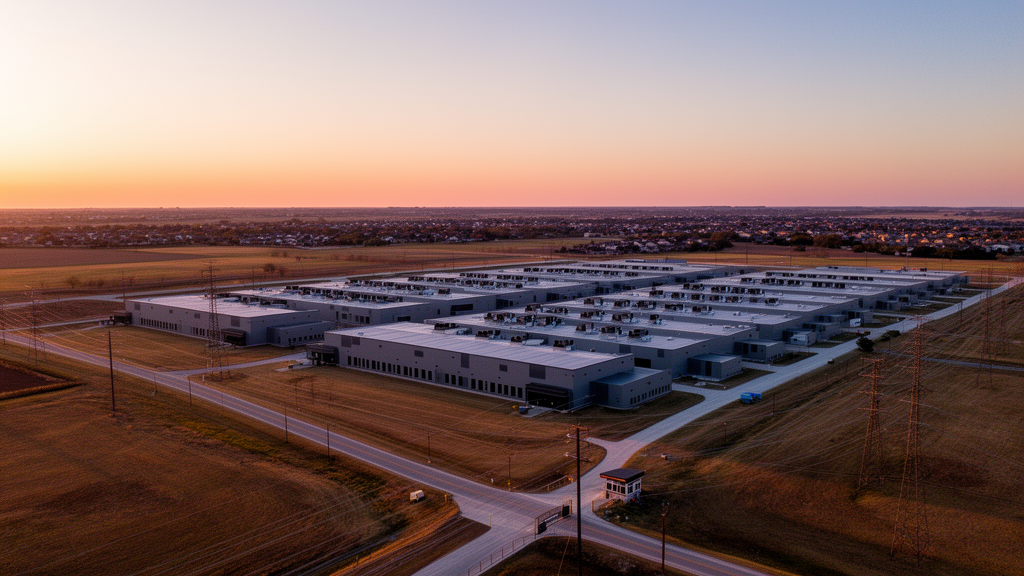
The rapid expansion of artificial intelligence and digital infrastructure has outpaced the policy frameworks that govern where and how data centers get built, according to a new exploratory study published in Frontiers in Sustainable Cities. Researchers from Iowa State University, Arizona State University and the University of Kansas examined the intergovernmental policy landscape in the United States, analyzing both state economic incentive programs and local land use regulations to understand which levels of government enable or restrict data center development.
The study, led by Yiwen Wu with co-authors Ian Njuguna, Joel Mendez and Lindsey Lyles, describes a mismatch between surging demand for digital infrastructure and local planning guidelines that is widely acknowledged but, the authors argue, understudied. Their exploratory scan of data center projects and regulation in what they call the first generation of governance responses reveals a broad spectrum of approaches across states.
At one end of that spectrum sit what the researchers term “incentivizing” states, which leverage legislative preemption to limit local zoning control, effectively clearing the path for data center construction. At the other end are “disincentivizing” states that enact moratoria and environmental mandates intended to safeguard local resources. Between these poles, the findings suggest, lies a varied patchwork of governance choices rather than a single national template.
A central finding is that these state-level interventions frequently override local autonomy. When states preempt zoning or attach conditions through incentive programs, local communities are left to manage the downstream consequences of data center development, including impacts on the electrical grid, water supplies and social equity. The study frames this as a governance gap: decisions about siting and incentives are made at one level of government, while the resource burdens fall on another.
The authors place this friction in historical context, arguing that the conflicts surrounding data center development mirror earlier land-use debates over energy and housing infrastructure.
To address the gap, the researchers call for proactive, resource-centered planning rather than reactive permitting. Their recommendations, drawn from the literature, include streamlining zoning regulations from multi-level governance perspectives so that state and local authorities operate with a clearer division of responsibility. They also propose utility performance metrics to track the infrastructure demands of data centers, water-use disclosures so communities can assess impacts on local supplies, and transparent Community Benefit Agreements and engagement processes that give residents a documented stake in project outcomes.
The study is explicitly exploratory in design, meaning it maps patterns across state incentive programs and local land use rules rather than testing causal effects of particular policies. The authors present their typology of incentivizing and disincentivizing states as a descriptive first pass at a rapidly evolving policy area, one intended to structure future research on how multi-level governance shapes digital infrastructure siting.
Its core message is that the first generation of governance responses has produced a spectrum rather than a consensus, and that closing the gap between state incentives and local capacity will determine whether communities can manage the grid, water and equity impacts now landing on their doorstep.
Subject of Research: Intergovernmental policy frameworks and land use governance of data center development in the United States
Article Title: State and county approaches to data centers: patterns in the first generation
Article References: Wu, Y., Njuguna, I., Mendez, J., & Lyles, L. (2026). State and county approaches to data centers: patterns in the first generation. Frontiers in Sustainable Cities, 8, Article 1948664. https://doi.org/10.3389/frsc.2026.1948664
Image Credits: AI Generated
DOI: 10.3389/frsc.2026.1948664
Keywords: data centers, land use, zoning regulations, state incentives, local governance, artificial intelligence, water use, community benefit agreements, sustainable cities, energy infrastructure, State, county
News Source: Denise Maddox. (October 28, 2026). Research report: State and county approaches to data centers: patterns in the first generation. Scienmag.