The records draw on two complementary monitoring approaches.
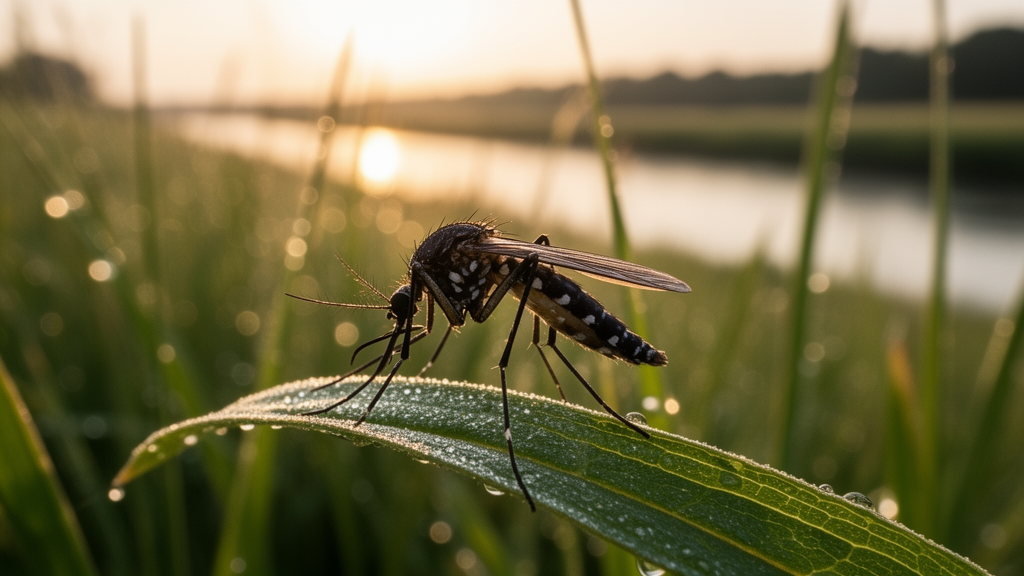
Aedes vexans is native to Europe and is already widespread in Germany, but it attracts particular attention because of its mass occurrence events, its floodplain-associated ecology and its potential role as a vector of pathogens affecting humans and animals. Mosquitoes more broadly are of major public and animal health relevance, since they may act both as nuisance pests and as vectors of a range of pathogens, and changes in climate, land use and global connectivity have facilitated the spread and establishment of both native and invasive mosquito species across Europe, including Germany.
Despite the species’ prominence, standardised occurrence data have been strikingly scarce. As of 11 February 2026, only 53 occurrence records from Germany were registered in the Global Biodiversity Information Facility (GBIF), underscoring how limited the publicly available data for this species have been. The new compilation therefore represents a substantial expansion of accessible information for researchers studying where the mosquito lives and under which conditions it thrives.
The dataset is not merely an archive. Portions of it have already been used in peer-reviewed studies addressing mosquito distribution modelling, habitat suitability and vector ecology. Previous work applied Aedes vexans occurrence data within a machine-learning framework to help characterise the climatic niche of the invasive species Aedes japonicus under conditions of limited occurrence data for the target species, to develop combined climate-habitat mosquito models, and to evaluate automated feature selection for mosquito distribution modelling. Subsets of the data have also contributed to studies on West Nile virus vectors in Germany and to a recent inventory of the German mosquito fauna.
Understanding the spatial distribution of Aedes vexans also matters for modelling its habitat suitability, and spatially extensive long-term monitoring is considered essential to understand mosquito distribution patterns, assess establishment risks and support vector surveillance and management strategies. The floodplain-linked ecology of the species means its occurrence patterns are closely tied to landscape and hydrological conditions, making detailed distribution data a useful foundation for such analyses.
The authors caution that the citizen-science component carries structural and behavioural biases that must be considered when interpreting and modelling the records. Studies of the broader “Mückenatlas” data have shown that submission numbers are strongly influenced by human population density, regional factors and environmental conditions, and that they reflect participant behaviour rather than true mosquito abundance alone. A follow-up study further quantified the influence of mass media coverage on citizen participation, showing that both the intensity and framing of media reports substantially affect submission numbers across time and space. Although those studies considered multiple mosquito species and the dataset as a whole, the identified biases apply equally to the Aedes vexans records included here.
Subject of Research: Occurrence records of the mosquito Aedes vexans in Germany from citizen-science and active monitoring
Article Title: Presence records of Aedes vexans ( Diptera , Culicidae ) in Germany
Article References: Pothmann, P., Werner, D., Kampen, H., & Thulke, H.-H. (2026). Presence records of Aedes vexans (Diptera, Culicidae) in Germany. Biodiversity Data Journal, 14, Article e191869. https://doi.org/10.3897/bdj.14.e191869
Image Credits: AI Generated
Keywords: Aedes vexans, mosquitoes, Germany, citizen science, Mückenatlas, occurrence data, vector surveillance, biodiversity monitoring, GBIF, floodplains, Presence, records
News Source: Drew Townsend. (October 27, 2026). Research report: Presence records of Aedes vexans ( Diptera , Culicidae ) in Germany. Scienmag.