


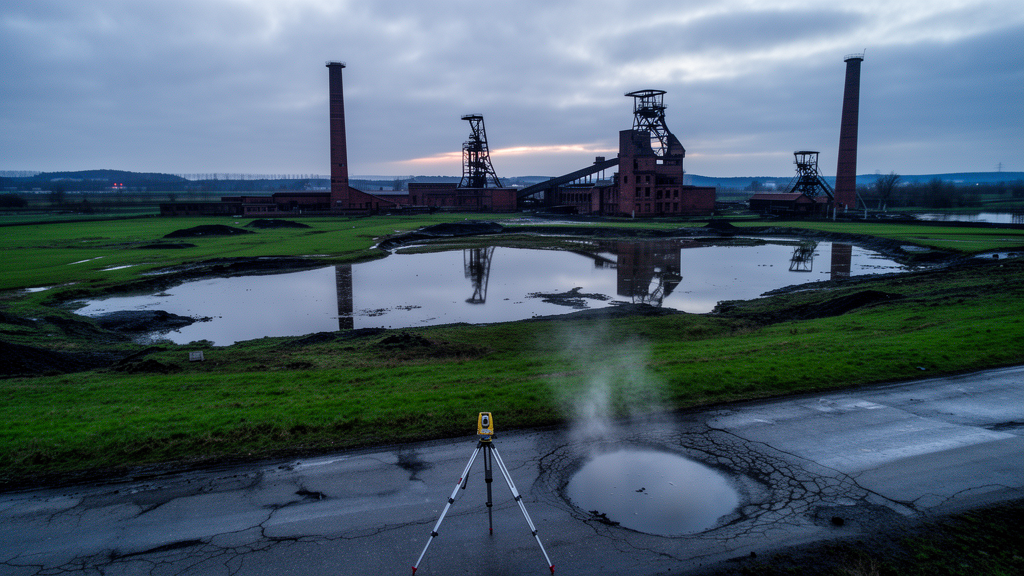
Across Germany’s former hard coal districts, the pumps are being switched off and the water is rising. The study, published in Geomechanics and Geophysics for Geo-Energy and Geo-Resources, draws together 3D fault models, stress analysis, seismological monitoring, satellite-based ground displacement measurements and soil gas surveys from three districts that are currently undergoing mine water rebound.
The motivation is global in scale. According to the authors, raw material depletion, uneconomic production and government policies aimed at climate mitigation and the energy transition will lead to the abandonment of hundreds to thousands of underground mines worldwide in the coming years. Once pumping stops, mine operators initiate flooding, and the rising water increases pore fluid pressure in the subsurface. In general, such pressure increases can change local effective stresses and induce both microseismicity and ground displacements. At the same time, abandoned coal mines open possibilities for geothermal applications, underground gas storage and unconventional gas production, making a careful understanding of the flooding process doubly important.
The three study areas are among the largest hard coal resources in Germany. Decades of industrial mining there recovered hundreds of drill cores and recorded hundreds of kilometers of seismic reflection lines, giving researchers an unusually detailed picture of the subsurface. Coal formation in central Europe began in the Late Carboniferous, when peat was deposited in equator-near sedimentary basins during the culminating stages of the Variscan orogeny. The weight of the resulting mountain belt formed foreland basins at the present-day locations of the Ruhr and Ibbenbüren districts, while intramontane basins such as the Saar-Nahe basin subsided under the control of regional fault systems. Kilometer-deep burial converted the deposits into siliciclastic rocks and hard coal, and later episodes of tectonic activity created complex fault systems. Today, natural seismic activity in the Ruhr and Ibbenbüren areas is considered low, whereas natural seismicity has been detected in the Saar area.
The study concentrates on three mines: Heinrich-Robert in the Haus Aden water province of the eastern Ruhr district, Ibbenbüren Ostfeld, and Primsmulde in the Saar district. Mining there took place within folded structures, with synclines and anticlines and dip angles ranging from sub-horizontal to very steep. The surrounding rocks in each area are similarly tight, with porosity below 10 percent and permeability below 1 millidarcy, consisting of sandstones, siltstones and claystones. Flooding proceeds differently in each district. In the Ruhr, mine water rebound is controlled at six dewatering sites; in the western Walsum site flooding was completed in 2016 at a level of minus 754 meters, while in the Haus Aden province flooding is ongoing. Coal production at Haus Aden ended in 2010, and in August 2020 the mine water reached a depth of minus 967 meters at which the mines Lerche, Heinrich Robert and Radbod 5 became hydraulically connected. In Ibbenbüren, mining in the Ostfeld continued until 2018, after which mine water rebound occasionally proceeded at rates of 1.00 meter per day. In the Saar district, a two-phase flooding process was initiated in 2013 after mining-induced earthquakes forced the abandonment of the Primsmulde excavation zone.
The seismic story is one of the study’s clearest findings. During active mining in the eastern Ruhr district, up to a few hundred events per month with magnitudes between ML 0.7 and 3.3 were detected. After mine abandonment in 2010, the number dropped rapidly to fewer than 10 events per month. When the mine water rebound began in mid-2019, seismicity increased again: rising water levels in October 2019 correlated with a rise to more than 10 events per month, and a second increase followed in August 2020 when the water levels at three shafts reached the depth of their hydraulic connection. The post-mining events are mainly smaller than ML 2.
Crucially, the dense seismic network in the Ruhr area allowed researchers to locate the post-mining events precisely. The microseismicity is focused below the lowest mine workings, where pillars are located, a pattern the authors explain through stress arch effects confirmed by geomechanical model calculations: stress concentrates beneath pillars and at the edges of excavation zones. In contrast, no spatial correlation between microseismicity and large faults was observed, and geomechanical calculations of slip tendencies consistently indicate a low fault reactivation potential, meaning the large faults displayed in the 3D model of the Ruhr district are stable under the applied stress conditions. In the Saar district, where seismic data are available until May 2018, the post-mining phase shows at most 16 events per month with magnitudes typically below ML 2, far less activity than during operational mining, when magnitudes reached ML 4.0 in February 2008. The shallow post-mining events, between 1.0 and 1.5 kilometers below sea level, and their occurrence during phases of highest flooding rates point to seismicity induced by increased pore fluid pressure. In Ibbenbüren, only three monitoring stations were available, so events are located with an uncertainty of about 1000 meters, which rules out spatial analysis and highlights how much the quality of the seismic network matters.
The ground displacement results come from radar interferometry, or InSAR, using Sentinel-1 satellite data processed with a clustering approach based on broken stick models. At Heinrich-Robert, the analysis of January 2018 to December 2022 revealed a complex spatiotemporal pattern. Moderate subsidence of about 4 millimeters per year near two measurement points accelerated to up to 30 millimeters per year as the mine water rise accelerated, with the strongest acceleration above the deepest excavations. When water levels stagnated at one shaft in early 2020, subsidence decelerated too, and a second acceleration followed once the shafts adjusted. By late 2021, the first signs of a turnaround to uplift appeared. Cumulated over the whole period, the strongest vertical displacements of about 5 centimeters sit directly above the mine workings with the deepest coal seams. In the Ibbenbüren Ostfeld, subsidence centers above the last-mined seams initially reached rates of several decimeters per year, then reversed to uplift of a few centimeters as the mine water rose, with uplift accelerating distinctly after December 2021 in coincidence with a steep rise of the water level. In the Saar district, the already flooded mines in Lorraine and Warndt show uplift with rising water levels, while at Primsmulde about 3 centimeters of subsidence overlaps the former excavation zones and subsidence is still ongoing.
Putting these observations together with earlier literature, the authors distinguish five phases of the mine life cycle. During production, strong subsidence occurs; after the end of production, residual subsidence persists, sometimes for decades. When mine water rebound begins, subsidence can re-intensify, an effect the authors describe as a new observation of the parallelism of mine water levels and subsidence during this phase at Heinrich-Robert. Only after the water reaches a certain impoundment depth, reported as 300 to 600 meters for comparable regions, does subsidence reverse to uplift, and once the final water level is reached the displacements decelerate and fade out. During the observation period, Heinrich-Robert passed through phases 2 and 3, the Ibbenbüren Ostfeld passed through phases 1 to 4, the Warndt area is within phases 4 to 5, and Primsmulde is in phases 2 to 3. Notably, the displacement fields in the studied areas show no influence of faults, in contrast to studies in Belgian and Dutch coal districts, and the strongest surface displacements sit above the largest flooded volumes of the workings.
The gas monitoring adds a further layer of complexity. Short-term soil gas measurements across two modelled fault traces in the Haus Aden water province showed localized anomalies of carbon dioxide up to 13 volume percent, radon up to 105,000 Bq per cubic meter, and oxygen depletions up to 8 volume percent, indicating structurally controlled gas migration along an exposed fault trace. Yet when newly developed sensor prototypes measured the same sites about eight months later, the carbon dioxide anomalies had vanished, with values below 2.5 volume percent. The authors attribute this to temporally variable processes, possibly including rising mine water levels occluding gas pathways; indeed, water levels at the Haus Aden site rose by about 40 meters between the two campaigns. The primary coal mine gas methane was not detected, likely because it is oxidized by microorganisms in the presence of water, producing carbon dioxide. The modular sensor prototypes performed promisingly but need better batteries for long-term deployment. The authors argue that their interdisciplinary workflow, combining 3D fault models, petrophysics, seismology, soil gas and geodetic monitoring, offers a cost- and time-efficient way to assess flooding impacts, and that in countries like Germany, where mine-flooding licensing requires an assessment of induced seismicity, the findings can support future mine water management, monitoring and even the planning of mine layouts that mitigate post-mining seismicity from the start.
Subject of Research: A synthesis of flooding-induced microseismicity, ground displacements and soil gas anomalies in the abandoned Ruhr, Saar and Ibbenbüren hard coal mining districts of Germany.
Article Title: Post-mining flooding-induced ground displacements, microseismicity, and gas anomalies: a synthesis of research on the abandoned Ruhr, Saar, and Ibbenbüren hard coal districts in Germany
Article References: Even, M., Quandt, D., Ukelis, O., Niederhuber, T., Rische, M., Müller, B., Zorn, R., Westerhaus, M., Kutterer, H., & Hilgers, C. (2026). Post-mining flooding-induced ground displacements, microseismicity, and gas anomalies: a synthesis of research on the abandoned Ruhr, Saar, and Ibbenbüren hard coal districts in Germany. Geomechanics and Geophysics for Geo-Energy and Geo-Resources, 12(1), Article 138. https://doi.org/10.1007/s40948-026-01257-w
Image Credits: AI Generated
DOI: 10.1007/s40948-026-01257-w
Keywords: mine flooding, post-mining, microseismicity, ground displacement, InSAR, soil gas, hard coal, Ruhr, Saar, Ibbenbüren, mine water rebound, geomechanics
News Source: Denise Maddox. (October 29, 2026). Research report: Post-mining flooding-induced ground displacements, microseismicity, and gas anomalies: a synthesis of research on the abandoned Ruhr, Saar, and Ibbenbüren hard coal districts in Germany. Scienmag.



