


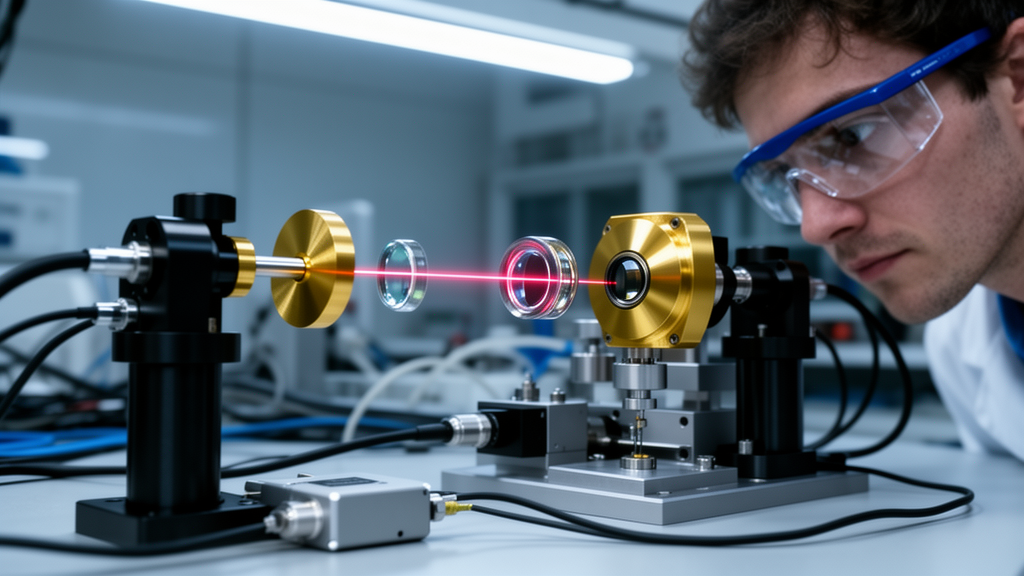
A laser system that fires ultrashort pulses of infrared light two micrometers in wavelength at a repetition rate of 200 kilohertz has now been characterized in extraordinary detail, and the results are striking. Physicists report that the carrier-envelope phase of these pulses — the precise alignment of the oscillating electric field within the pulse envelope — remains stable to within 70 milliradians across time scales spanning ten orders of magnitude, from microseconds to hours. For experiments that aim to steer electrons with the waveform of light itself, that level of control is the difference between observing a phenomenon and losing it in noise.
The work, published in Applied Physics B, addresses a long-standing gap in ultrafast optics. Light fields centered around two micrometers are exceptionally well suited for strong-field-driven control of charge carriers. Their photon energy, just over 0.6 electronvolts, lies far below the band gap of many materials, so the light can drive electrons without tearing them free of their hosts. At the same time, the optical oscillation period of roughly seven femtoseconds remains shorter than the coherence time of charge carrier oscillations, meaning the field can act on electrons before incoherent scattering destroys the delicate phase relationship between light and matter. But exploiting this window requires knowing, pulse by pulse, exactly what the electric field looks like.
That knowledge has been missing for high-repetition-rate systems in this wavelength range. Previous studies of two-micron lasers averaged their phase measurements over many pulses, leaving shot-to-shot fluctuations unmeasured. As the authors note, predictions for the visibility of field-driven phenomena were therefore impossible, and complex experiments had to begin on the assumption that short-term fluctuations were not too severe. The new system closes that gap by measuring the carrier-envelope phase of every single pulse in a train of 200,000 pulses per second, then extending the characterization outward to minutes and hours.
The laser itself is built from an ytterbium-based pump source delivering 200-femtosecond pulses at 1030 nanometers with 400 microjoules of energy, 200,000 times per second, and an energy stability of 0.04 percent. From there, the light passes through three frequency conversion and amplification stages. A small fraction of the pump generates a broadband white-light continuum in a yttrium aluminum garnet crystal, which seeds a visible non-collinear optical parametric amplifier producing 3.75-microjoule pulses. A difference frequency generation stage then mixes this visible signal with a portion of the 1030-nanometer light to create pulses in the short-wave infrared, centered near 2025 nanometers. This stage is the key to phase stability: because the two mixed pulses share the same pump laser, changes in the pump’s carrier-envelope phase cancel out, leaving the generated two-micron pulses passively stabilized.
The final stage amplifies these seed pulses by more than a factor of 70 in an optical parametric amplifier, reaching output energies of up to 25 microjoules — five watts of average power at 200 kilohertz — with a pulse energy stability of 0.19 percent. The amplified spectrum spans 1750 to 2450 nanometers and supports a transform-limited pulse duration of 18.1 femtoseconds. Measured with a third-harmonic-generation dispersion-scan technique, the compressed main pulse comes in at 19.2 femtoseconds, less than three optical cycles. Replacing the amplifier’s BBO crystal with bismuth triborate pushes the energy to 35 microjoules with a slightly shorter main pulse, though thermal instabilities in that crystal led the team to focus their study on the BBO configuration.
Characterizing the phase stability required a home-built f-2f interferometer, which splits the pulse’s spectrum, broadens it in a white-light generation process, doubles the broadened spectrum, and lets the two components interfere. The resulting spectral fringes shift with the carrier-envelope phase, allowing it to be read out shot by shot. Over one second — 200,000 consecutive pulses — the root-mean-square phase noise measured 65.8 milliradians. That figure rivals the best amplified systems reported previously, and it was achieved without averaging, meaning the measurement captures noise components that slower instruments would miss entirely.
The single-shot data revealed subtle structure in the noise. Spectral analysis showed low-frequency contributions at frequencies such as 135, 250, and 645 hertz, traceable to acoustic noise in the laboratory, plus a pronounced high-frequency component near 40 kilohertz. Detecting such fast fluctuations is only possible because the laser’s repetition rate and the camera’s acquisition rate are high enough to sample every pulse. The authors point out that other works which detect only every tenth pulse risk undersampling high-frequency noise and underestimating the true phase jitter. A comparison with simultaneous pulse-energy measurements found no significant correlation, suggesting the measured noise value is an upper bound limited by the interferometer’s signal-to-noise ratio of 15 decibels — the true phase stability may be even better.
On longer time scales, the system performed equally well. A seven-minute measurement, averaging 200 pulses per spectrum, yielded a root-mean-square noise of 55.7 milliradians, with only a slight drift of about 60 milliradians attributable to small changes in the lab environment such as air convection. With an active feedback loop adjusting a delay stage in the seed arm of the difference-frequency stage, the team then tracked the phase over more than eight hours and measured a noise value of 56.1 milliradians. Comparable systems reported in earlier literature showed 242 to 290 milliradians over similar or shorter periods. The feedback loop also allows the relative phase to be set at will, stepping through more than a full 2π cycle, so experimenters can choose the exact field waveform their samples will experience.
To demonstrate that this stability matters in practice, the team focused the pulses into an argon gas jet and generated high-order harmonics, producing extreme ultraviolet light with photon energies up to 160 electronvolts. The harmonic spectra changed dramatically as the relative carrier-envelope phase was shifted, with the spectral maxima in the cutoff region moving to different energies and the pattern repeating with π periodicity — a hallmark of emission from individual half-cycles of the driving field. Notably, these half-cycle cutoff effects appeared prominently even without active stabilization, a direct consequence of the system’s passive phase stability. The team also estimated the XUV photon flux at roughly 5×10^7 photons per second in the 70-to-180-electronvolt range, corresponding to a conversion efficiency of at least 4×10^-10, a lower bound since the spectrometer did not record the spectrum below 70 electronvolts.
The application horizon is concrete. For photoemission electron microscopy, an optical setup targeting a central photon energy of 130 electronvolts was designed, and simply rotating the relative phase from 0 to 0.4π increased the flux in that spectral window by 60 percent while the total integrated flux changed by only 2 percent. That ability to concentrate XUV light where an experiment needs it, at a repetition rate high enough to avoid space-charge distortions in electron measurements, positions the system for time-resolved studies of ultrafast charge carrier dynamics across nanoscale interfaces of metals and semiconductors. More broadly, the characterization across ten orders of magnitude in time replaces an assumed property — that the electric field structure of each pulse is reproducible — with a measured one, documenting residual carrier-envelope phase fluctuations below 70 milliradians RMS from microseconds to hours for this system.
Subject of Research: Carrier-envelope phase characterization of high-repetition-rate 2-micron ultrashort laser pulses and their application in high-order harmonic generation
Article Title: Multiscale carrier-envelope phase characterization of 2-µm pulses delivered by a 200-kHz optical parametric amplifier
Article References: Meier, K., Klösgen, A., Harland, K., Hansen, L., Barnekow, L., Guo, C., Juliano, C., Niu, J., Arnold, C. L., & Vogelsang, J. (2026). Multiscale carrier-envelope phase characterization of 2-µm pulses delivered by a 200-kHz optical parametric amplifier. Applied Physics B, 132(8), Article 97. https://doi.org/10.1007/s00340-026-08699-w
Image Credits: AI Generated
DOI: 10.1007/s00340-026-08699-w
Keywords: ultrafast optics, carrier-envelope phase, laser physics, optical parametric amplifier, high-order harmonic generation, extreme ultraviolet, strong-field physics, femtosecond pulses, difference frequency generation, f-2f interferometry, charge carrier control, photoemission electron microscopy
News Source: Denise Maddox. (October 30, 2026). Research report: Multiscale carrier-envelope phase characterization of 2-µm pulses delivered by a 200-kHz optical parametric amplifier. Scienmag.



