


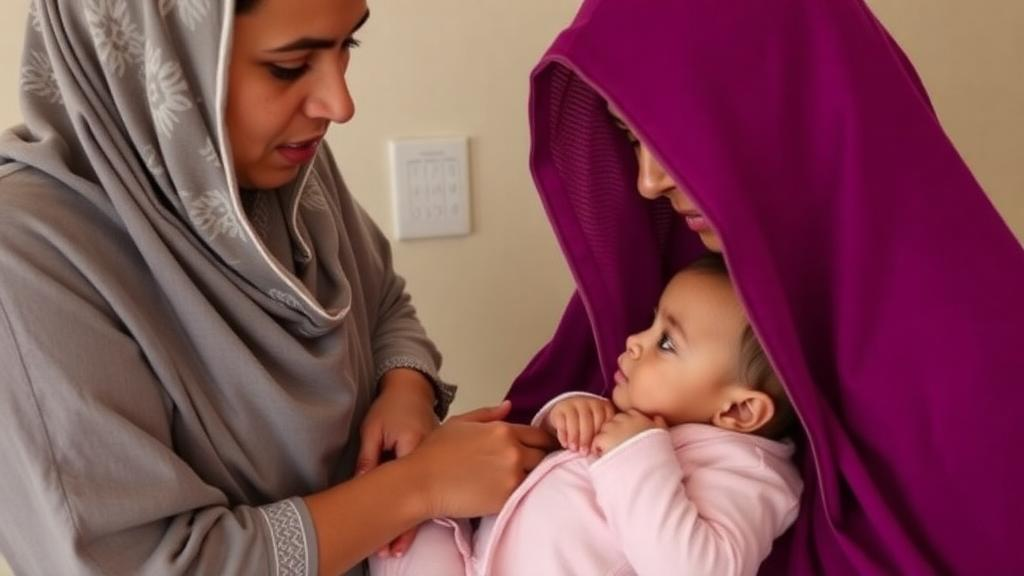
A large survey of more than 3,000 mothers across Oman has mapped which maternal factors go along with healthier infant feeding practices, and the results challenge some common assumptions. Mothers who reported healthier beliefs about infant feeding, who had received feeding counseling, and who rated their feeding knowledge as high tended to adhere more closely to infant feeding recommendations. Surprisingly, mothers with a baccalaureate degree or higher and those with family incomes of at least 1,000 Omani rials showed lower adherence to recommended practices, even though these same mothers held more favorable feeding beliefs. Mothers who delivered by cesarean section also reported poorer adherence.
The study, published in the International Journal of Public Health, was an analytical cross-sectional survey conducted between October 2023 and March 2024. Researchers recruited mothers of children aged one to three years from 120 healthcare centers spanning nine of Oman’s eleven governorates, covering 29 cities and both urban and rural settings. Because mothers were asked to report feeding practices from their child’s first year, children older than three years were excluded to limit recall difficulties. Participants had to read and write in Arabic, and non-Omani mothers were excluded because the study aimed to capture practices from a cultural perspective.
Data collection relied on 28 trained research assistants who followed a standardized protocol, approaching mothers at governmental health centers during morning shifts. The centers, affiliated with the Ministry of Health, were chosen because a national vaccination rate of 99 percent among children under three makes them an effective point of contact with nearly all families. Of 3,563 surveys collected with a 91 percent response rate, the researchers excluded 308 completed for children under 12 months and 219 with incomplete feeding practice items, leaving 3,036 surveys for analysis, including 2,907 complete belief responses.
The instrument was a validated Arabic Infant Feeding Practices and Beliefs questionnaire with 54 items. The practice section scored ten items against World Health Organization recommendations, covering exclusive breastfeeding in the first six months, breastfeeding continuation through the first year, and the timing of introducing formula, solid foods, meat, chicken and fish, fresh juice, yogurt, egg, unmodified cow’s milk, and honey. Each item scored one if it met the WHO recommendation and zero otherwise, producing a total practice score from 0 to 10. A parallel ten-item section measured beliefs on four-point Likert scales. Pilot testing showed acceptable test-retest reliability for both sections.
The mean practice score was 6.36 out of 10, with a standard deviation of 1.72, while the mean belief score was 28.91 with a standard deviation of 2.95. Behind these averages lay striking gaps between what mothers believed and what they did. While 93.5 percent of mothers agreed that exclusive breastfeeding for the first six months is healthy, only 35.8 percent reported practicing it. Similarly, 85.7 percent believed complementary foods should start at six months, but 68.8 percent actually did so, and 27.1 percent introduced solids between four and five months. Yogurt showed the same pattern: 82.5 percent endorsed introducing it after six months, yet only 62.6 percent did, with 19.6 percent introducing it too early and 14.1 percent waiting past the first birthday.
Not every gap ran in the same direction. Favorable practices for fresh cow’s milk and honey, at 76.6 percent and 76.1 percent respectively, exceeded the corresponding favorable beliefs of 48.2 percent and 52.3 percent, suggesting some mothers follow recommendations without endorsing the underlying principle. Beliefs and practices aligned more closely for fresh juice, where only 36.2 percent held favorable beliefs and 35.5 percent practiced accordingly, and for infant formula, at 58.8 percent favorable beliefs versus 54.7 percent favorable practice.
In bivariate analyses, mothers with less than a baccalaureate education scored significantly higher on practices (mean 6.43) than those with higher education (mean 6.24), yet the pattern reversed for beliefs, with more educated mothers reporting healthier attitudes. Family income showed the same divergence: mothers earning under 1,000 OMR monthly scored higher on practices but lower on beliefs. Counseling mattered on both fronts, as mothers who received infant feeding counseling scored higher on practices (6.51 versus 6.24) and beliefs than uncounseled mothers. Knowledge level also tracked with both outcomes, with high-knowledge mothers averaging 6.56 on practices compared with 5.92 for low-knowledge mothers. Childbirth factors played a role too: full-term birth, vaginal delivery, and no NICU admission were each associated with significantly higher practice scores, though none of these differed for beliefs.
Multivariable linear regression, including 2,723 participants, confirmed several independent predictors. The practice model was statistically significant and accounted for 11 percent of the variance (adjusted R-squared of 0.108). Healthier beliefs correlated with higher practice scores, as did receiving counseling. Baccalaureate or higher education and family income of at least 1,000 OMR were each linked to lower practice scores, while moderate or low knowledge predicted poorer practices relative to high knowledge. Cesarean delivery was associated with lower scores. Maternal age, parity, birth status, and NICU admission were not significant predictors in the adjusted model. The belief model explained only 4 percent of the variance, with education, income, counseling, and low knowledge as significant predictors.
The authors interpret the education and income paradox in light of workforce participation and maternity policies. In Gulf Cooperation Council countries, socioeconomic advancement among educated women often coincides with inadequate feeding practices, and inflexible workplaces have been identified as a main challenge for educated mothers in Oman, where only 23.2 percent of infants under six months are exclusively breastfed. The study also situates its findings against national health indicators: stunting affects approximately 12.9 percent of Omani children under five and overweight affects 8.8 percent, underscoring the public health stakes of early nutrition. Counseling coverage in the sample stood at 43.2 percent, which the authors flag as a clear target for expansion.
The researchers caution that the cross-sectional design cannot establish causal relationships, that convenience sampling and the exclusion of two governorates may limit national generalizability, and that self-reported data carry risks of social desirability and recall bias. They call for longitudinal designs to trace the causal pathways linking education, income, and counseling to feeding outcomes, and for research into the roles of fathers and extended family members. Practically, they recommend embedding comprehensive nutrition counseling, covering complementary feeding as well as breastfeeding, into routine antenatal and postnatal care, and designing culturally sensitive campaigns that work with community leaders to correct misconceptions about formula, early solids, juice, and honey.
Subject of Research: Maternal sociodemographic, psychosocial, and childbirth factors associated with infant feeding practices and beliefs among mothers in Oman
Article Title: Maternal determinants of healthy infant feeding practices in Oman: an analytical epidemiology study
Article References: Al Yazeedi, B., Al Omari, O., Al Yazeedi, S., & Khalaf, A. (2026). Maternal determinants of healthy infant feeding practices in Oman: an analytical epidemiology study. International Journal of Public Health, 71, Article 1609924. https://doi.org/10.3389/ijph.2026.1609924
Image Credits: AI Generated
DOI: 10.3389/ijph.2026.1609924
Keywords: infant feeding, breastfeeding, Oman, cross-sectional study, maternal education, feeding counseling, complementary feeding, WHO recommendations, cesarean delivery, public health nutrition, health beliefs, MENA region
News Source: Harold Sullivan. (October 29, 2026). Research report: Maternal determinants of healthy infant feeding practices in Oman: an analytical epidemiology study. Scienmag.



