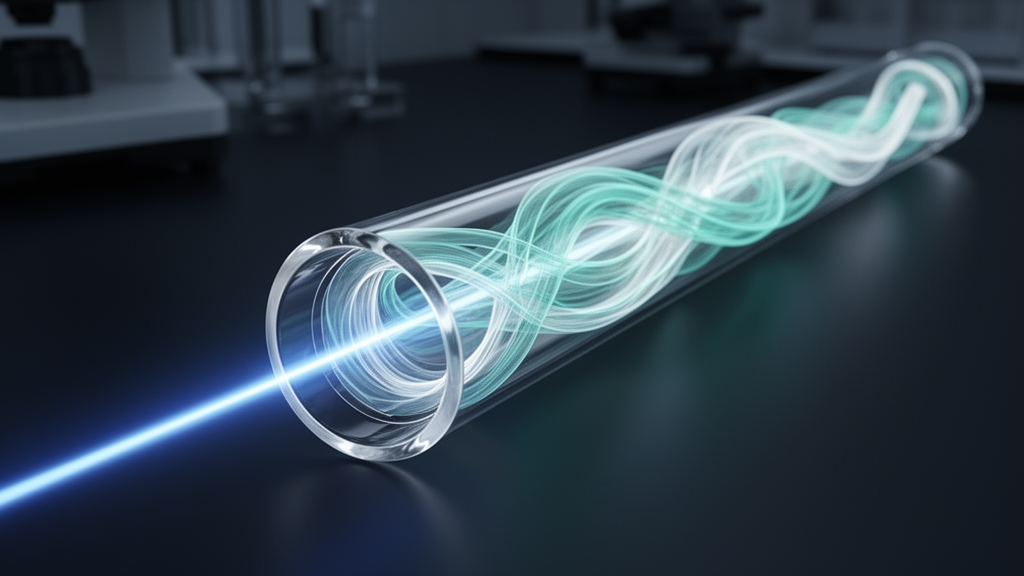
Hollow-core optical fibres guide light through a hollow, gas-filled core rather than through solid glass. Reporting in Results in Engineering, the researchers describe how they adapted the open-source fluid dynamics package OpenFOAM to simulate gas flow inside a 453-metre antiresonant hollow-core fibre, capturing pressure dynamics that a simple tube approximation underestimates by roughly 38 percent.
To understand why this matters, it helps to know how the technology has evolved. For more than half a century, optical fibre has been dominated by all-solid silica single-mode fibres, in which light travels through a solid glass core surrounded by a cladding. These fibres underpin modern communications, but their performance is ultimately limited by the interaction of light with the glass itself. Over the past 25 years, hollow-core fibre has emerged as an alternative: light is guided within a hollow, gas-filled core. The most prominent subtype today is antiresonant hollow-core fibre, or ARF, whose cladding consists of a ring of thin capillaries. Early designs from 2011 used eight simple touching capillaries; later generations, known as nested antiresonant nodeless fibres (NANF) and double nested antiresonant nodeless fibres (DNANF), use capillaries with one or two smaller capillaries nested inside them, and the capillaries no longer touch. Thanks to this microstructural evolution, hollow-core fibres can now achieve lower loss than solid-core fibres across wavelengths from the ultraviolet through the near-infrared and into the mid-infrared, with additional benefits including lower optical nonlinearity, lower and flatter dispersion, lower latency, reduced sensitivity of propagation time to environmental factors, and a higher damage threshold.
Because these fibres are hollow, they are also gas vessels. Gas is used during fibre fabrication to inflate the microstructure, and after drawing, the fibre ends are either sealed, trapping residual gas inside, or left open to equalise with the atmosphere. Either way, the gas and its pressure dictate the internal conditions of the fibre. Researchers recently discovered that a pressure difference between the core and the cladding creates a gas-induced differential refractive index, which alters the guiding properties of the fibre, either increasing or decreasing its optical loss. The chain of cause and effect runs from gas pressure to gas density to gas refractive index to the effective indices of the optical modes and finally to the loss of those modes. That could be seen as a nuisance, since fibre performance changes with pressure, but carefully tailored pressurisation can also improve performance. Crucially, these pressure changes, whether natural fluctuations in atmospheric pressure or deliberate pressurisation to purge the fibre of contaminants such as water vapour and carbon dioxide, do not happen instantaneously in long fibres. They propagate slowly along the length, creating dynamic pressure distributions in the core and capillaries that in turn determine the refractive index distribution and the fibre’s loss.
This makes gas dynamics essential to virtually every application of antiresonant fibre, from telecommunications to nonlinear optics, gas fibre lasers and gas sensing. In gas sensing especially, flow dynamics determines the response time, limit of detection and recovery rate of the sensor. Until now, however, flow inside hollow-core fibre was generally simulated by approximating the inner structure as a simple circular tube. That works reasonably well for photonic bandgap hollow-core fibres, whose cores can be closely approximated by a tube. But in antiresonant fibres with non-touching capillaries, such as state-of-the-art NANFs and DNANFs, the core has a far more complex shape, and the tube model shows poor agreement with experimental measurements of gas flow, indicating the need for a numerical model of the exact fibre geometry.
The Southampton team turned to OpenFOAM, an open-source C++ library for computational fluid dynamics that is popular for its availability and flexibility, though it has a steep learning curve. A previous study had shown that the OpenFOAM solver reactingFoam could simulate gas flow in a 15-metre tubular antiresonant fibre, focusing on gas mass fraction calculations to determine the filling time of a fibre gas cell for gas detection. The new work extends that approach in two important ways: it applies the simulation not only to the fibre core but also to the cladding’s outer capillaries, features of more general fibre geometries such as NANFs, and it tackles a much longer fibre length of practical interest for data transmission. The researchers took the geometry and length of an existing 453-metre fibre in their laboratory and, for the first time, compared the simulation results directly against a simple tube model, demonstrating significant differences between gas flow in a cylindrical capillary and in a real antiresonant fibre geometry.
Getting the physics right required careful analysis. The team first determined the flow regime using the Knudsen number, the ratio of the mean free path between molecular collisions to the characteristic fibre dimension, taken as the 5-micrometre gap between the outer capillaries. For air at room temperature and pressures between 3 and 6 bar, the Knudsen number came out between 0.0017 and 0.0035, far below 1, placing the flow firmly in the hydrodynamic regime described by the Navier-Stokes equations, with non-slip conditions at the walls. Compressibility posed a subtler question. Although the Mach number was low, the researchers noted that Mach number alone is not enough to judge incompressibility in a long narrow channel; a modified criterion that also accounts for viscous forces showed the flow must be treated as compressible. With Reynolds numbers below 2300, the flow is laminar, and the Froude number showed gravity could be ignored. The model therefore had to describe a transient, laminar, compressible flow.
The reactingFoam solver, originally designed for transient compressible reacting flows with combustion, suited this purpose once the chemistry, combustion and turbulence components were switched off, leaving a laminar multispecies compressible flow solver. The researchers treated the gas as two distinguishable species, air entering the fibre and air initially inside it, using a perfect-gas equation of state and constant transport properties. They chose the PISO algorithm over its PIMPLE variant after mesh convergence tests showed no computational benefit from PIMPLE, set seven non-orthogonal correctors for their highly non-orthogonal mesh, and kept the Courant number at or below 1 for numerical accuracy. Meshing the complex NANF geometry was itself a challenge: the cross-section was partitioned into roughly even quadrilateral regions in the open-source software SALOME, then extruded along the fibre length. The core was meshed at 3-micrometre resolution and the outer capillaries at 1.8 micrometres, with maximum skew factors of 56.1 and 46 respectively, both acceptable for OpenFOAM. Running in parallel on 192 cores of a high-performance computing node, the full simulation of 400,000 seconds of simulated time took under 80 hours when the core and five outer capillaries ran simultaneously on separate nodes, or under a week if run sequentially, corresponding to roughly 0.71 seconds of computation per second of simulated time for the core.
The headline result concerns what happens when the fibre, initially at a uniform 1 bar, is pressurised from one end at 6 bar, a scenario typical of purging the fibre of contaminants. In the NANF core, the pressure distribution evolves from a sharp slope to a lightly concave profile and then reaches steady state. The team defined the filling time as the point when the length-averaged pressure reaches 95 percent of its total range, and found it to be 149,000 seconds, or about 41.4 hours. The tube model, using the same 453-metre length and the 34.37-micrometre core diameter, predicted a filling time of 91,934 seconds, or about 25.5 hours, underestimating the real fibre by roughly 38 percent. The discrepancy arises because the simulation’s velocity field revealed gas leaking from the core into the narrow ‘wings’ between the cladding capillaries through the ‘gaps’, slowing the overall flow. The researchers believe the exact magnitude of this deviation is unique to this particular fibre’s core cross-section, since a different number or size of capillaries would change the gaps and wings and alter the flow rate, a connection they flag as a subject for future research. Encouragingly, the simulated pressure evolution closely followed experimental backscattering measurements previously made on the same fibre coiled on a 30-centimetre bobbin, validating both the model and the assumption that the fibre could be simulated as straight.
The simulations also separated two distinct timescales. Although quasi-steady pressure was reached at 41.4 hours, the core was not fully purged until 205,000 seconds, about 56.9 hours, when the entering air completely replaced the internal air. The outer capillary behaved similarly but more slowly, with a filling time of 211,260 seconds, about 58.7 hours, some 17.3 hours slower than the core, and a purge time of 294,000 seconds, about 81.7 hours. This temporary pressure difference between core and cladding is expected to create the gas-induced differential refractive index and a transient reduction in the fibre’s optical loss, since the core sits at higher pressure than the cladding for a period; once both reach the same distribution, the loss returns to its original value, unless only the core is pressurised and then sealed. For the inner capillaries, a generalised tube model predicts a filling time of 84.7 hours and a purge time of 133 hours, slower than both the core and the outer capillaries, meaning the time to fully fill or purge the whole fibre is set by the domain with the smallest cross-section. Alongside the results, the team published complete case files and practical meshing recommendations, hoping to help the growing hollow-core fibre community predict filling and purging times and optimise fibre performance without lengthy experiments.
Subject of Research: Computational simulation of gas flow dynamics inside antiresonant hollow-core optical fibres using the OpenFOAM reactingFoam solver
Article Title: Implementation of the OpenFOAM reactingFoam solver for modelling of gas flow inside antiresonant hollow-core optical fibres
Article References: Elistratova, E., Davidson, I. A., Wheeler, N. V., & Horak, P. (2026). Implementation of the OpenFOAM reactingFoam solver for modelling of gas flow inside antiresonant hollow-core optical fibres. Results in Engineering, 32, Article 113448. https://doi.org/10.1016/j.rineng.2026.113448
Image Credits: AI Generated
DOI: 10.1016/j.rineng.2026.113448
Keywords: hollow-core fibre, antiresonant fibre, OpenFOAM, computational fluid dynamics, gas flow, NANF, fibre purging, gas-induced differential refractive index, optical loss, meshing, telecommunications, gas sensing
News Source: Audrey Campbell. (October 28, 2026). Research report: Implementation of the OpenFOAM reactingFoam solver for modelling of gas flow inside antiresonant hollow-core optical fibres. Scienmag.