


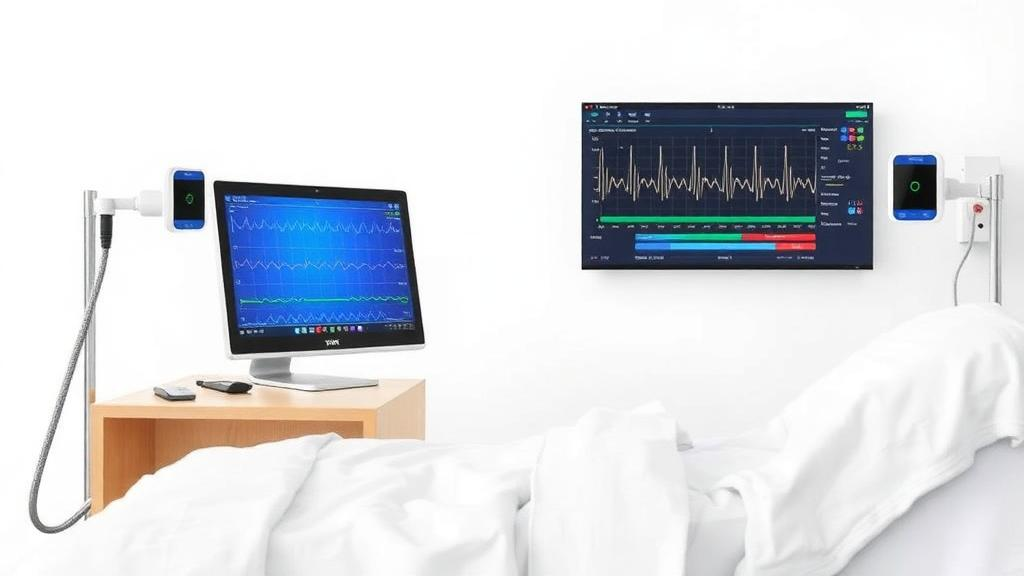
Intensivists at a single hospital have reported their first year and a half of experience with an unusual arrangement: instead of monitoring every patient on the general wards, or none of them, a small intensive care unit team used wearable sensors to remotely watch the vital sign trends of selected ward patients who were judged too unstable to leave unobserved but not sick enough to need an ICU bed. Between December 2024 and March 2026, 92 patients were monitored this way, according to a correspondence article published in Critical Care on 29 October 2026.
The logic behind the program starts with a problem that hospitals everywhere face. Continuous vital sign monitoring of non-ICU patients is becoming more common, but the authors argue that monitoring all ward patients would be inefficient, because most of them never deteriorate. Worse, they suggest, blanket monitoring may undermine clinicians’ confidence in their own judgement while adding workload and cost. Their answer was to let intensivists choose a small number of patients for high-frequency, intermittent trend monitoring, run entirely by ICU staff.
The selection process was deliberately restrictive. Remote monitoring was applied only when an intensivist, involved through a consultation or a Rapid Response Team call, judged that a patient did not require ICU admission but remained at risk of further deterioration. Even then, three conditions had to be met: any expected deterioration had to have an onset longer than two hours away, the patient had to be cooperative, and the burden of care on the ward had to remain manageable. The final choice was left to the discretion of the individual intensivist.
The technical setup was lean by design. A single ICU nurse, who carried no dedicated ICU patient assignment but was already responsible for Rapid Response Team calls and nursing consultations, ran the program. The wearable devices, MWear units made by Mindray, measured continuous oxygen saturation, three-lead ECG and respiratory rate, plus an hourly non-invasive blood pressure measurement. All alarms were disabled. Data streamed to monitors in the ICU nursing and physician rooms and were also available on mobile phones. Because one trained team operated the system with a maximum of four wearables, monitoring could be offered throughout the entire hospital rather than confined to a single unit.
Deterioration could surface through two parallel channels. Ward nursing staff continued to calculate Modified Early Warning Scores every four hours as usual. In parallel, the ICU nurse reviewed the remote monitoring trends every two hours and visited the patient every shift, while an ICU physician reviewed the trends every four hours and visited daily. If no deterioration appeared, the intensivist could stop remote monitoring during the daily visits. Responsibilities were split explicitly: the ICU physician detected deterioration and admitted patients to the ICU, while the treating physician handled all other medical issues.
The first-year numbers show how the system was used. The 92 monitored patients accounted for 1,797 hours of monitoring with a data capture rate of 95.4 percent. The indications varied widely, with severe infections the most common at 37 patients, followed by pulmonary embolism at 15 and COPD at 9. On starting monitoring, patients had a median MEWS score of 3 and a median SOFA score of 2. They were spread across 19 different wards, with a median of 4 patients per ward (interquartile range 1–5), monitored for a median of one day, with no more than three wearables in use at the same time.
The clinical outcomes underline both the promise and the limits of remote sensing. Deterioration was detected through remote monitoring in 11 patients, who were admitted to the ICU. Four other patients were treated on the ward, receiving diuretics, anti-arrhythmics or naloxone. Notably, the naloxone case involved unconsciousness without any vital sign abnormalities and was missed by remote monitoring entirely. Seven further patients were admitted to the ICU without remote monitoring detecting a problem, for reasons including the burden of care on the ward in three cases, worrying laboratory results, neurological deterioration, oxygen requirements beyond what the ward was allowed to administer, and a planned admission after semi-elective surgery. Across the whole cohort, no in-hospital cardiac arrests, Rapid Response Team calls, emergency ICU admissions or other ward interventions occurred.
For the authors, the missed cases carry the central lesson of the experience: 39 percent of the deterioration cases showed no disturbances in vital signs, which they say demonstrates the importance of bedside patient visits. Vital sign monitoring, in their view, should be regarded as an addition to bedside assessment and cannot replace nursing staff. They also frame the program as a trade-off between over-monitoring and missing deterioration, with patient selection as one method of optimizing that balance. A further practical advantage was organizational: because monitoring was performed solely by ICU personnel, only one team needed training, which they describe as more flexible and achievable than training all ward personnel.
The costs were itemized. The investment, based on a virtual central monitoring system with one workstation and two viewstations including installation, came to 52,332 euros excluding VAT, and the four reusable wearables cost 22,020 euros excluding VAT. Yearly technical support runs at 4,477 euros excluding VAT, and no additional staff were required. Beyond the routine setting, the authors suggest the benefits could extend to other situations, such as ICU bed scarcity, epidemics, patient isolation, or challenging patient management in disaster or warfare settings. They also weigh the broader trade-offs: keeping patients on wards with their specific expertise, sparing handovers where information can be lost, preserving ICU beds, and allowing more controlled transfers when deterioration occurs, against the risks of delayed ICU admission and dispersing near-critically ill patients throughout the hospital.
The authors are careful about how far these results travel. This was a single hospital, which limits transferability; indications and results may change over time; and the evaluation was retrospective, with the inherent limitations that implies. The team did not measure whether staff actually adhered to the protocolized two- and four-hour inspections and patient visits, the decision to apply remote monitoring depended on individual intensivists and may have been influenced by ICU bed occupancy, and the evaluation covered only the patients who were monitored, not those who were not. The device itself adds another caveat: apart from a validation study in healthy volunteers, no other clinical studies of the MWear wearable are available. The authors conclude that a broader evaluation is required for a full understanding of the efficiency and usefulness of this monitoring modality.
Subject of Research: ICU-led remote wearable monitoring of selected non-ICU hospital patients
Article Title: ICU-led remote vital sign trends monitoring of selected non-ICU-patients: a first year experience
Article References: Koning, M. V., & Peelen, R. V. (2026). ICU-led remote vital sign trends monitoring of selected non-ICU-patients: a first year experience. Critical Care, 30(1), Article 552. https://doi.org/10.1186/s13054-026-06426-7
Image Credits: AI Generated
DOI: 10.1186/s13054-026-06426-7
Keywords: remote monitoring, wearables, intensive care, vital signs, patient deterioration, ward monitoring, rapid response team, MEWS, SpO2, hospital safety, critical care, MWear
News Source: Ophelia Keating. (October 29, 2026). Research report: ICU-led remote vital sign trends monitoring of selected non-ICU-patients: a first year experience. Scienmag.



