• HOME
  • NEWS
  • EXPLORE
    • CAREER
      • Companies
      • Jobs
    • EVENTS
    • iGEM
      • News
      • Team
    • PHOTOS
    • VIDEO
    • WIKI
  • BLOG
  • COMMUNITY
    • FACEBOOK
    • INSTAGRAM
    • TWITTER
Sunday, October 25, 2026
BIOENGINEER.ORG
No Result
View All Result
  • Login
  • HOME
  • NEWS
  • EXPLORE
    • CAREER
      • Companies
      • Jobs
        • Lecturer
        • PhD Studentship
        • Postdoc
        • Research Assistant
    • EVENTS
    • iGEM
      • News
      • Team
    • PHOTOS
    • VIDEO
    • WIKI
  • BLOG
  • COMMUNITY
    • FACEBOOK
    • INSTAGRAM
    • TWITTER
No Result
View All Result
Bioengineer.org
No Result
View All Result
Home NEWS Science News Agriculture

Research report: Genetic diversity analysis and core collection construction of 259 garlic germplasm resources based on SSR molecular markers

by
October 25, 2026
in Agriculture
Reading Time: 2 mins read
0
Research report: Genetic diversity analysis and core collection construction of 259 garlic germplasm resources based on SSR molecular markers

Research report: Genetic diversity analysis and core collection construction of 259 garlic germplasm resources based on SSR molecular markers

Share on FacebookShare on TwitterShare on LinkedinShare on RedditShare on Telegram

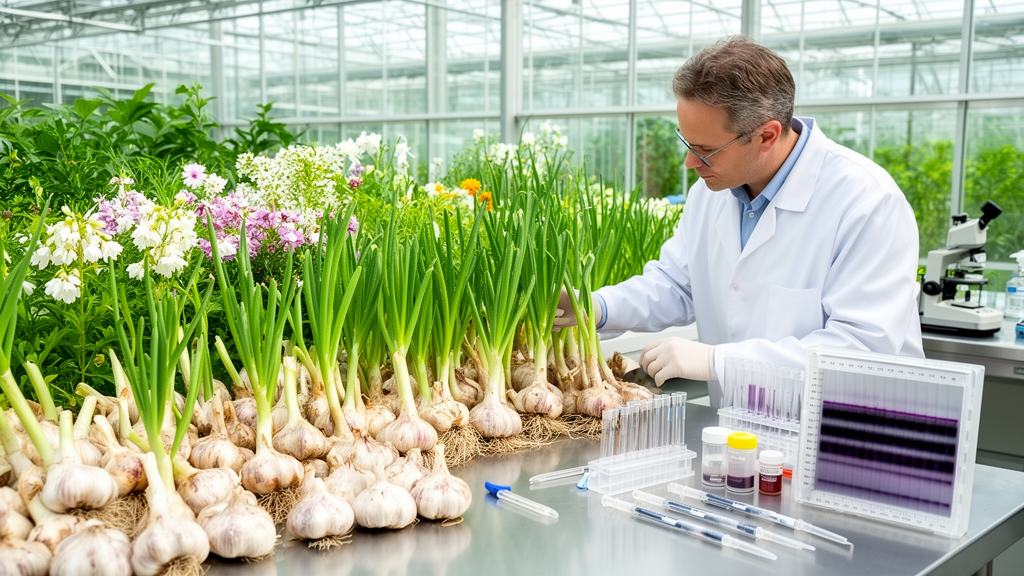
A study of 259 garlic germplasm accessions used 23 simple sequence repeat (SSR) primer pairs to characterize genetic diversity and assemble a 50-accession core collection. The analysis detected 171 polymorphic loci, with an average of 7.43 alleles per primer pair. Researchers selected the core collection with Powercore software and evaluated its representativeness through genetic parameters and principal coordinate analysis (PCoA).

The selected accessions retained all alleles detected in the full collection and were distributed evenly across the PCoA plot, according to the research published in BMC Plant Biology . The researchers amplified SSR markers across the full collection and separated the products by capillary electrophoresis. The polymorphism information content ranged from 0.081 to 0.669 and averaged 0.407.

The effective number of alleles per locus ranged from 1.04 to 3.79. Across the collection, mean Shannon’s diversity index was 0.938, observed heterozygosity was 0.488, expected heterozygosity was 0.517, and Nei’s diversity index was 0.482. The researchers also used locus-based statistical methods to assess diversity and clustering.

Cluster analysis divided the 259 accessions into five groups, although some groups included accessions with identical amplification profiles. After entries sharing identical loci were excluded, the researchers identified 100 distinct accessions using the 23-primer set. They then applied an allele-maximization strategy in Powercore to choose 50 accessions for the core collection, representing 19.31% of the original collection.

Relative to the full set, the core retained 100% of the observed alleles. Its effective number of alleles and Shannon’s diversity index reached 155.20% and 137.15% of the corresponding full-collection values. Together with the even PCoA distribution, these results indicated that the selected subset was representative of the sampled diversity.

The study also reduced the molecular fingerprinting panel. Of the original 23 SSR primer pairs, 13 were selected based on the numbers of unique alleles and distinguishable accessions. These primers were used to construct a fingerprint map for the 50 core accessions, providing a compact reference for distinguishing the selected germplasm.

The authors said the core collection could support more efficient screening, conservation and utilization of garlic genetic resources, while the reduced marker panel could assist future fingerprinting work and the breeding of new varieties. The analysis was limited to the genetic variation captured by 23 SSR primer pairs in the 259 accessions studied. The supplied article was also an early version of the peer-reviewed paper and remained subject to further editorial revision.

Within those boundaries, the study produced a 50-accession subset that retained the full collection’s detected alleles, displayed comparatively even coverage in PCoA space and could be distinguished with a 13-primer fingerprinting panel.

Subject of Research: Genetic diversity and core collection construction in 259 garlic germplasm accessions using SSR markers

Article Title: Genetic diversity analysis and core collection construction of 259 garlic germplasm resources based on SSR molecular markers

Article References: Zhong, Y., Li, C., Qiao, Q., Song, Y., Wu, Z., Lu, X., Tang, Z., Liang, H., & Xie, D. (2026). Genetic diversity analysis and core collection construction of 259 garlic germplasm resources based on SSR molecular markers. BMC Plant Biology. https://doi.org/10.1186/s12870-026-09880-1

Image Credits: AI Generated

DOI: 10.1186/s12870-026-09880-1

Keywords: garlic, germplasm, genetic diversity, SSR markers, core collection, molecular fingerprinting, allele diversity, plant breeding, genetic conservation, Genetic, diversity, analysis

News Source: Juliet Wilcox. (October 25, 2026). Research report: Genetic diversity analysis and core collection construction of 259 garlic germplasm resources based on SSR molecular markers. Scienmag.

Tags: allele diversityanalysisCore collectiondiversitygarlicgeneticgenetic conservationGenetic diversitygermplasmmolecular fingerprintingplant breedingSSR markers
Share12Tweet7Share2ShareShareShare1

Related Posts

Drone-mounted multispectral sensors outpredict handheld NDVI for wheat yield

Drone-mounted multispectral sensors outpredict handheld NDVI for wheat yield

October 25, 2026
Rosemary breeding produces lines with denser glands and richer compounds

Rosemary breeding produces lines with denser glands and richer compounds

October 25, 2026

Low-Dose Copper and Zinc Oxide Nanoparticles Lift Soybean Yields Under Drought

October 25, 2026

Sodium silicate improves salt-stressed tomato growth and ion balance in plant study

October 25, 2026

POPULAR NEWS

  • Retrospective single-center Rwanda cohort reports treatment gaps and survival estimates

    Retrospective single-center Rwanda cohort reports treatment gaps and survival estimates

    29 shares
    Share 12 Tweet 7
  • Research report: Genetic diversity analysis and core collection construction of 259 garlic germplasm resources based on SSR molecular markers

    29 shares
    Share 12 Tweet 7
  • Single beta-band brain signal tied to several schizophrenia symptoms in MEG study

    29 shares
    Share 12 Tweet 7
  • Diffusion imaging tracks nerve recovery after lumbar surgery

    29 shares
    Share 12 Tweet 7

About

We bring you the latest biotechnology news from best research centers and universities around the world. Check our website.

Follow us

Recent News

Retrospective single-center Rwanda cohort reports treatment gaps and survival estimates

Research report: Genetic diversity analysis and core collection construction of 259 garlic germplasm resources based on SSR molecular markers

Single beta-band brain signal tied to several schizophrenia symptoms in MEG study

Subscribe to Blog via Email

Enter your email address to subscribe to this blog and receive notifications of new posts by email.

Join 85 other subscribers
  • Contact Us

Bioengineer.org © Copyright 2023 All Rights Reserved.

Welcome Back!

Login to your account below

Forgotten Password?

Retrieve your password

Please enter your username or email address to reset your password.

Log In
No Result
View All Result
  • Homepages
    • Home Page 1
    • Home Page 2
  • News
  • National
  • Business
  • Health
  • Lifestyle
  • Science

Bioengineer.org © Copyright 2023 All Rights Reserved.